


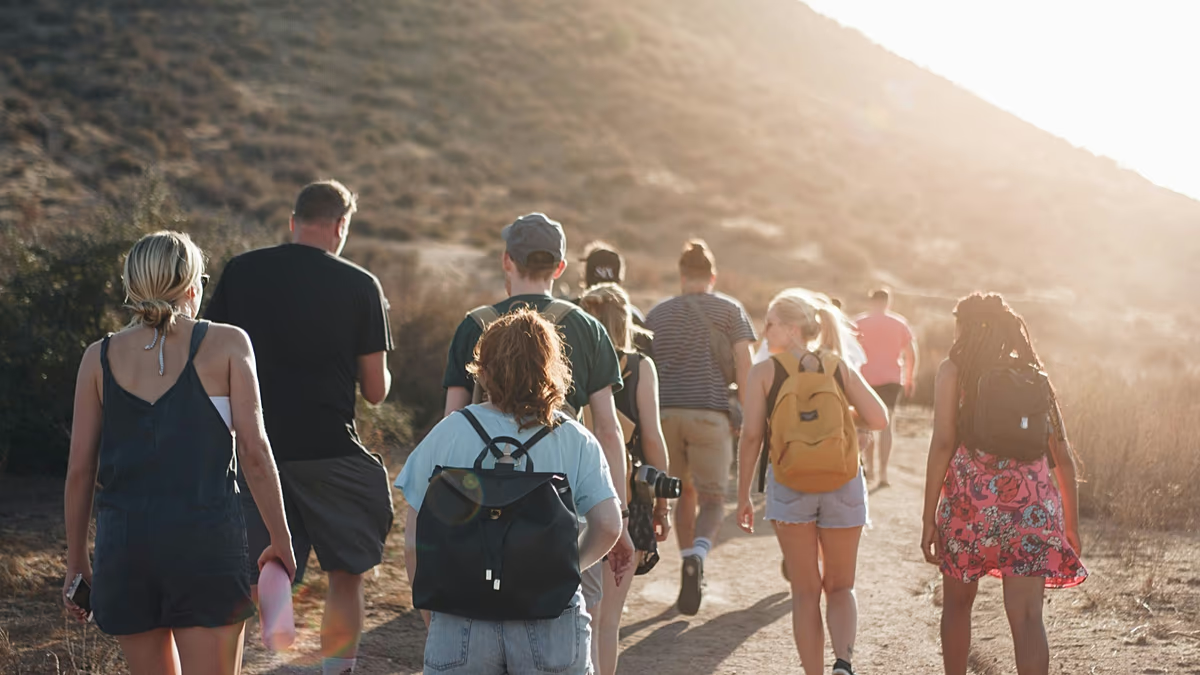
When we dream of escaping our daily lives, our minds often paint pictures of postcard-perfect landscapes: the sun setting over an ancient cobblestone plaza, the crisp mountain air of a remote peak, or the rhythmic crashing of turquoise waves on a secluded beach. Yet, if you ask returning travelers what truly redefined their journey, they will rarely point solely to the monuments or the scenery. Instead, they will speak of the people—the stranger who shared their umbrella during a sudden downpour, the fellow wanderer who joined them for a late-night feast, or the local guide who opened up their home. A landmark study conducted by the travel platform WeRoad, which surveyed 5,000 adults across Spain, Italy, France, Germany, and the United Kingdom, confirms this profound human truth: travel is not just about changing our coordinates, but about changing how we connect with one another. Remarkably, nearly half of all Europeans (45%) now believe that traveling is the single most effective way to cultivate meaningful, long-term personal relationships, far surpassing traditional social incubators like the workplace, neighborhood gatherings, or university lecture halls.
This striking shift in how we seek companionship highlights a powerful truth about the psychology of wandering. When we step outside our routine, we undergo a quiet, internal transformation that makes us fundamentally more approachable and open-minded. The WeRoad survey reveals that eight out of ten travelers feel significantly more receptive to meeting new people when they are away from home, while 58% view socializing as an absolutely indispensable, non-negotiable component of the journey itself. Stripped of the daily pressures, social masks, and familiar comforts of home, we are naturally pushed to look outward. This vulnerability pays off beautifully, with an impressive 66% of respondents reporting that they have forged a deeply authentic, lasting connection with someone they met while traveling. On the road, we don’t just observe the world; we actively participate in it, allowing our shared curiosity to break down the walls of suspicion and hesitation that so often keep us isolated in our everyday lives.
What is the secret formula that makes friendships forged during travel so uniquely resilient and intense? According to the survey participants, the bonds created on the road are built on a foundation of shared vulnerability and intense, focused presence. Sixty percent of travelers credit these deep connections to the sheer power of shared experiences—navigating unfamiliar streets, trying strange foods, or overcoming unexpected travel mishaps together. Furthermore, 43% point to the unique physical reality of travel, which often involves spending entire, uninterrupted days in each other’s company, a rare luxury in our hyper-scheduled home lives. Another 30% believe that simply being removed from their daily grind creates the mental clarity needed to bond, while 19% cherish the total absence of mutual expectations that usually clutter relationships back home. Finally, 16% savor the liberation of not feeling trapped in their usual, rigid social roles, allowing them to express their true selves without the fear of judgment from those who have known them for years.
This widespread yearning for raw, authentic, and unscripted connection comes at a time when society is grappling with a profound sense of digital fatigue. Despite living in an era where we are ostensibly more connected than ever through fiber-optic cables and glowing screens, we are starving for real, physical presence. Only a meager 9% of the survey respondents turn to dating apps or social media networks to build their social circles, a telling statistic that highlights a growing dissatisfaction with online-only interactions. In stark contrast, a resounding 72% of participants expressed an urgent, active desire to live more social experiences offline, seeking out the nervous excitement of in-person eye contact, shared laughter, and spontaneous conversations. We are realizing, perhaps a bit late, that a heart emoji or a double-tap can never truly replicate the deep warmth of a real human voice echoing across a campfire or a crowded dining table.
The urgency of this desire is underscored by a sobering reality: making friends in the modern world has become an uphill battle. The study reveals a collective crisis of connection, with 66% of Europeans admitting that meeting new people is far more complicated today than it was just a few short years ago. Even more concerning, 84% believe that building truly deep, meaningful, and vulnerable relationships in this day and age is more difficult than ever before. Over half of those surveyed admitted to being deeply dissatisfied with their current social lives, pointing to a variety of modern obstacles. One-third (33%) blame a chronic, exhausting lack of time, while 25% cite a paralyzing insecurity when it comes to taking the terrifying first step to introduce themselves. Additionally, 21% struggle with debilitating social anxiety, a mental health hurdle that turns even simple interactions into daunting, exhausting trials of willpower.
In a world where one in five people now admits to living with an entrenched, painful sense of loneliness—regardless of whether they reside in towering metropolitan high-rises or quiet, isolated rural villages—travel emerges as a powerful, therapeutic equalizer. When we pack our bags and step into the great unknown, we leave behind our social status, our job titles, our anxieties, and the invisible coordinates of our daily lives. On the road, everyone is reduced to the same basic, beautiful status: we are all simply travelers, navigating the beautiful complexity of a world larger than ourselves. By placing us on this completely equal footing, travel strips away the self-consciousness that paralyzes us at home, inviting us to reach out, share our stories, and listen to others. Ultimately, these findings remind us that while the destination may draw us to the airport, it is the beautiful, unexpected tapestry of human connection we weave along the way that truly brings us home.