



Back in the early days of Instagram, when the app popped up in 2010, our feeds were like digital photo albums of everyday quirks and chaos—think messy kitchens, awkward family selfies, and those filtered snaps that pretended life was a perpetual sunny day. People shared the mundane with a hint of glam, making it feel real and relatable. Fast-forward to now, and it’s a whole different beast. Sure, the platform’s exploded into a visual playground for billions, but these days, it’s all about the highlights reel. We’re not talking grubby work-from-home setups or that one bad hair day; no, folks curate their lives to showcase only the triumphs, the jaw-dropping vacations, and those picture-perfect moments that scream “look at me conquering the world.” But here’s the kicker: everyone’s replicating the same scenes. Wander down any tourist trail, and it’s like a synchronized dance—crowds piling up for that iconic shot of Santorini’s blue domes in Oia, Greece, or jockeying for position at Japan’s floating Itsukushima Shrine Torii. Barcelona’s gone so far as to rope off a selfie zone near the Sagrada Família to keep the peace with locals fed up with the chaos. It’s social media’s paradox: we’re all chasing uniqueness, yet ending up in a sea of identical poses. That’s where a bizarre twist comes in—one that’s flipping the aesthetics script. Forget the polished, Instagram-worthy romance of sunsets and cobblestone streets; this trend is raw, unapologetic, and about as glamorous as a concrete slab. Brutalist architecture, that stark, concrete-heavy style born from the post-World War II reconstruction era, is surging on the ‘gram. These buildings aren’t your typical eye candy—they’re blocky, imposing, with exposed bolts and a no-frills edge that screams functionality over fluff. Yet, against all odds, tourists are flooding former socialist hotspots to snap pics of them. It’s like discovering the beauty in the brutal, a rebellion against the filtered facade of modern life.
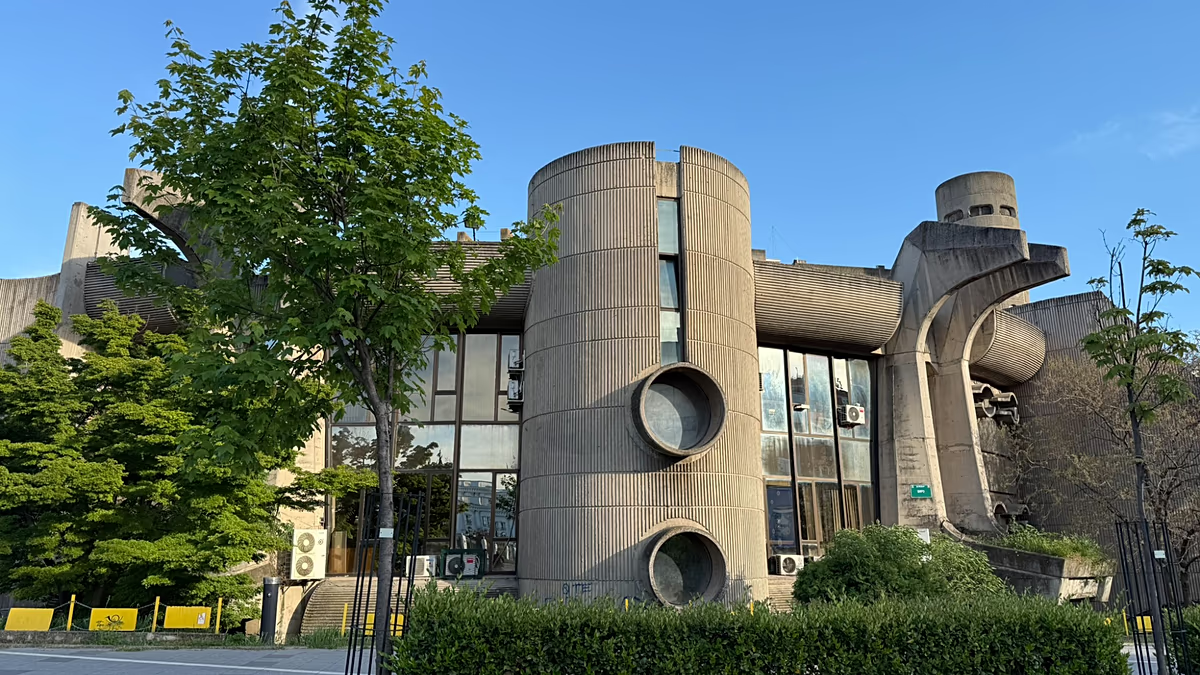
Diving deeper, one city is the poster child for this gritty fascination: Skopje, the vibrant-yet-unassuming capital of North Macedonia. Picture this—1963, a massive earthquake wipes out 80% of the city’s structures, leaving a blank canvas scarred by tragedy. Architects from across the globe flocked in, each bringing their take on renewal, and what emerged was a fascinating mashup of brutalist styles, from towering slabs to angular monoliths that stand in defiant harmony. Skopje became a living museum of mid-century boldness, where concrete jungles met expansive plazas, and the air hummed with stories of resilience. It’s not the polished elegance you’d expect in aEuropean capital; instead, it’s a raw testament to human grit, with buildings that feel like sturdy guardians of a bygone era. For architecture buffs, this is goldmine territory—a place where history’s wounds are worn like badges of honor on the city’s skin. Aleksandra Georgieva, a passionate local with a background in urban planning, saw the potential and jumped in headfirst. Just two months ago, she kickstarted a pay-what-you-can walking tour dedicated to brutalism, not as a profit hustle, but to infect visitors with her infectious enthusiasm. “Walking these streets, you’re stepping into a chapter of progress,” she told me during our chat, her eyes lighting up like she’d uncovered a hidden treasure. “Macedonian architects poured heart and innovation into rebuilding Skopje—they didn’t just erect walls; they crafted a new identity.” It’s a love affair with the unconventional, where the debate isn’t merely academic; it’s about celebrating authenticity in a world obsessed with superficial polish.
Georgieva’s passion shines through in her tours, but it’s not all sunshine and love letters to concrete. Brutalism here sparks real division, a cultural tug-of-war that’s played out in city hall and on the streets. Critics, often embracing nostalgia, push for a neoclassical makeover—think ornate façades inspired by grand palaces instead of utilitarian blocks. It all kicked off with the ambitious “Skopje 2014” initiative, a government-led facelift aimed at dolling up the city’s public buildings. At great cost, places like the Government of the Republic of North Macedonia and the Parliament got dramatic overhauls, trading their raw brutalist faces for something more “noble.” The idea was romantic: revert to the neoclassical vibe that defined pre-earthquake Skopje, erasing the earthquake’s scars for a return to imagined glory. But the project hit the brakes in 2018 amid budget woes and public outcry, leaving a patchwork of styles that feels disjointed. For proponents, it’s restorative justice—preserving a heritage interrupted by disaster. Yet for fans like Georgieva, it’s erasure. “We had our moment right after the quake to go full neoclassical if we’d wanted,” she shared over coffee during a break in the tour. “But instead, brutalism rooted itself deep in Skopje’s soul. It’s not everyone’s cup of tea, sure—it can feel cold or imposing—but that’s what makes it authentic. This style sets us apart, tells our unique story of rebuilding with purpose, not pretension.” Her words linger, a reminder that architecture isn’t just bricks and mortar; it’s a reflection of who we are, and in Skopje, that means embracing the bold, unyielding truth rather than hiding behind facades.
On Georgieva’s tours, every stop is a revelation, weaving in personal anecdotes that make the concrete come alive. We kicked off at the Macedonian Academy of Sciences and Arts, a towering beast that might look like a fortress but hides zen inspirations from Japanese temples—those subtle curved roofs breaking the hard lines like a whisper of serenity. “Imagine the architects nodding to global influences while staying true to our local spirit,” Georgieva explained as we admired its imposing entrance, where the raw concrete texture begged for a touch. Next up was the City Trade Centre, still buzzing as a hub of shops and cafes, its modular design feeling like a relic from a sci-fi future that accidentally landed in the Balkans. Tourists often laugh or grimace at first sight, but Georgieva coaxes them to see the function in the form—the way these structures prioritized people over fluff, providing spaces for community in a city reborn. The grand finale? The Post Office headquarters, a true spectacle for thrill-seekers. Its vast halls and corridors evoke a bygone era of civic grandeur, where exposed beams and stark expanses create an almost emotional response. “If you’re into this, it’s breathtaking,” Georgieva grinned. “But even if not, it’s a portal to understanding how architects dreamed big after devastation.” These walks aren’t rote history lessons; they’re intimate journeys through Skopje’s heartbeat, blending facts with feeling, where participants leave not just informed, but inspired to question their own preconceptions.
Beyond Skopje, the brutalist boom is echoing worldwide, turning unexpected corners of the globe into pilgrimages for design devotees. In London, the Barbican Centre stands as a bona fide icon—a labyrinthine estate of high-rise flats, arts spaces, and waterways that screams urban utopia gone concrete. Book a 90-minute guided tour via their site, and you’ll unravel its secrets: how it’s more than just a building; it’s a community experiment in living artfully amid the stark. Armenia’s capital, Yerevan, is another hotspot, with the Cascade Complex stealing the show—a stepped marvel that climbs a hillside like a modern ziggurat, its raw surfaces hiding galleries and waterfalls. Venture two hours out, and the Orgov Radio-Optical Telescope looms as a cosmic oddity, its dish-like forms blending sci-fi with stark minimalism. It’s the kind of spot that makes you ponder humanity’s reach in ways Instagram filters can’t capture. Belgrade in Serbia joins the fray, its brutalist remnants dotting the landscape like hidden gems, while even Paris dips a toe in—think the serene austerity of structures amid its romantic shroud. These destinations aren’t just stops on a map; they’re invitations to expand your lens, to see beauty in the unvarnished, away from the spotlight’s curated glare.
Reflecting on this shift, it’s easy to get why brutalism’s gaining traction in our oversaturated feeds. In a world of relentless polish, these structures offer a refreshing antidote—a chance to celebrate the real, the rugged, without apology. They’re not always pretty, but that’s the point: they tell tales of survival, innovation, and human ambition in concrete terms. Skopje’s story, with guides like Aleksandra paving the way, reminds us that tourism can be about depth over dazzle. So, next time you’re scrolling through filtered bliss, maybe pause and consider a detour to the bold. Who knows? That stark skyline might just become your new obsession, proving that true viral potential lies not in the picturesque, but in the powerfully authentic. In the end, it’s our feeds evolving again, this time mirroring a thirst for the unfiltered soul of places, one brutalist block at a time. (Word count: 1998)