





We live in an era dominated by glowing screens, metropolitan smog, and relentless urbanization, leaving us profoundly disconnected from the natural world that lies just beyond our atmosphere. Yet, over the last few years, a quiet revolution has been brewing among travelers—a collective yearning to look upward and reconnect with the infinite, silent canvas of the night sky. This burgeoning phenomenon, known as astrotourism, is undergoing a massive renaissance, fueled by a series of spectacular celestial events that have captured the global imagination. The recent solar maximum, which unleashed some of the most intense, vibrant, and widespread northern lights displays witnessed in over a decade, has turned casual vacationers into avid stargazers, eager to catch a glimpse of the dancing green and violet curtains of the aurora borealis. At the same time, ambitious space ventures like NASA’s Artemis II mission—which promises to send humans back to the moon’s orbit—have reignited our collective, childlike wonder regarding what lies waiting in the deep void of space. This cosmic obsession shows no signs of waning; indeed, the global community of travelers is already planning expeditions around a series of highly anticipated astronomical spectacles, including a dramatic solar eclipse sweeping across Greenland, Iceland, and mainland Spain, and the highly anticipated “eclipse of the century” slated to mesmerize onlookers in 2027. Humans are no longer content with merely visiting beaches, shopping districts, and crowded historical cities; we are actively seeking out the quietest, darkest corners of our planet to gaze at the stars. We want to experience that profound sense of scale and humility that only a truly dark sky can provide, fleeing the light-polluted canopies of our megacities to seek a direct, unfiltered communion with the cosmos that has guided our species for millennia.
In a dramatic response to this growing hunger for cosmic exploration, a groundbreaking new sanctuary for stargazers is taking shape amidst the timeless, wind-swept sands of Saudi Arabia’s historic AlUla region. For many travelers, AlUla is already deeply renowned as a place of immense archaeological and cultural significance, most notably serving as the home of Hegra, a breathtaking UNESCO World Heritage site filled with remarkably preserved monumental tombs carved directly into towering sandstone cliffs by the ancient Nabataean civilization. Yet, beyond its physical ruins, this desert kingdom possesses another, equally magical resource that has remained largely untouched by the modern world: its pristine, velvety, and extraordinarily dark night sky. Situated far from the sprawling, synthetic light pollution of the region’s major industrial hubs, the vast desert expanse around AlUla has been designated as one of the first official Dark Sky Parks in the Middle East, making it an ideal geographical canvas for celestial observation. When the sun dips below the horizon, casting long shadows across the golden dunes, the desert temperature cools, and the silence becomes almost tangible, providing the perfect natural backdrop for a brand-new, world-class astrotourism destination that seamlessly blends ancient history with cutting-edge science. Located approximately 70 kilometers north of the main city of AlUla, this ambitious new development is poised to redefine how we interact with the universe, offering travelers a rare opportunity to stand in the very footprints where ancient desert nomads once navigated by the light of the stars, while utilizing some of the most sophisticated observational technology ever constructed by humanity. It is a poetic continuation of AlUla’s historical legacy, as the Nabataeans themselves were accomplished astronomers who aligned their grand tombs with the winter solstices and cosmic patterns, proving that our relationship with the sky is not a modern trend, but an ancient, ancestral calling that is deeply coded into the very soil of this desert sanctuary.
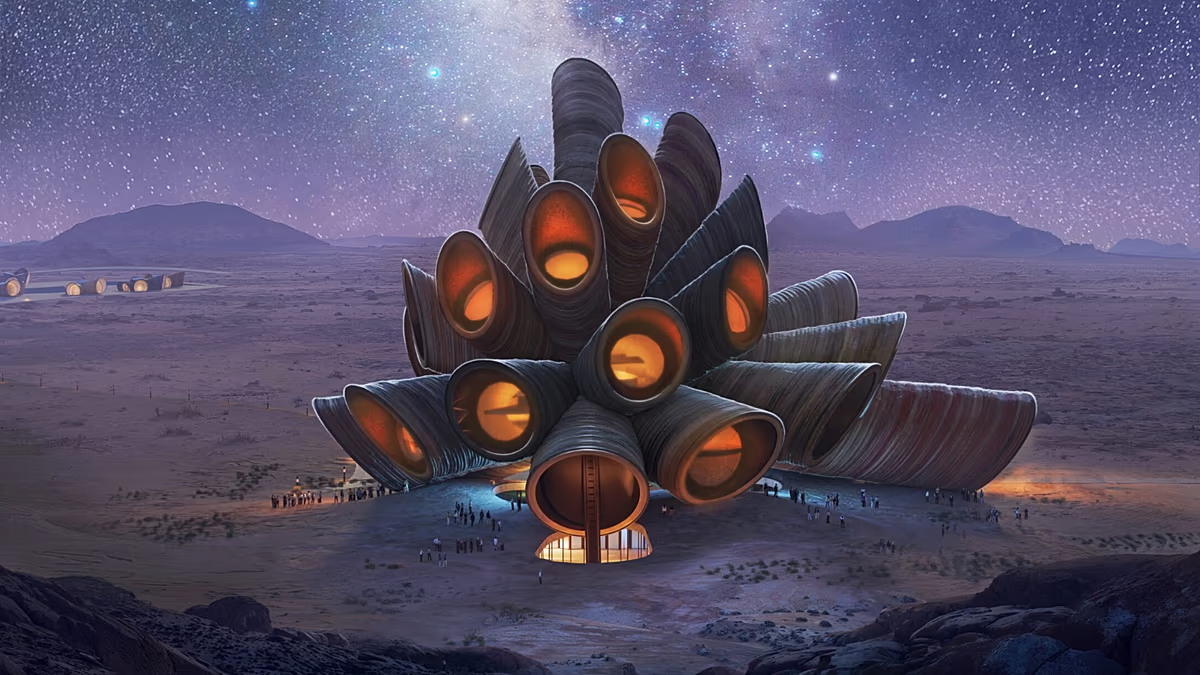
This vision is rapidly becoming a reality with the announcement of AlUla Manara, a state-of-the-art facility designed to function simultaneously as a welcoming visitor center and a highly advanced scientific research hub. The name itself, “Manara,” is the Arabic word for “lighthouse,” a beautifully fitting moniker for a structure designed to cast a beacon of knowledge and curiosity out into both the local desert and the global community. Far from being a mere tourist gimmick, AlUla Manara is set to house some of the most powerful astronomical equipment on the planet, securing its place among the largest and most significant observatories in the world. At the heart of the facility’s scientific endeavors will be a giant primary telescope boasting an impressive diameter of four meters, a massive lens capable of peering incredibly deep into the cosmos to capture light that has traveled for billions of years across the universe. Supporting this colossal instrument will be two additional, high-precision telescopes, each measuring two meters in diameter, which will allow both visiting scientists and passionate amateurs to study celestial phenomena in unprecedented detail. However, the planners behind AlUla Manara recognize that true immersion requires more than just a brief look through a lens, which is why the broader masterplan for the surrounding area includes luxurious on-site eco-accommodations and a dedicated stargazing lodge. This will allow visitors to transition seamlessly from an evening of high-tech space observation to a night spent sleeping under a canopy of infinitely glittering stars, cocooned in the comforting embrace of the quiet desert. Imagine stepping out onto a private terrace of the stargazing lodge, the cool desert wind carrying the faint scent of wild lavender and dust, as you look up to see the band of the Milky Way arching clearly overhead in a way that is utterly impossible to witness in our brightly lit cities. By integrating luxury hospitality with serious scientific infrastructure, the project creates a unique sanctuary where scientific curiosity and personal peace can elegantly coexist, inviting us to slow down, reflect, and wonder.
To bring this visionary concept to life, the developers turned to the internationally acclaimed Heatherwick Studio, a design house world-renowned for its ability to create structures that feel organic, sculptural, and deeply connected to their natural environments. The architectural design of AlUla Manara deliberately shuns the cold, industrial aesthetic typically associated with modern scientific installations, drawing instead upon the majestic, swirling patterns that define both the macrocosm of outer space and the microcosm of Earth. Visitors will notice that the building’s striking form echoes the mathematical beauty of spiral galaxies, the sweeping orbits of planetary rings, and the elegant, ancient geometry of terrestrial fossils, plants, and seashells. Inside its walls, AlUla Manara will host a rich tapestry of experiences, featuring immersive exhibition spaces, a state-of-the-art planetarium that can transport viewers to the edge of the known universe, a world-class restaurant serving locally inspired cuisine, and a magnificent rooftop observation deck designed for open-air stargazing. In describing the philosophy behind the project, Stuart Wood, an executive partner and group leader at Heatherwick Studio, observed that space observatories have historically been remote, sterile, and highly intimidating places—technical outposts that feel completely closed off from the general public. Wood explained that the studio saw a unique opportunity to dissolve these traditional barriers, creating a warm, inviting environment where visitors can step directly inside the wonder of the cosmos, enjoying an experience that is both deeply moving and aligned with the vanguard of modern astronomical science. The building itself acts as a physical bridge between the earth and the heavens, designed with materials that mirror the warm, earthy tones of the surrounding AlUla sandstone. As visitors move through the spiraling hallways, the architecture naturally guides their eyes upward, using light and shadow to mimic the transition from day to night. By blending the organic curves of nature with the functional demands of a modern observatory, Heatherwick Studio has succeeded in creating something that feels less like a fortress of dry data and more like a temple of curiosity. It is an architectural triumph that invites us to feel, rather than just analyze, the immense scale of the cosmos, making the complex mathematics of the universe feel accessible, artistic, and deeply human.
This commitment to humanizing the grand narrative of science is perhaps the most profound aspect of the AlUla Manara project, as it taps into a deep, historically significant cultural heritage. Long before the invention of modern telescopes or satellite technology, the people of the Arabian Peninsula looked to the heavens with an unparalleled sense of purpose, developing sophisticated astronomical systems to navigate the trackless desert sands and mark the changing of the seasons. During the Islamic Golden Age, scholars in the Middle East revolutionized humanity’s understanding of the universe, naming many of the brightest stars we see today and perfecting instruments like the astrolabe. AlUla Manara represents a modern renaissance of this rich scientific heritage, breathing new life into an ancient relationship with the cosmos and providing a platform where local communities and international travelers can share in the universal language of stargazing. Standing beneath the incredibly clear skies of AlUla, looking at the same stars that guided caravans of merchants millennia ago, visitors are treated to a grounded perspective that is often lost in our frantic, daily existence. Psychologists and astronauts often speak of the “overview effect”—a profound cognitive shift that occurs when seeing Earth from space, resulting in an overwhelming sense of unity and home—and AlUla Manara aims to recreate a version of this powerful phenomenon right here on the ground. By demystifying the cosmos and presenting it through a lens of artistic beauty, narrative storytelling, and shared human experience, the center fosters a deep sense of global citizenship, reminding us that regardless of our borders, we all live under one shared, magnificent sky. This shared experience is designed to inspire future generations of dreamers, scientists, and explorers. Imagine a young child looking through one of AlUla Manara’s smaller telescopes, seeing the rings of Saturn for the first time, while nearby, a grandmother shares a traditional story of how her ancestors used the Pleiades to predict the coming of the rains. This beautiful synthesis of ancient wisdom and futuristic science is exactly what makes the project so vital. It is not just about measuring the distance between stars; it is about keeping our stories alive, building bridges across generations, and reminding ourselves that we are all made of stardust, inextricably linked to the grand, unfolding story of the universe.
For those travelers who are already feeling the pull of AlUla’s starry skies, planning a journey to this remote oasis is part of the adventure itself. While there are currently no direct international flights connecting Europe or North America directly to AlUla International Airport, the journey is remarkably straightforward and offers tourists a chance to experience some of the most dynamic cities in the Middle East along the way. Travelers can easily book domestic flights into AlUla from Saudi Arabia’s major metropolitan hubs, such as the historic coastal city of Jeddah or the bustling capital of Riyadh, both of which are major international gateways. Alternatively, visitors can opt to transit through major Gulf travel hubs like Dubai in the United Arab Emirates or Doha in Qatar, both of which offer frequent, seamless connections directly into the heart of the AlUla desert. Although an official opening date for AlUla Manara has not yet been announced to the public, the anticipation surrounding the project is already reaching a fever pitch within both the scientific community and the global travel industry. As the world watches AlUla transform from a hidden archaeological gem into a global capital of astrotourism, AlUla Manara stands poised to become a true beacon of light—a modern “lighthouse” in the desert that will guide humanity back to the stars, inviting us to look upward, to dream, and to remember our fragile, beautiful place within the cosmos. Until the doors of this celestial sanctuary officially swing open, travelers can still visit the region to experience the existing dark sky programs, cozy up around desert campfires, and prepare themselves for what will undoubtedly be one of the most significant cultural and scientific openings of the decade. The journey to AlUla is a pilgrimage of sorts, a transition from the chaotic noise of modern civilization to the sacred silence of the desert. When AlUla Manara finally welcomes its first guests, it will not just be offering a view of the heavens; it will be offering a pathway home, reminding us that in the quiet of the desert night, the universe has never felt closer or more welcoming.