


Imagine starting your day in one of the most bustling airports on the planet, where the air hums with the energy of over 106 million passengers zipping through in a single year. That’s the reality at Hartsfield-Jackson Atlanta International Airport, which once again claimed the crown as the world’s busiest hub in 2025, according to data from the Airports Council International (ACI) World. It’s a spot many of us know well, with Delta Air Lines as its major carrier, turning Atlanta into a central nervous system for global travel. Think of it as the beating heart of southern aviation, handling a staggering volume of travelers from all walks of life—business executives rushing to meetings, families on vacation, and even celebrities dodging paparazzi. But while it topped the charts, the numbers tell a subtle story of resilience amid fluctuations. Second place went to Dubai International Airport in the UAE, with its sleek, futuristic terminals and luxury lounges drawing in the crowds, followed closely by Tokyo Haneda Airport in Japan, known for its punctuality and efficiency. Rounding out the top five were Dallas Fort Worth International Airport in Texas, a gateway to the American Southwest, and Shanghai Pudong International Airport in China, a symbol of Asia’s rising connectivity. These rankings aren’t just statistics; they’re a reflection of how air travel ties our world together, from bustling Middle Eastern oil hubs to technologically advanced Japanese metropolises and sprawling American plains.
Diving deeper, Atlanta’s passenger traffic dipped slightly in 2025 compared to the previous year, down 1.6% from 2024 and 3.8% from pre-pandemic levels in 2019. It’s a reminder that even the mightiest giants of aviation aren’t immune to economic headwinds or global events, but it also speaks to a steady recovery. While Atlanta held onto its title, the story of 2025 was really about the rebound in the Asia-Pacific region. Tokyo Haneda climbed one spot from 2024 and two from 2019, reflecting Japan’s growing role as an international crossroads. Picture the serene efficiency of Haneda, where travelers sip matcha lattes while waiting for flights, and it’s easy to see why it’s surging. Shanghai Pudong made an even more dramatic leap, jumping from 10th place in 2024 to 5th in 2025, bettering its 2019 ranking of 8th. This airport, with its massive capacity and high-tech security, recovered impressively from pandemic lows. Even Guangzhou Baiyun International Airport went from obscurity—57th worldwide in 2022—to 9th in 2025, highlighting China’s rapid expansion. For many of us who traveled during the COVID days, this feels like a personal victory; remember the empty terminals and canceled flights? It’s heartening to see places like these flourishing again, serving millions with modern amenities like contactless check-ins and VR experiences for bored kids. O’Hare International in Chicago snuck into 6th, while Denver International and London’s Heathrow rounded out the top 10, each with its own flair—from O’Hare’s windy weather challenges to Denver’s iconic peaks-inspired design.
“We congratulate the world’s busiest airports for managing growing air travel demand amid increasing operational complexity,” said ACI World Director General Justin Erbacci in a statement that really captures the human spirit behind these figures. It’s not just about numbers; these hubs are lifelines, keeping people and goods flowing across borders. Imagine the stories they enable: a businessman sealing a deal in Dubai, a tourist marveling at Tokyo’s cherry blossoms, or a family reuniting in Atlanta. Erbacci emphasized their role in supporting global trade, tourism, and economic growth—think of how airports like these fuel local economies, creating jobs and boosting communities. But to handle demand, governments need to step up their game. “To help keep pace with rising demand,” he urged, “governments must prioritize sustained investment in airports and the broader aviation ecosystem.” This rings true if you’ve ever faced outdated terminals or long security lines; investment means better infrastructure, greener technologies, and maybe even more comfortable seats. Without it, the strain could lead to more delays or higher fares, affecting everyday travelers like you and me.
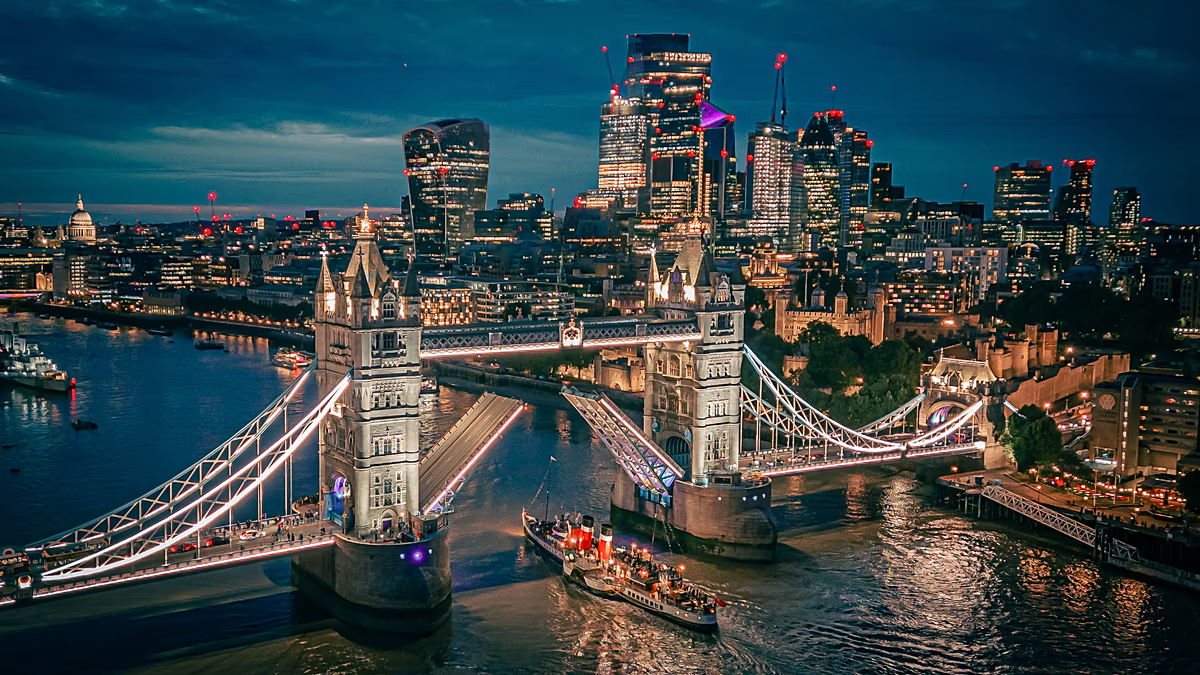
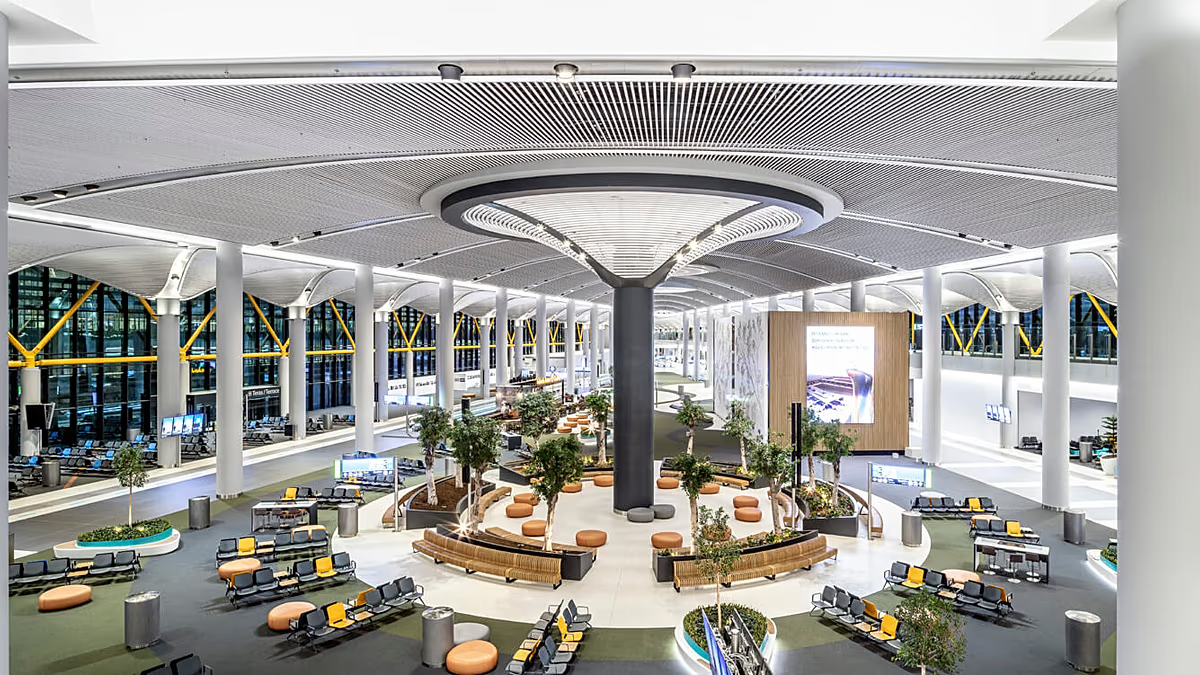
Europe’s presence in the global picture is intriguing, with only two airports cracking the top 10 in 2025’s passenger traffic rankings, underscoring a regional shift amid competition. London Heathrow, that iconic gate to the UK and beyond, handled 84,482,126 passengers and dropped to seventh place from fifth in 2024. It’s a hub where history meets modernity—think Concorde lounges and bustling duty-free shops. Just behind, Istanbul Airport in Turkey processed 84,437,710 passengers, slipping from seventh to eighth but showing massive growth since 2019, when it was 28th. Istanbul’s transformation is a tale of ambition, turning into a southeast European powerhouse with stunning architecture and high-end amenities. These European contenders highlight how airports adapt: Heathrow, facing slot limits and environmental pressures, and Istanbul, bridging East and West with its multicultural vibe. Meanwhile, the top 10 overall featured American dominance at the top, with Atlanta leading, followed by Dubai, Tokyo Haneda, Dallas Fort Worth, Shanghai Pudong, Chicago’s O’Hare, Heathrow, Istanbul, Guangzhou Baiyun, and Denver International. For Europeans, this might spark nostalgia or frustration, but it’s also an opportunity—places like Frankfurt and Paris Charles de Gaulle are strong in international metrics, proving old-school charm still wins hearts.
Beyond total traffic, the surge in international travel painted an even brighter picture for global connectivity in 2025, with numbers hitting four billion passengers—a 5.9% uptick from 2024 and an impressive 8.3% rise from 2019. It’s like the world exhaled post-pandemic, with people itching to explore beyond their borders. In this arena, Dubai shone as the undisputed king for international flights, processing 95,192,160 passengers. As the UAE’s only major airport, domestic flights aren’t a factor, making it a pure global player’s playground, from luxury shoppers to transcontinental flyers. London Heathrow followed closely with 79,874,784 international passengers, leaving about 4.6 million for domestic travel—testament to its role as a British lifeline. South Korea’s Incheon International, serving Seoul, nabbed third, famed for its streamlined operations and cultural gateways; Singapore’s Changi Airport, with its reputation for world-class service and gardens in terminals, was fourth. Amsterdam Airport Schiphol rounded out the top five with 68,767,548 international travelers, its compact charm drawing in cyclists and artists. Other European stars like Istanbul (sixth), Paris Charles de Gaulle (seventh), and Frankfurt (ninth) joined the mix, alongside Hong Kong and Qatar’s Hamad for an Asian flair. This international boom isn’t just about vacation hotspots; it’s about reconnecting economies, fostering understanding, and even reviving industries hit hard by global closures.
Economically, ACI World noted that dropping jet fuel prices—down 13% year-on-year—alongside easing inflation, gave passengers more buying power, stoking demand throughout 2025. It made travel feel accessible again, encouraging those spontaneous trips or family reunions we’d all postponed. But as we look ahead, the report hinted at turbulence: “Suffice to say, that won’t be the case this year…” This implies rising costs or uncertainties might temper optimism, reminding us that aviation’s fate is tied to broader forces like geopolitical tensions or climate policies. For everyday folks like traveling parents, budget-savvy retirees, or global nomads, this means weighing frequent flyer points, eco-friendly choices, and mental preparedness for potential hiccups. Airports aren’t just transit points; they’re mirrors of our world, adapting to conflicts, technologies, and dreams. As Atlanta reigns supreme, Dubai dazzles, and Tokyo perseveres, the message is clear: invest wisely, innovate boldly, and keep those skies open for all. After all, in the grand scheme, flying isn’t just about destinations—it’s about the journeys that shape us.