


Poland’s Port Polska: A New Beginning for European Travel
Poland’s ambitious mega-airport project, now officially named Port Polska, is poised to transform the European transportation landscape when it opens in 2032. Located strategically between Warsaw and Łódź, this massive transportation hub aims to welcome 40 million passengers annually, placing it among Europe’s busiest airports like London Heathrow and Istanbul. The project represents not just an expansion of infrastructure but a bold statement about Poland’s growing role in European and global connectivity. After receiving initial approval in 2017, the project faced challenges including corruption allegations involving the previous government. However, under current Prime Minister Donald Tusk, who took office in 2023, the project has been given “a clean start” and renewed focus, with Tusk promising that the airport will “completely revolutionize travel across the country and beyond.”
With an impressive budget of 131 billion Polish złoty (approximately €30 billion), Port Polska is designed to be far more than just an airport. Construction is scheduled to begin in 2026 on a massive 2,585-hectare plot that will feature two parallel 4,000-meter runways initially, with plans to expand to three or four runways as demand grows. The vision extends beyond air travel—Port Polska aims to become one of Central Europe’s most significant transportation hubs, integrating international flight connections with an extensive high-speed rail network. This integrated approach will connect travelers to major Polish cities like Kraków, Gdańsk, and Wrocław, offering sustainable alternatives to short-haul flights. Perhaps most impressively, the airport will be reachable from Warsaw in just 20 minutes via high-speed rail, with planners expecting about 40 percent of passengers to arrive by train rather than road transport.
The project’s renewed direction comes after controversy surrounded its earlier incarnation. Originally named Centralny Port Komunikacyjny (CPK), the airport project became entangled in allegations of corruption when investigations revealed that the previous government had sold 160 hectares of land—crucial for the airport’s construction—to a private company under questionable circumstances. Prime Minister Tusk’s commitment to giving the project “a clean start” includes both the new name and a promise of transparent governance moving forward. This reset aims to restore public confidence in what is one of Poland’s largest infrastructure investments in decades, positioning the project as a national achievement rather than a political battleground.
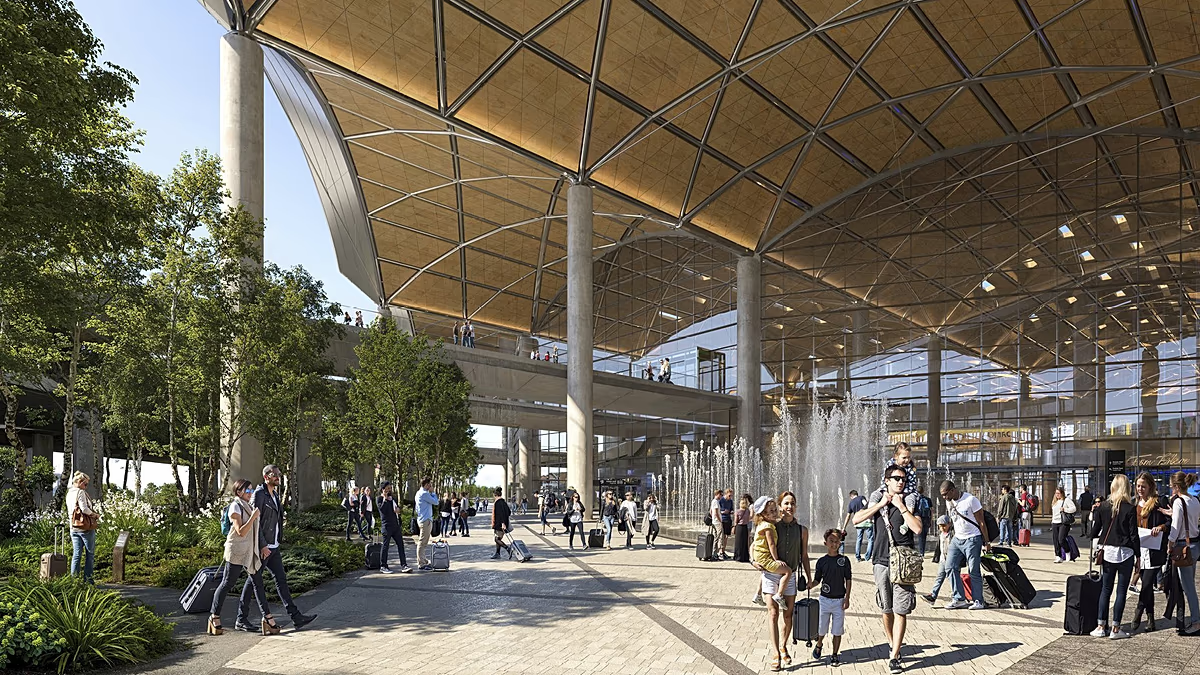
Port Polska’s architectural vision is equally ambitious, with renowned British studio Foster + Partners leading the design efforts. The plans call for an innovative “landside interchange plaza” that will serve as the heart of the complex, bringing together air, rail, and road transportation in a unified space. This plaza won’t be a sterile transit corridor but a vibrant public space “animated by lush greenery and flooded with natural light,” according to the architects. The design philosophy emphasizes creating a welcoming environment where people can gather before their journeys or while waiting for arriving travelers. This human-centered approach reflects a growing trend in transportation hub design that prioritizes passenger experience and well-being rather than merely processing travelers efficiently.
The broader implications of Port Polska extend far beyond Poland’s borders. As Prime Minister Tusk declared, the hub will welcome “aircraft from all over the world, 24/7,” positioning itself as “the largest transport hub in the region” with “the fastest rail network in Europe.” This ambitious scope represents Poland’s growing confidence and desire to establish itself as a key gateway between Eastern and Western Europe. For travelers, the hub promises more convenient connections throughout Central and Eastern Europe, potentially reducing travel times and expanding destination options. The integration of high-speed rail also aligns with Europe’s broader climate goals by offering alternatives to short-haul flights for regional travel, potentially reducing the carbon footprint of transportation across the continent.
When completed, Port Polska will likely reshape travel patterns across Central and Eastern Europe. Its strategic location makes it a natural connecting point between Western Europe and destinations further east, potentially drawing traffic from other major hubs. For Poland itself, the economic benefits could be substantial—beyond construction jobs, the airport will create thousands of permanent positions and generate significant economic activity in surrounding areas. The high-speed rail connections will extend these benefits beyond the immediate vicinity of the airport, potentially stimulating development along transportation corridors throughout the country. If successful, Port Polska will stand as a testament to Poland’s growing economic and political significance within Europe—a physical embodiment of the country’s aspirations to be at the crossroads of European connectivity in the 21st century.