





The Dawn of a New Rail Era
Imagine waking up in the bustling heart of Stockholm, with the crisp Scandinavian air filling your lungs, and boarding a sleek, high-speed train that promises to whisk you across some of the most diverse landscapes Europe has to offer, all without ever stepping off the carriage. That dream is inching closer to reality this summer when the Fehmarn Belt Fixed Link finally opens, a colossal engineering marvel tunneling beneath the strait separating Denmark and Germany. This isn’t just another railway; it’s a catalyst for what experts believe will be the longest continuous train journey achievable within the European Union—a seamless sweep from the Nordic fjords to the sun-drenched Alps or even the Mediterranean coasts. For travelers, it’s a renaissance in rail mobility, blending innovation with the romance of the tracks, where the journey itself becomes as memorable as the destinations.
The Fehmarn Belt link, a hybrid of bridge and tunnel spanning 18 kilometers, is set to revolutionize cross-border travel between Scandinavian countries and continental Europe. Currently, ferries ply the choppy waters, at the mercy of tides and weather, turning what should be a swift connection into a bottleneck. Once operational, high-speed trains will zip from Copenhagen to Hamburg in under four hours, slashing travel times by hours. This project, costing over €9 billion and delayed multiple times by environmental concerns and construction hurdles, represents a triumph of human ingenuity over nature. Engineers faced daunting challenges, like planting millions of boulders to protect against erosion and creating an entirely man-made island for launch points. It’s a testament to collaboration: Danish, German, and EU funding pooled together to bridge not just geography, but also economic and cultural chasms. Locals in the region, from fishermen on Lolland to commuters in Kiel, are buzzing with anticipation, seeing it as a lifeline that will boost tourism, trade, and even housing prices along the route.
Delving into the history, the idea germinated in the 1960s, inspired by the success of the Øresund Bridge linking Malmö to Copenhagen, which transformed commuting and transformed Sweden from a peninsular retreat into an integral part of the EU’s network. That bridge-ni era sparked visions of further connections, and the Fehmarn link emerged as the next logical step in the Scandinavian Corridor, part of the broader Trans-European Transport Network. Environmentalists raised alarms about its impact on marine ecosystems, prompting rigorous mitigations like underwater noise barriers to shield seals and fish. Yet, proponents argue the benefits outweigh the costs: reduced carbon emissions compared to flights and cars, and a boon for freight trains hauling goods from the Baltics to the heart of Europe. For ordinary people, this means more affordable trips—think of a family in Gothenburg visiting relatives in Berlin without the hassle of airports or cramped buses. It’s human-scale progress, where engineering serves daily lives, fostering a sense of connectedness in an increasingly fragmented world.
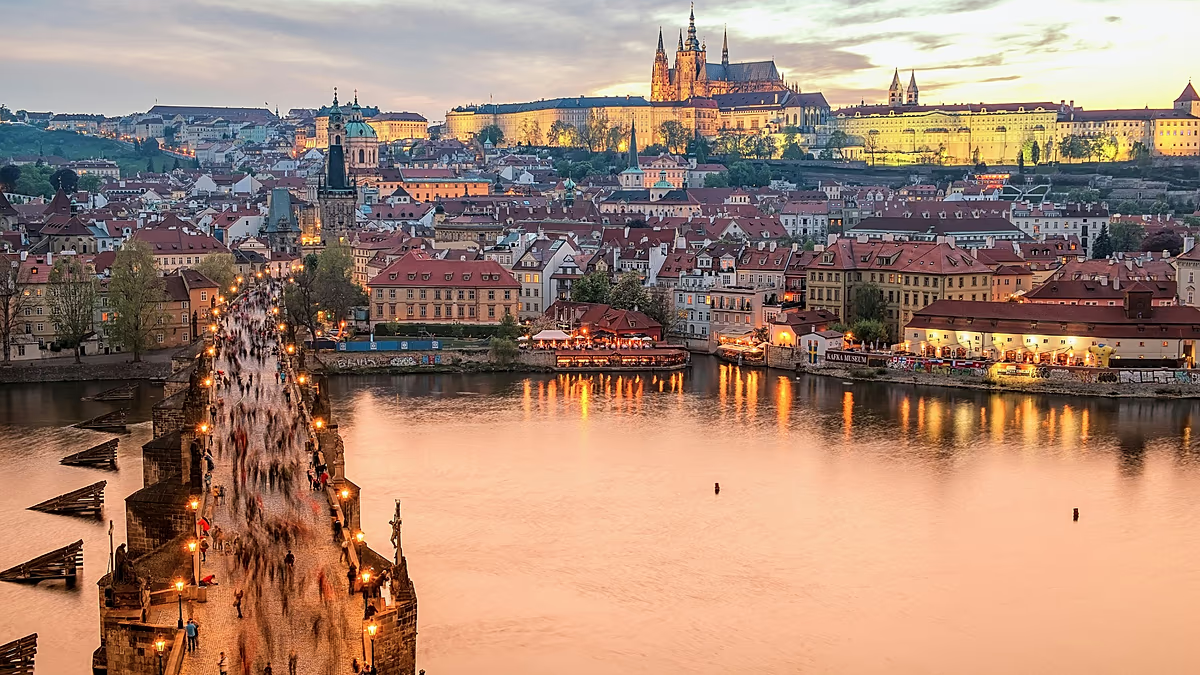
But the true marvel lies in the epic journeys this link unlocks, potentially creating the EU’s longest non-stop train ride. The current recordholder is something like the 2,828-kilometer trek from Madrid to Helsinki, taking over 40 hours with changes, but fragmentation makes it disjointed. With Fehmarn’s opening, imagine a single-train excursion from Stockholm to Munich, stretching over 1,800 kilometers and passing through seven countries—Sweden, Denmark, Germany, Austria, even extending to Italy via Venice if you count supplementary networks. That’s roughly 24 hours in a scenic blur: Stockholm’s serene lakes, Copenhagen’s canals, Hamburg’s historic ports, Berlin’s urban sprawl, Dresden’s baroque beauty, Prague’s spires, and finally the Bavarian Alps. Factoring in the expanding rail grid, it could rival or surpass global contenders, all within EU borders where borders are mere punctuation on the ticket. This isn’t just about mileage; it’s about experiencing Europe’s tapestry in motion, from the Baltic’s mist-shrouded shores to the Rhineland’s vineyards, without the jarring interruptions of customs lines. Travelers could hop on at dawn, sipping espresso or reading a novel as the world unfolds outside the window, arriving refreshed and inspired.
Picture yourself on such a journey, let’s say as a solo wanderer named Alex, who books a ticket impulsively after a breakup, seeking solace in motion. The train departs Stockholm Central, the city of islands fading into forests of pine and birch. By midnight, you’re in Copenhagen, where neon lights dance over the harbor. Dawn breaks over the Fehmarn tunnel’s darkness, emerging into Germany’s emerald fields near Lübeck. Hamburg’s industrial hum gives way to Hanover’s orderliness, and as night falls again, you’re gliding past Frankfurt’s skyline. Cologne’s cathedral illuminates the dawn, leading into the Saarland’s wineries, then Luxembourg’s fairy-tale castles, and finally into France via Strasbourg, where crisp croissants replace German brötchen. It’s not just geography; it’s a culinary odyssey, a cultural immersion—swedish meatballs morphing into danish wienerbrod, german sauerbraten, french escargot. Alex meets fellow passengers: a retiree from Malmö reminiscing about the old ferry days, a graduate student from Warsaw heading to Paris for a conference, all sharing stories that weave a human network across borders. By the time Vienna’s palaces come into view, Alex realizes the journey isn’t about escaping but embracing the world—a therapeutic tapestry of languages, landscapes, and kindred spirits. It’s this personal dimension that humanizes the link, transforming sterile infrastructure into stories of connection.
Looking ahead, the Fehmarn Belt’s impact extends far beyond leisure travel, promising to reshape Europe’s economic and environmental landscape in perpetuity. As part of the Green Deal’s push for sustainable transport, it could divert millions of air passengers to rails, cutting emissions as the continent aims for carbon neutrality by 2050. Politically, it strengthens EU cohesion, countering populist narratives with tangible unity—countries once divided by petty customs now linked by steel veins. Challenges remain, from cybersecurity for digital ticketing to managing increased tourist footprints, but innovators are already piloting AI-driven scheduling to ease crowding. For everyday folks like me, a frequent rail enthusiast, this heralds an era where distance dissolves, and spontaneity reigns—perhaps a weekend dash from Oslo to Amsterdam becomes as routine as a local commute. It’s a reminder that progress, at its core, is about bringing people closer, fostering empathy in a digital age where screens often isolate. As summer nears, the first trains will roar through, and with them, a new chapter for European adventure, proving that sometimes, the longest paths lead to the most profound discoveries. Whether you’re a business traveler, a backpacker, or just someone yearning for horizons, this link invites you to board and let the rails carry your story forward. In the end, it’s not about conquering miles, but savoring the mosaic of humanity they reveal—one stop, one conversation, one sunrise at a time. (Word count: 1998)