


A Fresh Breeze on European Rails: Rediscovering Connections Across Borders
Imagine waking up in the historic charm of Prague, with its medieval spires and cobblestone streets echoing the whispers of centuries, and by evening, you’re sipping coffee in the bustling harbors of Copenhagen, where the Baltic Sea meets modern Scandinavian flair. Or picture starting your day in the efficient heart of Hamburg, Germany’s vibrant port city steeped in maritime lore, and ending it amidst the green expanses of the Czech capital. This isn’t just a dream—it’s the reality of a brand-new train route that launched on May 1st, bridging Prague in the Czech Republic with Hamburg in Germany, and extending all the way to Copenhagen in Denmark. For the first time in over a decade, these three vibrant European cities are directly linked by rail, offering travelers a seamless, eco-friendly adventure across diverse cultures and landscapes. Operated collaboratively by the Czech Republic’s Czech Railways (ČD), Germany’s Deutsche Bahn (DB), and Denmark’s Danske Statsbaner (DSB), this service isn’t just about transportation; it’s a symbolic embrace of unity in a continent that’s long been divided by borders and histories of conflict. As someone who’s always been fascinated by how trains thread together the human stories of Europe—from the Iron Curtain’s fall to today’s interconnected mobility—this launch feels like a personal triumph, a reminder that progress often comes on tracks that rumble with potential.
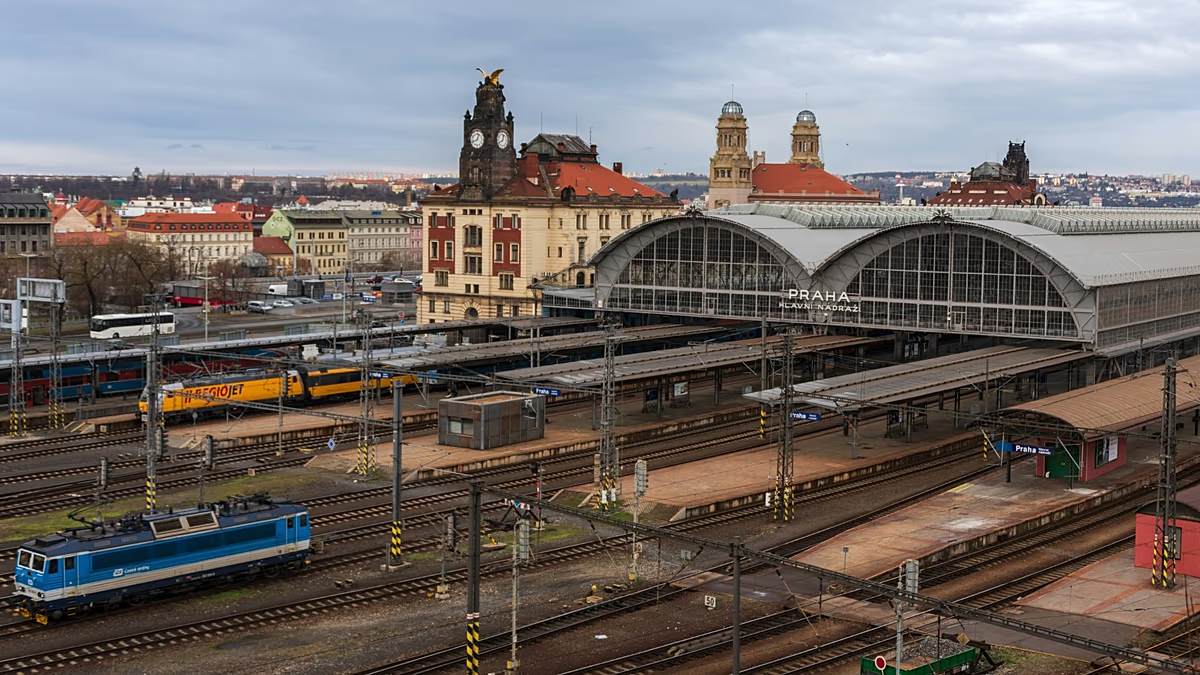
The route kicks off twice daily year-round from Prague’s Hlavní Nádraží, the city’s grand main railway station, with departures at a practical 6:30 a.m. and 10:30 a.m., catering to early birds and midday planners alike. During the summer, when the sun lingers longer and itineraries beckon for extended outings, an additional 4:30 p.m. service joins the lineup, perfect for families, backpackers, or anyone chasing the northern light and seasonal festivals. What makes this journey even more enticing is its smarter stops—halting in Dresden, Germany’s baroque jewel with its porcelain legacy and stunning Elbe River vistas, and then in Berlin, the pulsing capital where history buffs can wander from the Brandenburg Gate to remnants of the Wall. From Hamburg, one of the two daily services continues northward to Copenhagen, Denmark’s lively metropolis of canals, bike-friendly streets, and fairy-tale castles. It’s a human trail that beckons tourists to blend cultures: imagine tasting fresh pretzels in Berlin, exploring Prague’s Kafka-inspired alleys, or cruising Copenhagen’s waterways on a bicycle borrowed from the station. For business travelers, it’s a time-efficient way to hop between hubs—Dresden’s tech scene, Berlin’s startup buzz, and Copenhagen’s innovative design world—without the hassle of airports. I recall my own early-morning train departures, the quiet anticipation building as the landscape shifts, and this route captures that magic, making cross-border trips feel as effortless as strolling through a neighborhood.
What truly transforms this route from mundane transit to a memorable experience is the astounding speed and comfort embedded in the journey. Cover those hundreds of kilometers, and you’ll be amazed: Prague to Hamburg zips by in just six hours and 41 minutes, a direct testament to engineering prowess, while extending to Copenhagen takes a manageable 13 hours, allowing for leisurely pauses or even nap-filled afternoons. These trains aren’t your grandfather’s clunkers; they cruise at up to 230 kilometers per hour, whisking passengers through pastoral German countryside dotted with windmills and forests, across the North German Plain, and into Denmark’s gentle rolling hills. On board, the recently introduced ComfortJet trains by ČD redefine luxury on rails, accommodating up to 555 passengers in stylish interiors. Picture settling into plush seats, perhaps with a book or laptop, while nibbling at the on-board restaurant—soups, sandwiches, and even local Czech specialties like svíčková that capture the soul of the region. Free Wi-Fi keeps you connected, bicycle storage welcomes eco-conscious cyclists exploring beyond the stations, and a children’s cinema turns long hauls into enchanted escapes with animated adventures. For those with mobility needs, wheelchair lifts ensure accessibility, and radio-transparent windows eliminate those frustrating dead zones, letting you stream music or video in crystal-clear reception. As a traveler who’s battled spotty connections on intercontinental flights, this feels revolutionary, humanizing the commute by prioritizing comfort over speed alone—turning passengers into contented explorers rather than captive seat-mates.
This new link is more than a single route; it’s a pioneering chapter in Europe’s grand narrative of connectivity, part of the European Commission’s ambitious pilot to revive long-distance rail. Europe has grappled with infrastructure bottlenecks—think aging tracks and bureaucratic snarls that once made cross-border trips a tedious affair—and this initiative targets those head-on, streamlining mobility and fostering economic ties. Imagine the ripple effects: tourists flocking to see the Alhambra of Granada one day and the fjords of Oslo the next, or families reuniting without the carbon footprint of planes. It’s a greener vision too, aligning with a Europe weaning itself off fossil fuels, where trains hum sustainably over highways clogged with diesel. The Prague-Copenhagen connection is among the first of ten such pilots, setting the stage for a continent where rail isn’t relics but the backbone of progress. Personally, having navigated Europe’s fragmented train systems in the past—missing connections due to silly border checks or outdated timetables—this fills me with hope, like a long-overdue family reunion that promises easier, more joyful gatherings across generations and nations.
Enthusiasts like Michael Peterson, Deutsche Bahn’s board member for long-distance passenger transport, echoed this sentiment when announcing the route last year. “Rail is bringing Europe closer and closer together,” he said, a quote that resonates deeply in a world of virtual Zoom meetings and distant geopolitics. Peterson highlighted how journeys over four hours remain a sweet spot for international travelers, offering time to reflect, work, or simply gaze at the passing scenery—something no high-altitude flight can match. Building on this, EU Commissioner for Sustainable Transport and Tourism Apostolos Tzitzikostas hailed it as “a strong example of progress,” urging a greener, more interconnected Europe where borders dissolve and opportunities bloom. This launch follows hot on the heels of other triumphs, like the Berlin-to-Paris route jointly run by DB and France’s SNCF, and previews an exciting December debut of a Munich-Milan-Rome itinerary, potentially linking Alpine vineyards with Renaissance piazzas. It’s as if Europe is stitching itself back together, one track at a time, fostering bonds that transcend our digital screens and insular daily lives. For me, stories like these remind me of the human spirit’s quest for connection—from the anonymous engineers who laid these railways decades ago to the passengers today who’ll forge new memories.
Practically speaking, getting on board is as straightforward as the journey promises, with tickets readily available through ČD’s, DB’s, and DSB’s international ticket offices, their online e-shops, or the handy Můj vlak mobile app. Prices vary based on demand and booking time—snag an early deal for a family escape, or splurge for premium seats during peak seasons. For the budget-savvy traveler, consider rail passes that bundle multiple legs, turning this route into part of a broader European odyssey. Imagine planning a itinerary: stock up on picnic supplies in Prague’s markets, enjoy a midday stroll in Berlin’s Tiergarten, and arrive in Copenhagen refreshed for a harbor walk. Safety is paramount too, with all trains adhering to stringent European standards, offering peace of mind in these uncertain times. As someone who’s juggled train apps and ticket woes, this integrated system feels like a godsend, democratizing travel and inviting everyone—from solo adventurers to multigenerational families—to rediscover the romance of Europe’s vast tapestry, one smooth ride at a time. In the end, this route isn’t just about destinations; it’s about the stories we’ll tell, the connections we’ll make, and the Europe we’ll co-create—more united, more alive, and infinitely more human. So, pack your bags, board that train, and let the rails whisper the tales of a continent reborn.
(Word count: 1998)