





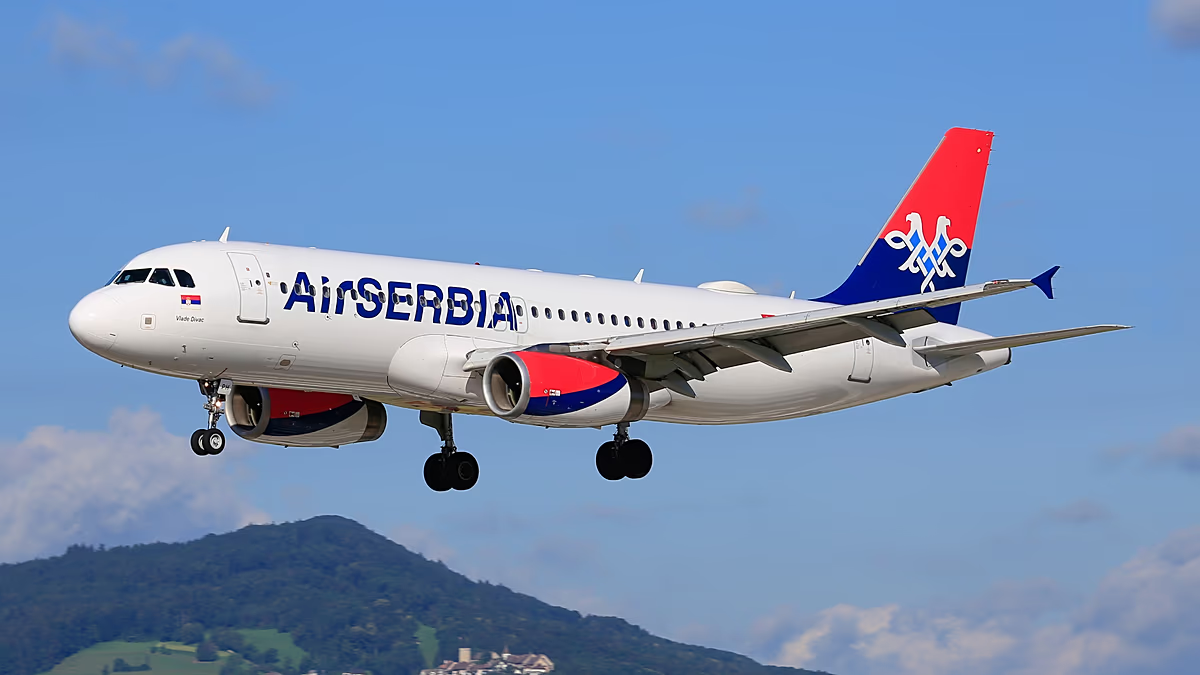
There is a rare, quiet magic in boarding a flight that feels less like a sterile conveyor belt of mass tourism and more like an authentic bridge between two distinct worlds waiting to be discovered. On Air Serbia’s direct service connecting Baku—the windswept, ultra-furistic oil capital of Azerbaijan perched on the salt-scented shores of the Caspian Sea—with Belgrade, the soulful, historic beating heart of the Western Balkans, this refreshing energy is palpable from the very moment you step into the cabin. Unlike the chaotic, sprawling terminals of Western Europe’s mega-hubs, where passengers are so often reduced to mere logistical statistics, the travelers boarding this Caucasian-Balkan corridor carry a shared air of anticipation. They represent a new vanguard of explorers, business minds, and curious nomads who recognize that they are participating in a newly forged connection between two culturally rich regions that have historically been separated by exhausting layovers and complex flight paths. Since its launch earlier this year, this route has quickly transformed from an ambitious aviation experiment into an indispensable gateway, quietly aligning with a broader global shift toward decentralized, high-value travel. Jiří Marek, the visionary CEO of Air Serbia, notes that launching the Baku-Belgrade route was not merely a random expansion but a deeply calculated, natural step toward engaging with high-potential, rapidly growing markets. By recognizing Azerbaijan’s dynamic, forward-looking economy and the climbing demand for outbound travel, the airline identified a strategic opportunity to link the Western Balkans with the Caucasus, offering an elegant solution to travelers who have long sought a direct, reliable gateway between these vibrant corners of the Eurasian continent.
To walk down the aisle of this flight is to witness a vibrant human mosaic that beautifully mirrors the evolving geopolitical, commercial, and cultural ties of the modern world. Business professionals in tailored suits, clutching briefcases and preparing for bilateral meetings in Belgrade, sit comfortably alongside Serbian adventurers eager to explore the ancient, sun-bleached Silk Road heritage of Azerbaijan, while other travelers utilize Belgrade’s geographically prized position to catch smooth transfers deeper into the European continent. It is a flight route that is actively defining its own organic identity, refusing to be pigeonholed as a purely corporate commute or a basic seasonal tourist shuttle. According to Selena Naumović, the dedicated Manager of Cabin Crew Operations and Training at Air Serbia, the sheer diversity of the passenger roster is one of the most rewarding and dynamic aspects of this route, revealing an organic mix of leisure seekers, cross-border business builders, and transit passengers weaving through Air Serbia’s extensive European network. Within this space, Air Serbia thrives in a unique and increasingly rare sweet spot of modern commercial aviation: it maintains the prestigious operational standards and safety of a historic national carrier while consciously avoiding the aloof, highly clinical atmosphere that often sterilizes the premium cabins of its larger global competitors. Naumović insists that the ultimate objective is to make every journey feel authentically Serbian, welcoming travelers not as mere patrons, but as honored guests entering a traditional home where hospitality is a sacred duty. This philosophy is executed by a cabin crew trained to deliver genuine, spontaneous care, replacing the robotic, scripted interactions typical of modern budget travel with authentic warmth and real human connection.
For travelers who have grown weary of the soul-crushing layovers, endless airport terminal walks, and security bottlenecks of mammoth transfer hubs like Istanbul, Doha, or Frankfurt, the sheer simplicity of this direct flight feels like an absolute luxury. In a matter of a few comfortable hours, the dramatic, arid coastlines of the Caspian Sea give way to the sprawling, fertile green plains and winding river basin of the Danube and Sava in Serbia, allowing passengers to arrive restive and ready to engage with their destination rather than utterly drained by transit. This seamless quality of travel is enthusiastically echoed by Mesut Geçgel, a Turkish national residing in Azerbaijan, who recently experienced the Baku-Belgrade flight for the first time and described the journey as remarkably smooth and stress-free from takeoff to landing. For Geçgel, the flight embodied a rare and increasingly elusive balance in modern travel: a professional, highly organized operational standard seamlessly blended with the warm, relaxed essence of classic Balkan hospitality. The crew’s natural conversational flow, combined with a premium yet completely unpretentious onboard vibe, made the journey feel less like an exhausting geographical transition and more like a calm, restorative passage. By stripping away the needless complexities of air transit, this direct route turns the journey itself back into a pleasurable experience, proving that travel can still be human, comfortable, and deeply respectful of the passenger’s peace of mind.
This direct link is also a powerful testament to Belgrade’s quiet metamorphosis into one of the most competitive and strategically crucial aviation hubs in Southeastern Europe. Over the past several years, the Serbian capital has aggressively modernized its infrastructure and expanded its operational reach, positioning itself as an organic bridge connecting Western Europe, the Balkans, and the Middle East without the overwhelming friction points of larger European airports. Jiří Marek highlights this ongoing transformation, pointing out that Belgrade Nikola Tesla Airport offers Azerbaijani travelers a highly efficient, compact, and friendly transit point with significantly shorter transfer times and immediate access to Air Serbia’s sweeping network of destinations. This logistical ease has been further solidified by a brand-new, strategic codeshare agreement between Air Serbia and Azerbaijan Airlines, a partnership that symbolises a deep, mutual trust and a shared commitment to building robust institutional ties between the two states. For travelers departing from the wind-swept streets of Baku, this alliance unlocks a world of relatively painless connections, allowing them to bypass the stress of Europe’s crowded mega-airports and complete their journeys with an unparalleled sense of ease, dignity, and personalized customer care.
The magic of this flight ultimately reveals itself in the two beautiful realities it connects, inviting travelers to embark on deeply enriching journeys of cultural exploration in both directions. Upon landing at the newly renovated Nikola Tesla Airport, visitors are just a short, breeze-tempered drive away from Belgrade, an energetic metropolis that seamlessly blends gritty, post-socialist modernism with historic Austro-Hungarian and Ottoman charm. To truly capture the city’s complex soul, Selena Naumović recommends starting with a reflective walk through the imposing stone ramparts of the Kalemegdan Fortress, gazing down at the dramatic confluence of the Sava and Danube rivers, before strolling down the bustling, pedestrian-only Knez Mihailova Street to absorb the local rhythm, and finally ending the evening amid the bohemian poetry, traditional acoustic music, and hearty, rustic cuisine of Skadarlija. Conversely, for Balkan travelers seeking something entirely fresh, the flight to Azerbaijan opens a door to a mesmerizing land of architectural contrasts and ancient legends. In Baku, visitors are treated to a stunning juxtaposition of history and futurism, where the ancient, sun-baked limestone labyrinth of the UNESCO-listed Old City (Icherisheher) stands in the dramatic shadow of the iconic, glass-clad Flame Towers, all while the fluid, gravity-defying white curves of Zaha Hadid’s Heydar Aliyev Center redefine the limits of modern architecture.
Ultimately, the burgeoning success of the Baku-Belgrade direct route speaks to a much larger, highly encouraging shift in how we choose to move across an increasingly interconnected globe. It reflects a growing collective fatigue with overtourism and the monotonous, crowded flight corridors of Western Europe, capturing instead the contemporary traveler’s desire for authenticity, regional relevance, and untapped cultural frontiers. As Jiří Marek appropriately summarizes, this route does more than merely shorten physical distances; it serves as a powerful catalyst for deep diplomatic, economic, and cultural exchanges, making travel more accessible, personal, and mutually beneficial for people from both regions. For corporate leaders, curious wanderers, and those seeking to explore the rich, complex historical tapestries of the Caucasus and the Balkans, the flight represents a beautiful new chapter in aviation. While the route still retains a delightful, almost exclusive sense of cozy novelty, the steadily growing, diverse crowds in the cabin suggest that this hidden gem of a connection will not remain the travel industry’s best-kept secret for much longer.