



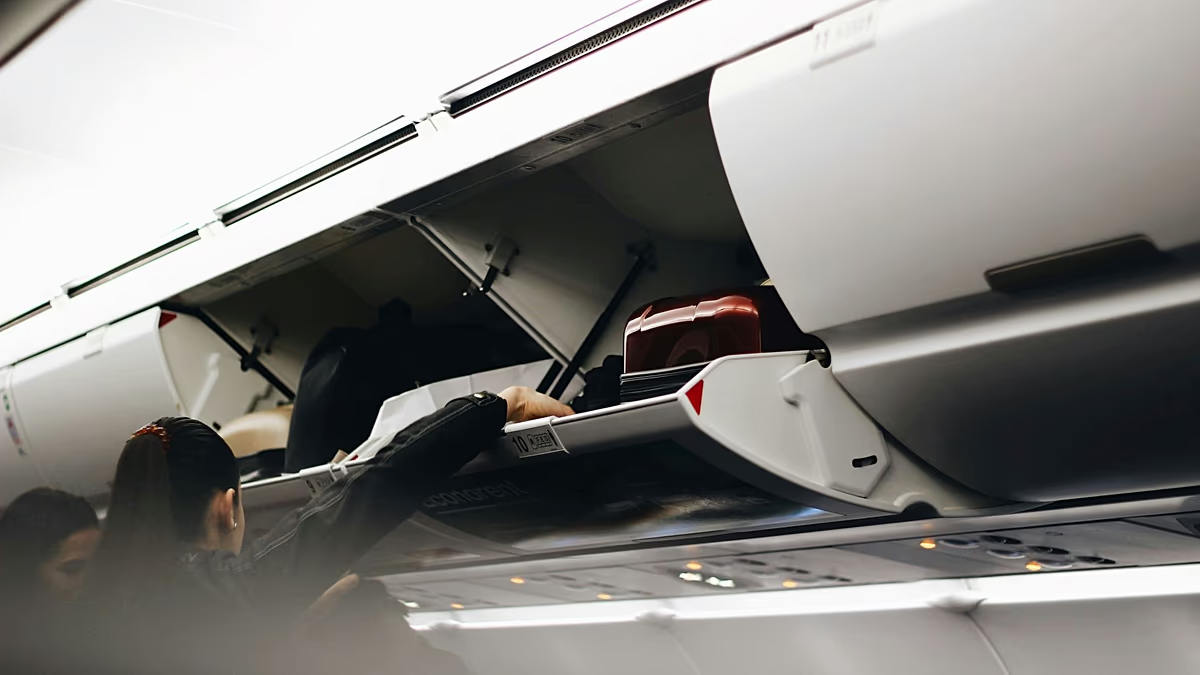
Every single day, millions of travelers step onto commercial airplanes, leaving behind the solid ground to fly miles above the earth in a beautifully orchestrated dance of modern engineering and human trust. From the moment we find our assigned rows, walk down the carpeted aisle, and lift our bags into the overhead compartments, we settle into a delicate, temporary home, surrounding ourselves with the personal items that keep us connected, comfortable, and feeling secure in the sky. However, the rise of checked baggage fees and the convenience of modern rolling suitcases have led to a massive cultural shift over the past two decades, with travelers packing more valuable, irreplaceable items directly into their carry-on bags. Suspended within this artificial peace is a fragile social contract that can be instantly shattered when the unexpected occurs on the runway or in the clouds. It is in these rare, high-stakes moments of an in-flight emergency that our primal survival instincts and our deeply ingrained material habits collide head-on in a dangerous way. Recognizing this highly problematic dynamic, the International Air Transport Association (IATA) has stepped forward with a vital, lifesaving global campaign designed to fundamentally shift how we view emergency instructions: “Save a Life, Not a Bag.” This global initiative is not merely a set of rigid corporate rules designed by airlines; it is an urgent plea to passenger empathy, targeting a growing and highly hazardous behavior where travelers risk lives to save physical luggage. Aviation, at its core, relies on absolute synchronization and human cooperation, and when a cabin fills with smoke or comes to a sudden halt, there is zero room for the weight of our worldly possessions. By unpacking the heavy psychological attachment we hold to our carry-on bags and looking closely at the statistics surrounding passenger behavior, the airline industry hopes to reshape our collective instinct so that we prioritize human life over material cargo during critical evacuations.
The necessity of this campaign is backed by striking, and somewhat alarming, data from a recent global poll of travelers across the United States, the United Kingdom, the United Arab Emirates, and Singapore. The study revealed a deeply troubling disconnect between perceived safety knowledge and actual emergency behavior: while an impressive 80 percent of respondents confidently claimed they knew exactly what to do in an aviation emergency, only 61 percent could correctly identify that their immediate course of action should be to abandon all personal belongings and exit the aircraft as quickly as possible. Even more concerningly, a full ten percent of those surveyed admitted that they would still actively try to retrieve and carry their baggage during a live evacuation, even if explicitly instructed by the flight crew to leave everything behind. This ten percent represents a massive hazard to everyone on board, suggesting that inside any packed commercial aircraft, there are dozens of individuals who would willingly jeopardize the escape of hundreds of others for the sake of their laptops, souvenirs, clothing, or expensive designer cases. This discrepancy highlights a fundamental human flaw known as normalcy bias, where people under extreme stress struggle to comprehend the reality of a life-or-death crisis and instead cling to the comfort of their daily routines. When people are afraid, their brains crave familiarity, and grabbing a purse or a backpack is a subconscious attempt to maintain control in a situation that is spiraling out of control. By exposing these statistics, IATA hopes to ground passengers in the harsh reality that during an evacuation, their personal items are not comforting lifelines, but rather heavy, hazardous obstacles that threaten the safety of every single person seated in their row and behind them.
To truly understand why the “Save a Life, Not a Bag” initiative is so critical, one must look at the brutal physics of a modern airplane evacuation, where every split second determines whether a life is saved or lost. When aviation authorities certify a commercial aircraft, they perform rigorous, real-world tests to prove that a full plane can be completely cleared of passengers in under ninety seconds, even with half of the emergency exits blocked or completely unusable. This highly precise timeline relies on a frictionless flow of human movement down incredibly narrow aisles that often measure less than twenty inches across. When a single passenger pauses to pull their baggage from the overhead bin, they immediately create a catastrophic bottleneck in the narrow cabin corridor, trapping fellow passengers behind a wall of moving plastic and fabric. In a cabin that may be rapidly filling with toxic smoke or fire, a delay of just three seconds can be the difference between survival and tragedy for the passengers at the back of the aircraft. Beyond blocking exits, these bags pose massive physical dangers: they easily trip up frightened children, the elderly, or those with mobility issues, and their sharp corners, heavy wheels, and metal zippers can effortlessly tear or puncture the delicate, highly pressurized fabric of the inflatable escape slides that passengers must use to flee the aircraft. As Willie Walsh, IATA’s Director General, passionately emphasized, grabbing even one minor bag can have a domino effect that halts the entire evacuation process, turning standard security procedures into a chaotic, life-threatening scenario where the simple act of trying to save a piece of luggage can ultimately cost someone else their life.
This troubling trend of passengers prioritizing their belongings during emergencies has forced aviation leaders to consider escalating their strategies from simple public awareness to more severe, mandatory structural changes. Speaking at the IATA general meeting in the vibrant city of Rio de Janeiro, Nick Careen, the senior vice president for operations, safety, and security, addressed this issue with a mix of urgency and frustration. Careen explained that while the industry wishes to start with education, aiming to gently steer passenger behavior through empathy, advertising, and clear pre-flight instruction, they are fully prepared to take more draconian measures if the problem persists. These potential strategies could include imposing steep financial penalties or legal charges on passengers who disregard emergency evacuation rules, or even engineering physical, automated locks on the overhead bins that automatically engage during takeoff, landing, or any sudden mid-flight emergency. The logic behind such drastic choices is clear: if human nature cannot resist the call of its possessions, technology and law must step in to force compliance. Yet, implementing such hardware-based solutions presents its own set of logistical challenges and safety hazards, as passengers might desperately waste valuable time trying to break open locked bins in a panic, which makes the success of the current educational campaign all the more crucial for preserving a harmonious and safe flying experience.
Fortunately, the “Save a Life, Not a Bag” campaign does not merely dictate rules; it acknowledges the raw, human anxiety behind why we grab our bags in the first place, offering a simple, highly effective behavioral workaround. Most travelers who reflexively reach for their luggage are not doing so out of greed or a desire to save their clothes; they are driven by the deep fear of losing their absolute essentials—their identification, passports, financial resources, and life-sustaining prescription medications. To address this highly relatable panic, IATA is strongly urging passengers to adopt a simple pre-flight habit: secure these tiny, crucial lifelines directly onto your person, in your pockets or on a lightweight wearable strap, before the aircraft cabin doors close. The data overwhelmingly supports this humanized approach, showing that a promising sixty percent of surveyed passengers said they would be dramatically less likely to grab their hand luggage during an emergency if they knew their passports, wallets, and medication were safe in their pockets. By translating a complex safety protocol into an easy personal ritual, travelers can enjoy peace of mind throughout the flight, knowing that if things go wrong, they are already carrying everything they truly need to survive, which allows them to clear out of the exit door quickly, empty-handed, and with complete mental clarity.
Ultimately, our journeys through the skies are a beautiful testament to human cooperation, reminding us that we are all deeply interconnected, even when sitting in silence next to strangers. Every takeoff and landing is a shared leap of faith, built on the premise that we will look out for one another’s well-being should the unexpected occur in the clouds. IATA’s campaign is a powerful reminder that true safety is not just a collection of mechanical checks and regulatory mandates, but a living, breathing commitment to our collective survival. Moving forward, let us change our flying culture to view emergency exits not as a personal escape route, but as a shared sanctuary where we honor the lives of our fellow travelers by letting go of the material things we carry. By keeping our pockets filled with our essentials and our hands entirely free, we can turn a moment of potential crisis into a profound demonstration of human empathy, ensuring that every traveler returns safely home to the arms of those they love. Let our legacy as modern passengers be defined not by the objects we managed to save, but by the lives we actively helped to protect.