


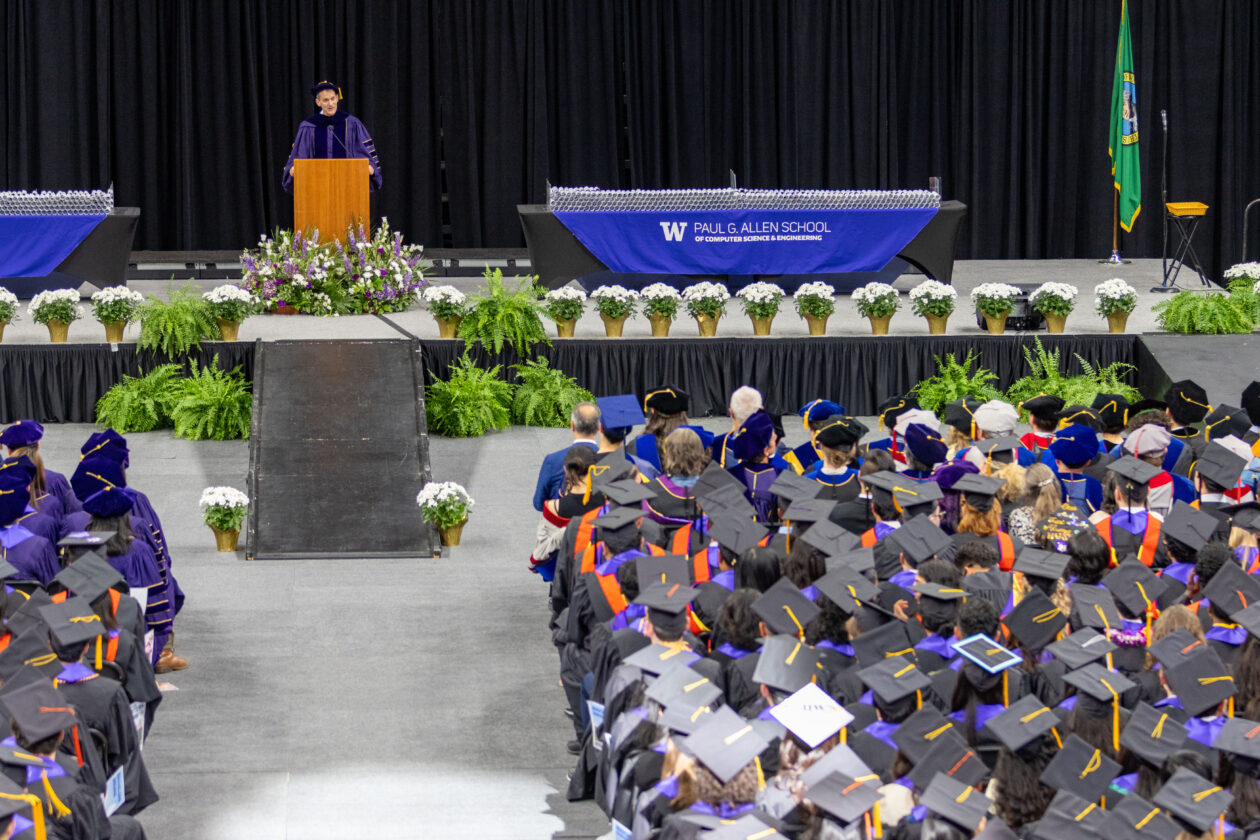
Under the soaring arches of the Alaska Airlines Arena, amidst a vibrant sea of excited families, proud faculty, and over eight hundred eager graduates of the University of Washington’s Paul G. Allen School of Computer Science & Engineering, the air was filled with a rare mixture of nostalgia and future-facing anticipation. Standing at the podium was Jeff Dean, Google’s chief scientist and one of the primary architects behind the groundbreaking Gemini AI models, who had traveled a long, remarkable road to get back to this very campus. Three decades prior, in the early 1990s, Dean was not a global tech luminary but a tireless, caffeine-fueled graduate student, hunkered down inside a cramped, makeshift metal trailer nicknamed “The Chateau” that sat wedged awkwardly next to the old computer science building. It was within those drafty, humble walls that he spent his days and nights optimizing software compilers for object-oriented programming languages, a technically grueling pursuit that was invisible to the wider world but vital to laying the foundations of modern computing. Returning to his alma mater as the commencement speaker, Dean stood as a living bridge between that era of quiet, hands-on experimentation and today’s hyper-connected, AI-driven world. The graduation ceremonies, which could easily have been marked by the anxiety and tension currently bubbling across many global campuses over the rapid rise of automation, instead felt like a warm, supportive homecoming where the lessons of the past were being passed down to the leaders of tomorrow.
The core of Dean’s message was a refreshing and deeply humanizing antidote to the techno-determinism that so often dominates modern discussions of technology. Addressing a generation of graduates who are entering a highly volatile tech landscape—one marked by job market fluctuations, restructuring, and deep anxieties over the future of human labor—Dean chose to center his address on the unique, indispensable value of human consciousness. He reassured the audience that while artificial intelligence tools are undeniably powerful, capable of effortlessly drafting complex software code and synthesizing vast oceans of digital data in seconds, they are fundamentally incomplete without the guidance of human experience, empathy, and wisdom. “AI is an incubator for ideas,” Dean declared to the packed, silent arena, “not a substitute for human ingenuity.” He argued that machines, no matter how many billions of parameters their neural networks contain, cannot possess personal ethics, lived human struggles, or the intuitive moral compass required to determine what is actually worth building in this world. This sense of knowing what matters to humanity, he promised the graduates, would ultimately become their true superpower in their professional journeys. Rather than painting AI as a detached corporate tool, Dean humanized its role by reflecting on his own upbringing in Somalia, where his parents worked in global health; he explained how modern machine learning models are now being used to predict severe floods in that very region, showcasing how technology, when guided by deep human empathy and local understanding, becomes a vital tool for saving lives and protecting vulnerable communities.
To illustrate how profound scientific achievements require journeying through long periods of uncertainty, Dean shared the story of his own academic path and the vital necessity of patience. He recalled how, as a young senior at the University of Minnesota in the late 1980s, he had become deeply fascinated by the concept of artificial neural networks, yet quickly discovered that the technology of that era was woefully unequipped to tackle practical, real-world problems. Dean had theorized that the missing ingredient was raw computational power, but he could never have fully anticipated the sheer scale of the wait that lay ahead of him. It would ultimately take a million-fold increase in processing power—a staggering technological threshold that the global computer science field did not cross until around the year 2012—before his early scientific dreams could finally be realized on a global scale. This journey was mirrored in his personal life when he and his wife, Heidi, first decided to move to Seattle and attend the University of Washington. Drawn in by a glossy promotional brochure featuring an iconic photograph of the campus’s Drumheller Fountain framed perfectly against a sunny, pristine Mount Rainier, they arrived only to discover that the relentless, cloudy Pacific Northwest autumn would keep the actual mountain completely hidden from their sight for their first eight months in the city. Dean used this humorous memory to deliver a profound piece of advice to the class of 2024, urging them to be patient and persistent, pointing out that ideas they study today may seem completely impossible now, only to become revolutionary realities decades later when the rest of the world’s infrastructure finally catches up.
Woven tightly into Dean’s scientific wisdom was an earnest reminder of the critical importance of human connection and community. He fondly reminisced about the cramped confines of “The Chateau” trailer, explaining that the true value of his time at the University of Washington was not merely the code he wrote under professor Craig Chambers, or the academic papers he published, but the deep, authentic friendships he forged with his fellow graduate students in those close quarters. Many of those trailer-mates went on to become his lifelong friends, trusted intellectual sounding boards, and professional colleagues who would directly shape his trajectory when he joined Google in 1999 as its twentieth employee, working above a modest Palo Alto storefront. He urged the graduating class to be deeply intentional about the human ecosystem they construct around themselves, advising them that keeping a supportive, intellectually curious, and diverse group of friends close by is the single best predictor of a fulfilling life. This advice carries immense weight for the new graduates of the Allen School, many of whom are preparing to transition into highly competitive roles at leading global tech organizations such as Microsoft, Amazon, Google, Anthropic, and Nvidia. Dean reminded them that the peers sitting alongside them in the Alaska Airlines Arena are not competitors to be bested, but rather the very community that will sustain their mental health, inspire their creativity, and hold them ethically accountable as they navigate the unpredictable pressures of the high-tech workforce.
This celebration of human-centric innovation and close-knit community was a vibrant theme that echoed throughout the entire ceremony. Magdalena Balazinska, the director of the Allen School, set a warm and welcoming tone for the evening, acknowledging the immense journey the graduates had undergone and expressing her profound confidence in the energetic, passionate young hands into which the future of technology is now being placed. This sentiment was brought to life by Vaishnavi Vidyasagar, a graduating senior from Sammamish, Washington, who made history as the Allen School’s first-ever undergraduate commencement speaker. Vidyasagar delivered an incredibly moving speech, asserting that computer scientists are not merely mechanical writers of code, but creators of doors that open up access and equity for human beings. She spoke passionately about her own capstone project—a specialized technical tool designed specifically to help individuals suffering from misophonia comfortably navigate an overwhelming world of harsh sounds—as a prime example of using engineering to relieve human suffering. The human element was further highlighted during the presentation of the Alumni Impact Awards, which honored David Dawson, a 2006 graduate who co-founded the eco-friendly residential recycling service Ridwell, and Nodira Khoussainova, a 2012 doctoral graduate who co-founded the widely used developer tool Streamlit and now leads Focused Space, illustrating how a UW education consistently produces innovators focused on improving daily life.
As the commencement ceremony drew to its emotional close, Dean left the graduates with a powerful ethical roadmap to guide their upcoming professional careers. He highlighted a co-authored scientific paper that outlined eighteen critical, non-negotiable milestones where artificial intelligence and advanced computing must be applied to solve systemic global crises. These milestones include providing highly customized, empathetic digital tutoring to every struggling student on the planet, creating sophisticated tools to detect and neutralize weaponized misinformation, accelerating the discovery of life-saving medical treatments, and revolutionizing global healthcare delivery systems. He challenged the graduates to use their refined technical skills not to serve a select, privileged few, but to actively build ethical safeguards and moral boundaries that ensure technological progress benefits the broader public good. Dean’s final, parting words to the class of 2024 served as a beautiful, grounding reminder that in an age increasingly dominated by cold algorithms, our humanity remains our greatest asset. He implored the new computer scientists to always treat every single person they meet with profound respect and kindness, to prioritize problems that truly matter to human well-being, and above all, to never lose the sense of wonder, curiosity, and pure fun in the work they do.