


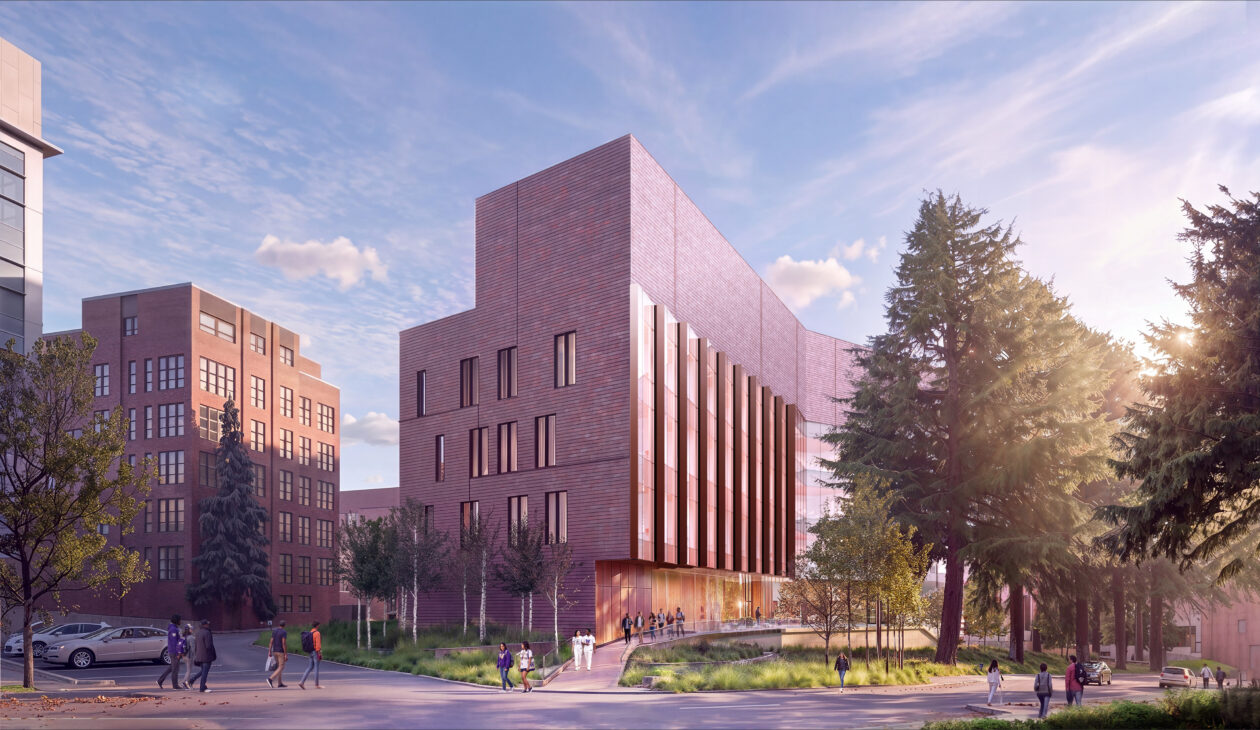
On a bright late-September morning, the University of Washington campus hummed with a different kind of energy. Faculty members in hard hats, students clutching notebooks, and state leaders in suits gathered around a patch of ground west of Bagley Hall—not to mourn the passing of an old library, but to celebrate the beginning of something much larger. The occasion was the official groundbreaking of the UW’s new Chemistry Sciences Building, a $231.1 million, five-story, 104,500-square-foot facility that will rise in the heart of the Seattle campus. When it opens in 2029, it will not simply be a new set of laboratories and classrooms. It will be a home for discovery, a place where researchers will tackle some of the most pressing questions of our time: how to make chemistry more sustainable, how to build materials that can transform medicine, how to unlock the strange and powerful world of quantum science, and how to protect and improve human health. “The work that happens here will help advance science, strengthen our state and improve lives for generations to come,” said UW President Robert Jones, his voice carrying over the crowd as the ceremonial shovels broke the earth. For the students and faculty who have long worked in aging, cramped spaces, the moment felt less like a construction milestone and more like a promise finally kept.
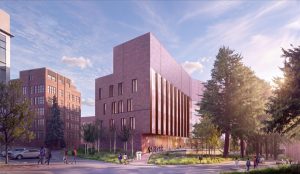
The new building will replace the Chemistry Library Building, a modest structure that has sat quietly for decades just west of Bagley Hall. But its significance goes far beyond replacing outdated shelving and study nooks. The construction of the Chemistry Sciences Building is the first phase of a two-part transformation: once the new facility is up and running, it will allow the university to undertake a complete renovation of Bagley Hall, the longtime home of the Department of Chemistry. Bagley Hall is one of those buildings that feels like part of the campus soul. It was built in 1937, and for generations, students have walked its corridors, hunched over benches, and mixed compounds in its labs while the Drumheller Fountain sparkled just outside. But nearly ninety years of scientific discovery have taken their toll. The building’s infrastructure is outdated, its spaces are ill-suited to modern research, and its classrooms struggle to accommodate the department’s enormous and growing community. The renovation will give Bagley a second life, transforming it into a space that matches the ambition of the people who work inside it. The Chemistry Sciences Building, meanwhile, will be designed to be a state-of-the-art home for instruction and research, with flexible laboratories that can adapt to new scientific techniques, collaborative spaces where chemists can talk across specialties, and infrastructure that supports everything from delicate quantum experiments to large-scale materials synthesis. The design-build team of Skanska and Payette+EHDD has been charged with bringing this vision to life, and their artist’s renderings show a sleek, light-filled structure that feels both futuristic and welcoming—a building that looks like the future of science, but also like a place where people will actually want to spend their days.
Money, of course, is always part of the story. The $231.1 million price tag is being covered through a combination of public and private investment. Washington state has committed $129 million, a major appropriation that signals the importance of the project beyond campus. The remaining funds come from the UW’s College of Arts & Sciences, the university itself, and private donations from individuals and foundations who believe in the power of chemical discovery. But the university is not stopping at the Chemistry Sciences Building. The complete renovation of Bagley Hall is still in the planning stages, and a university spokesperson confirmed that funding for that portion of the project has yet to be fully identified. It is a reminder that even transformative projects require patience and persistence. Yet the state’s investment is already being framed as a bet on Washington’s future. Gov. Bob Ferguson, who attended the groundbreaking, put it plainly: “Washington’s economy is built on innovation. Maintaining our leadership requires a reliable pipeline of skilled, highly educated workers. We’re proud to be an investor in this state-of-the-art new building.” His words echo a broader truth: universities are not just places of learning; they are economic engines. They train the engineers and scientists who fill local companies, they attract federal research dollars, and they spin out ideas that become startups and patents. By investing in a building like this, the state is investing in its own competitiveness, its own workforce, and its own ability to remain a place where innovation thrives.
For the Department of Chemistry, this new building cannot come soon enough. The department is one of the largest in the United States, and its numbers tell a story of vitality and demand. According to its online directory, the department has about 275 staff and faculty members. At the start of the 2025 academic year, it reported 985 undergraduate majors and 320 graduate students and postdoctoral researchers. Those students and researchers are not just filling seats; they are doing serious, funded work. In 2025 alone, the department managed $28 million in research funding, with support coming from major federal agencies including the National Science Foundation, the National Institutes of Health, the Department of Energy, and the Department of Defense, as well as from industry partners and private foundations. This is the kind of research that doesn’t just produce papers—it produces solutions. It can lead to new drugs that fight disease, new materials that make batteries last longer, new catalysts that reduce industrial waste, and new insights into the fundamental building blocks of nature. But all of that work requires physical space, and the current facilities have been straining under the weight of the department’s success. The new building will give students and faculty room to breathe, to collaborate, and to push the boundaries of what chemistry can do. For an undergraduate walking into a lab for the first time, it will be an invitation. For a postdoc spending long nights chasing a breakthrough, it will be a sign that the university values their work. For a professor building a research program from scratch, it will be the foundation on which that program can grow.
The Chemistry Sciences Building also arrives at a significant moment for the University of Washington’s physical campus. It will be among the largest new academic facilities in Seattle since the Interdisciplinary Engineering Building opened in the spring of 2025. That 72,000-square-foot College of Engineering facility was itself a landmark, but the Chemistry Sciences Building is bigger, more ambitious, and more central to the university’s identity. It is also a sign of resilience. Just last year, the university scuttled plans for a much larger 345,000-square-foot facility, nicknamed Brightwork, that would have been built just west of the main campus to house research programs in clean energy, protein design, and precision medicine. The collapse of that project was a disappointment, a reminder that big dreams sometimes have to be recalibrated. But this groundbreaking shows that the university has not lost its momentum. Instead, it has regrouped, focused on the most critical needs, and moved forward. The Chemistry Sciences Building is not just a building; it is a statement that the UW remains committed to being a world-class research institution, even in the face of budget constraints, shifting priorities, and the many challenges that come with running a major public university. It is also a reminder that progress is rarely linear. Sometimes it comes in grand gestures, and sometimes it comes in the form of a five-story laboratory building that takes years to plan, fund, and construct. But it comes.
As the ceremony wound down and the hard hats were returned, the real work was just beginning. The next few years will bring construction crews, cranes, and the inevitable dust and noise of a major building project. But when the doors finally open in 2029, a new generation of chemists will walk through them. They will be the ones who discover new reactions, design new molecules, and train the next generation after them. They will work in spaces that were built for the science of tomorrow, not the science of yesterday. They will stand at the intersection of sustainable chemistry, human health, advanced materials, and quantum science—fields that barely existed when Bagley Hall was first erected. And they will do so because a community of people came together to believe in something bigger than themselves: the idea that science can change the world, and that the University of Washington is the right place to make that happen. The Chemistry Sciences Building will be many things—a workplace, a classroom, a laboratory, a symbol. But above all, it will be a place where human curiosity gets a home. And that is something worth celebrating, not just with shovels and speeches, but with the quiet confidence that comes from knowing that the best discoveries are still ahead.