


Trevor Noah Connects with Students Through AI Learning
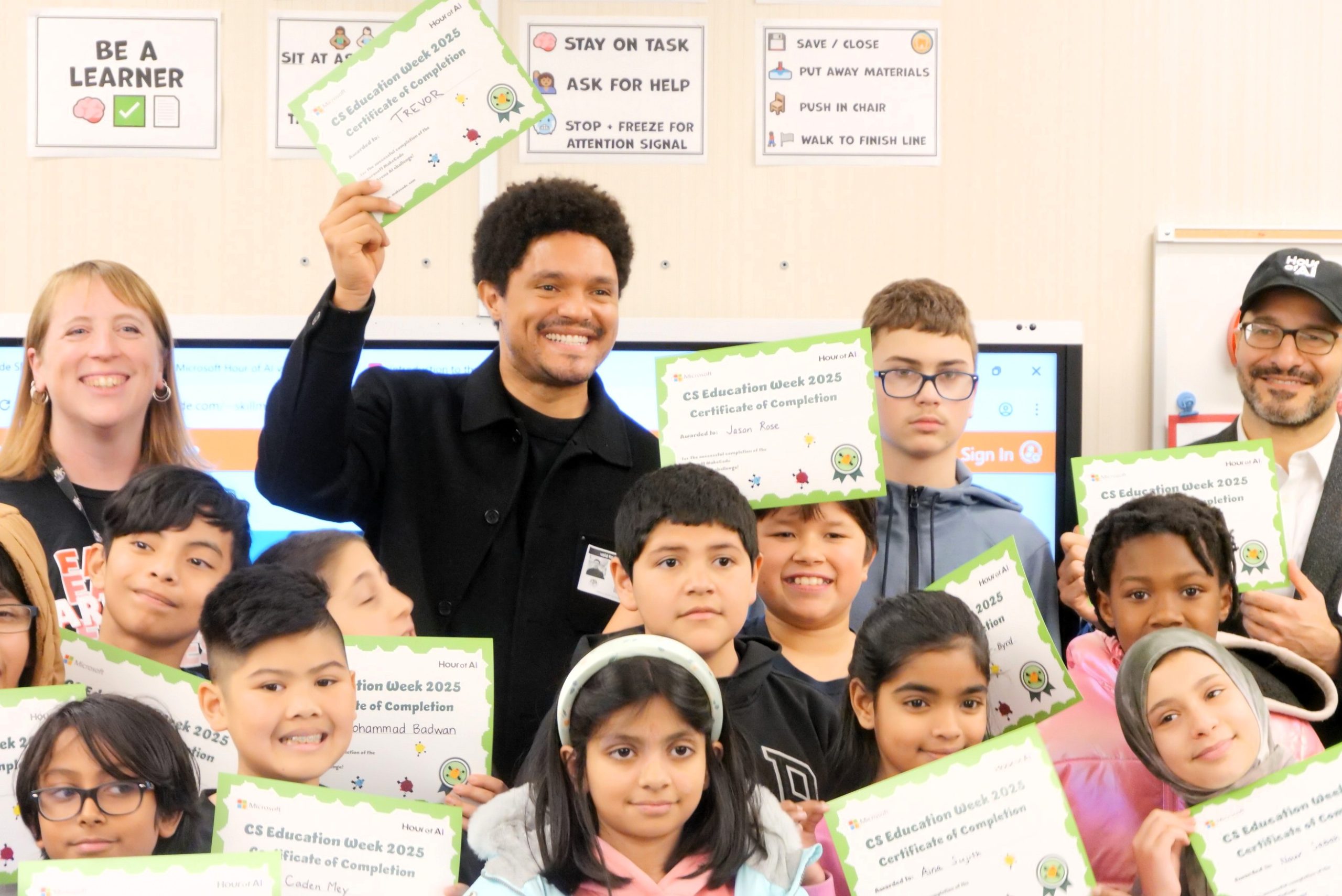
In a refreshing display of educational camaraderie, Trevor Noah stepped into a fifth-grade classroom at Ardmore Elementary School in Bellevue, Washington, not as a celebrity, but as a fellow learner. The former Daily Show host, now serving as Microsoft’s “Chief Questions Officer,” joined students for Code.org’s Hour of AI during Computer Science Education Week. Noah relished the fact that the young students didn’t recognize him from his television fame, creating a genuine connection unfiltered by celebrity status. “Kids don’t know me at all, which I love — it’s my favorite thing ever,” Noah shared after the class. “They aren’t responding to me because of celebrity, and I’m not responding to them from a position of celebrity. It’s just us in a room.” This authentic starting point created the perfect environment for collaborative learning about artificial intelligence.
Throughout the session, Noah engaged with students as they programmed in “Bug Arena,” a game where digital bugs compete to cover territory with paint. Rather than positioning himself as an expert, Noah asked genuine questions that sparked thoughtful discussions. When he inquired why the “random” algorithm worked initially but failed later, a student offered insight: “Random can work a lot of times, but later on, when the puzzles get more difficult, you gotta use your techniques.” This exchange exemplified Noah’s approach—not testing the students but exploring alongside them. His vulnerability in admitting his own questions about the technology resonated with the class. “We are all kids in the age of AI,” Noah later reflected. “This isn’t the kind of situation where adults have a leg up. I would argue most adults in the world are behind kids when it comes to AI.”
Noah connected with the students through their shared love of gaming, revealing his own passion for video games from Grand Theft Auto to Minecraft and Elden Ring. “I could probably beat all of you in any game,” he playfully challenged, though he conceded defeat in Madden NFL when a student mentioned it. This gaming enthusiasm served as Noah’s gateway to technology, as he explained to the students: “Sometimes you play a game and you think, it should be like this. I want to make my own games.” Beyond the classroom, Noah has been actively exploring AI for his own projects, developing tools to transcribe and archive his stand-up comedy sets. This personal investment in technology made him a relatable guide as students navigated their AI learning journey, creating a classroom dynamic that emphasized collaborative exploration rather than traditional instruction.
The event itself marked an evolution in computer science education. Formerly known as the Hour of Code, the initiative has reached over one billion students across more than 180 countries in the decade since its inception. The shift to “Hour of AI” reflects a fundamental change in educational priorities. In an era where AI can generate code, the focus has moved beyond teaching programming to helping students understand the technology’s underlying mechanisms, including its limitations. “We want the kids to get a real understanding of how AI doesn’t necessarily ‘know.’ It’s always guessing and using probabilities to make its best judgments,” explained Hadi Partovi, Code.org’s CEO, who joined Noah in teaching the class. This perspective aligns with Noah’s approach of encouraging critical thinking about technology rather than passive acceptance.
The classroom visit carried broader significance for the Bellevue School District and its educational mission. Principal Yusra Obaid emphasized the inclusive message: “Computer science is for everybody. You don’t have to be a specific person or look a certain way.” The event also highlighted the district’s funding structure, with local levies accounting for nearly a quarter of its budget. Voters will soon decide whether to renew a four-year technology and capital projects levy that supports classroom technology, student devices, and STEM programs. Microsoft’s involvement extended beyond Noah’s appearance, with the company training 300 employees to visit classrooms throughout Western Washington as part of their broader Elevate Washington initiative for AI education. This collaboration between industry, schools, and public figures like Noah represents a comprehensive approach to preparing students for a technology-driven future.
Before leading the class, Noah took time to listen to Bellevue School District teachers who shared their concerns about AI’s impact on education. Rather than dismissing these worries, Noah acknowledged their validity while encouraging continued engagement. “There is a valid concern from teachers in and around whether or not AI will erase what we consider learning to be,” he reflected. Yet he viewed this as a reason to lean into understanding the technology rather than resisting it. “A good teacher is somebody who continues to ask themselves questions, doesn’t assume that they know, and then themselves tries to keep on learning,” Noah observed, embodying this philosophy throughout his visit. His parting message emphasized maintaining “unbridled curiosity” about technological developments. “Keep being curious, keep having fun with it,” he encouraged, “and keep enjoying the fact that you don’t know.” In a world increasingly shaped by artificial intelligence, Noah’s approach modeled how embracing questions can be more valuable than clinging to certainties—a lesson that resonated beyond algorithms and programming to touch on the fundamental nature of learning itself.