


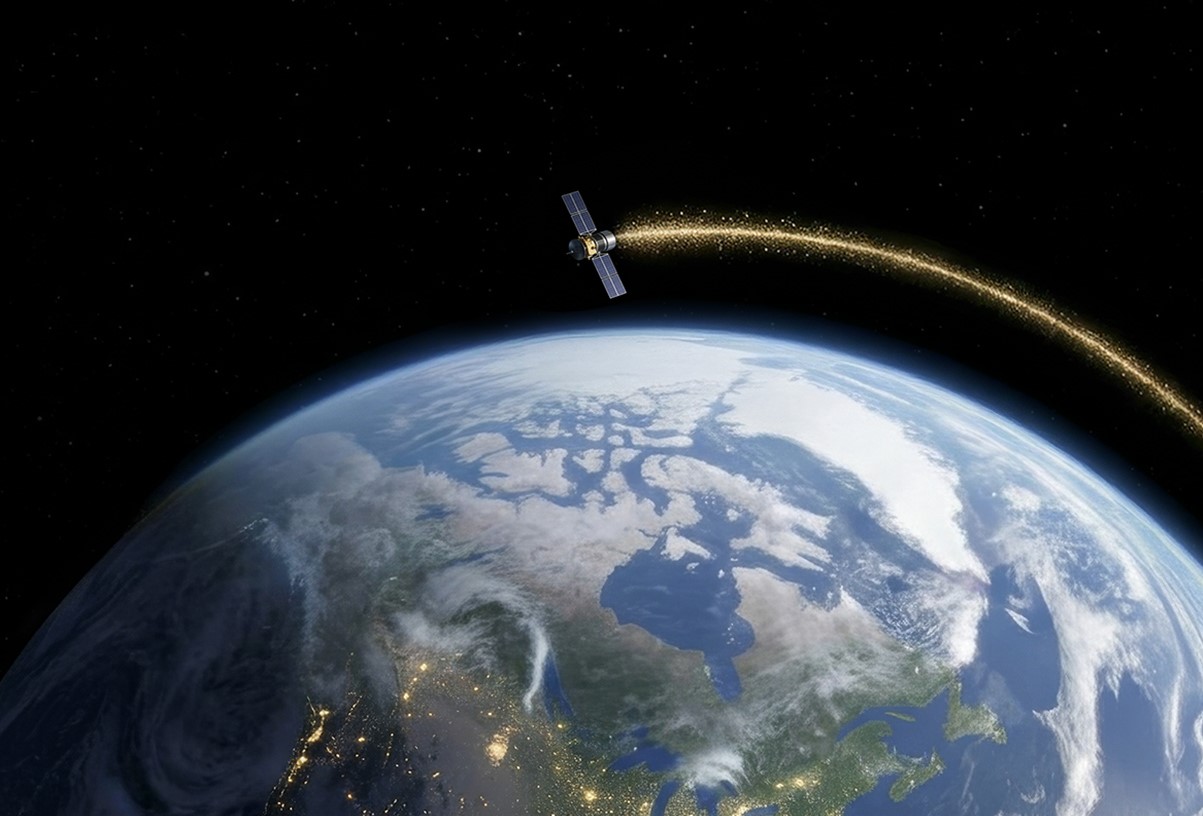
In the quiet, rain-soaked corner of the Pacific Northwest, a revolution is being assembled not with rivets and steel, but with silicon and starlight. Starcloud, a young and ambitious startup, has just announced a monumental leap forward in its quest to push the boundaries of artificial intelligence beyond the confines of our planet. The company has successfully raised a staggering $250 million in new funding, a financial war chest designed to fuel its audacious plan: to build a constellation of data centers in the sky, powered by the most advanced AI chips ever created. This isn’t science fiction; it’s a carefully orchestrated business move that signals a definitive shift in how we think about computing, data, and the very infrastructure of the digital age. The investment, a Series A extension led by the financial powerhouse Manhattan West, brings Starcloud’s total funding to $450 million, catapulting its valuation to a breathtaking $2.3 billion. This isn’t just a vote of confidence; it’s a declaration that the future of AI might very well be written in orbit.
The sheer weight of the investor list reads like a who’s who of the technology and investment world. Alongside the leadership of Manhattan West, the round saw participation from existing backers like Benchmark, EQT, Soma, NFX, and 776, who have clearly doubled down on their initial belief in the company’s vision. But the most electrifying addition to the cap table is Nvidia itself, the undisputed titan of the AI chip industry. Joining Nvidia are other strategic heavyweights like Cisco Investments, Cedar Capital, Goanna Capital, and Standard Capital. This isn’t merely a financial transaction; it’s a profound strategic partnership. By investing directly, Nvidia is not just a supplier but a co-conspirator in Starcloud’s mission. It’s a powerful signal to the entire industry that the concept of space-based AI processing is not a fringe idea but a viable, necessary, and inevitable evolution. The collaboration transforms Starcloud from a promising startup into a key player in Nvidia’s grand strategy to expand its computing empire beyond the terrestrial limits of power grids and cooling towers.
To truly grasp the significance of this moment, one must look back at the trailblazing steps Starcloud has already taken. In November 2025, the company achieved a world-first by flying Nvidia’s H100 GPU, the workhorse of the current AI boom, into orbit. This wasn’t just a publicity stunt. The team successfully used that chip in the harsh, radiation-filled environment of space to train a large language model called NanoGPT. This was a monumental milestone, a proof-of-concept that shattered the assumption that complex AI workloads could only be handled in pristine, climate-controlled data centers on Earth. It demonstrated that the vacuum of space, with its unique challenges, could be conquered to perform the most demanding computational tasks. This successful mission laid the groundwork for everything that follows, proving that the technology is not just theoretical but operational. It was the first small step on a journey that is now about to become a giant leap.
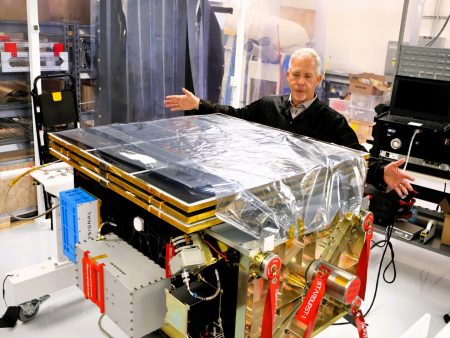
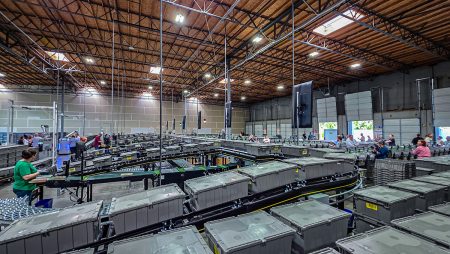
And what a leap it will be. Starcloud’s future satellites will be equipped with Nvidia’s next-generation marvel, the Space-1 Vera Rubin Module. The numbers are almost incomprehensible: this new module is expected to deliver a staggering 25 times the in-space compute capability of the H100 that flew on the first mission. This isn’t an incremental improvement; it’s a generational leap in processing power. Starcloud’s satellites will serve as the early flight platform for these space-rated chips, effectively becoming the testbed and launchpad for the most advanced AI hardware in existence. The company is already building the infrastructure to support this ambition, with a new 100,000-square-foot manufacturing facility in Woodinville, Washington, dedicated to producing its Starcloud-3 spacecraft. This is where the future is being assembled, where the hardware that will power the next era of AI is being built, piece by piece, under the watchful eyes of engineers and visionaries.
The new capital will be strategically deployed to accelerate this ambitious timeline. It will fund the continued buildout of that manufacturing capacity, allowing Starcloud to move from producing a handful of satellites to a full-scale production line. It will also fuel the deep engineering collaboration with Nvidia, ensuring that the Vera Rubin modules are perfectly integrated into the spacecraft and can withstand the rigors of spaceflight. Perhaps most critically, the funding will be used to procure future launch slots, securing the rockets needed to actually get these data centers into orbit. The company has already filed an application with the Federal Communications Commission to operate a staggering constellation of up to 88,000 satellites, a number that dwarfs the current total of active satellites. This is a clear statement of intent: Starcloud is not just dabbling in space; it is planning to build a massive, orbital computing network that could rival the scale of terrestrial cloud providers.
This push to move AI infrastructure into space is not happening in a vacuum. It is a direct response to a growing terrestrial crisis. The explosive growth of AI has created an insatiable demand for computing power, which in turn has created massive bottlenecks on Earth. Data centers are voracious consumers of land, energy, and water, and their proliferation is sparking political controversies and straining local resources. Communities are pushing back against the construction of new facilities, and power grids are struggling to keep up with the demand. Space offers a potential escape valve. In orbit, there is unlimited solar energy, no need for land, and no competition for water resources. By moving the most intensive AI workloads into space, Starcloud and its competitors, like SpaceX with its own Starmind project, are offering a solution to these earthly constraints. They are proposing a future where the most demanding computational tasks are handled in the ultimate high ground, leaving Earth to focus on the tasks that are best done here. The $250 million raised is more than just capital; it is a down payment on a future where the sky is no longer the limit, but the new frontier for human ingenuity.