


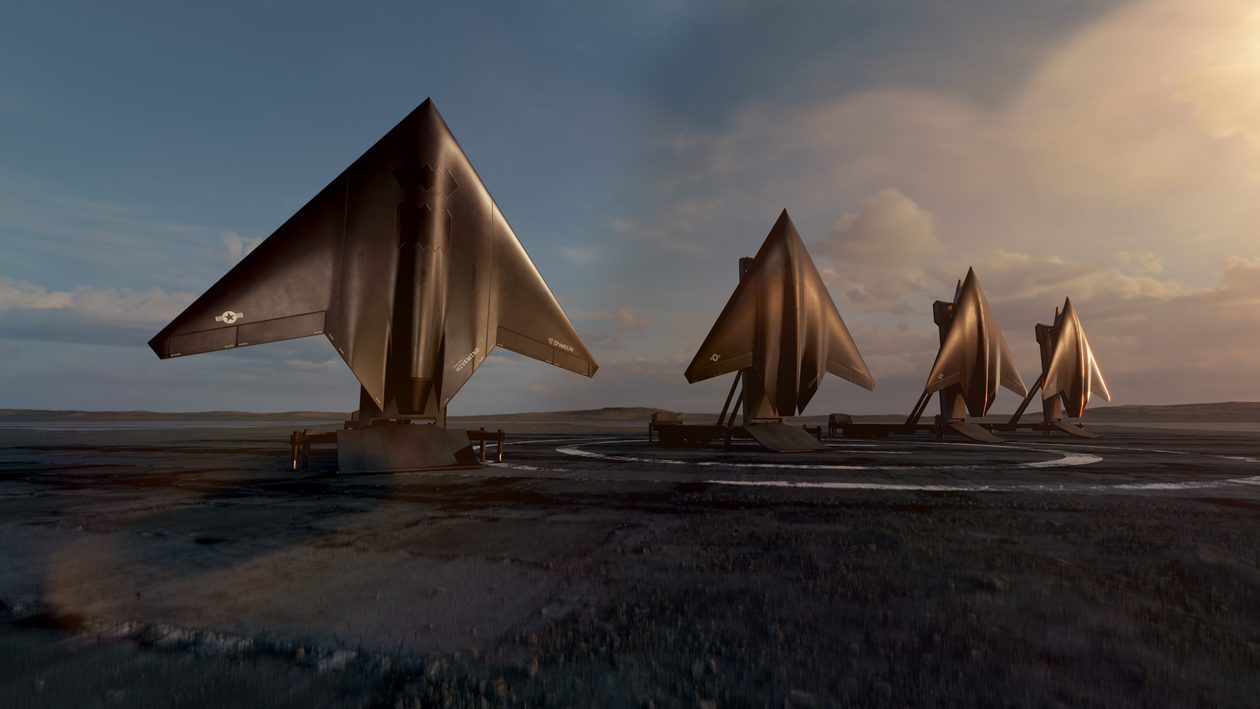
For most of the history of military aviation, the ability to project airpower has been inseparable from a handful of massive, fixed, and increasingly vulnerable pieces of infrastructure: long concrete runways, sprawling airbases, and aircraft carriers that can be tracked from orbit. A single well-placed missile or a coordinated drone strike against a runway can ground an entire air wing, and the logistics needed to sustain those bases makes them obvious targets in any modern conflict. Shield AI’s new X-BAT autonomous fighter jet is designed to shatter that old equation. It is a runway-independent fighter that no longer needs a paved strip at all, because it can take off and land vertically. Instead of relying on a billion-dollar carrier or an airfield in the rear area, the X-BAT can be launched from a mobile trailer, driven on highways, parked in remote outposts, or staged from the deck of an ordinary cargo ship. The company’s tagline, “Earth is our runway,” is not just a marketing slogan—it is a fundamental rethinking of how a combat aircraft could be deployed, dispersed, and hidden in an era of satellites, ballistic missiles, and long-range drones. The X-BAT is not science fiction; it is in advanced development, with ground engine tests already completed and production planned for the Seattle area in the near future.
What makes the X-BAT truly revolutionary is not just its vertical lift capability, but the fact that it carries no human pilot and does not even need a remote pilot to steer it from a ground station. The aircraft is operated by Shield AI’s Hivemind autonomy system, a suite of onboard algorithms that allows the X-BAT to navigate, make decisions, and execute complex strike missions on its own. In many modern theaters, GPS and satellite communications are expected to be jammed or degraded by adversaries, which can turn a traditional remotely piloted aircraft into a lost drone. Hivemind is designed to operate in exactly those conditions—using sensors, terrain mapping, and artificial intelligence to find its way, identify threats, and press an attack without any datalink to home base. This represents a profound shift in military aviation. A human pilot is an extraordinary asset, but is also limited by physical endurance, physiological stress, reaction time, and the need for years of training. The X-BAT never gets tired, never panics, and can be designed purely around performance and survivability rather than accommodating a human body in a cockpit. The role of the human shifts from pilot to mission commander: setting objectives, defining rules of engagement, and letting the AI execute the tactical details. That is not to say autonomy is an easy problem—it is perhaps the hardest problem in defense technology today—but Shield AI has spent years building and refining Hivemind across a variety of aircraft, and the X-BAT is its most ambitious application yet. The idea of an AI-piloted fighter is no longer theoretical; it is being engineered and tested for real.
The X-BAT may be autonomous and agile, but it also needs raw power, and that is where GE Aerospace comes into the story. This summer, Shield AI and GE Aerospace reached a major milestone: the integration and ground testing of the jet’s F110 thrust-vectoring nozzle. The F110 engine itself is a proven, battle-tested power plant that has been flying on fighter jets for decades, but pairing it with a thrust-vectoring nozzle is a significant step for the X-BAT, because thrust-vectoring provides the kind of low-speed control and maneuverability needed for vertical takeoff and landing without sacrificing the speed and altitude performance of a traditional fighter. Think of it like the heart of the aircraft, a powerful and reliable pulse, now connected to muscles that can direct that energy in any direction. The ground tests were a critical validation that the engine and airframe are compatible, that the enormous exhaust forces can be handled, and that the computer-controlled systems can modulate thrust to keep the aircraft stable during vertical flight. The X-BAT has not yet made its first flight, but these tests are the tense, exciting moment before the curtain goes up—the equivalent of a race team firing up a new engine in the garage, checking for leaks, listening for irregular vibrations, and watching the gauges settle into the right ranges. It is the difference between a concept on a screen and a machine that might actually fly. With the engine test complete, the path is clear for the first vertical flights, expected in 2026.
If you look at the X-BAT’s specifications, you begin to understand why defense analysts are paying attention. The aircraft is compact—just 26 feet in fuselage length with a 39-foot wingspan—which makes it significantly smaller than crewed fighters like the F-35. But it has a service ceiling greater than 50,000 feet, meaning it can operate at high altitudes where many air-defense systems struggle to reach. It is designed for an objective combat radius of about 1,000 nautical miles on an out-and-back mission, which is roughly double the F-35A’s combat radius of around 590 nautical miles. Total range is estimated at 2,000 nautical miles. That kind of reach, combined with vertical takeoff and landing, means the X-BAT can strike targets deep behind enemy lines without needing a large, vulnerable runway anywhere near the front. It also has an internal payload bay capable of carrying weapons in the 2,000-pound class, allowing it to drop joint direct attack munitions, glide bombs, or other precision-guided weapons. The internal bay is crucial: it keeps stores hidden from radar, preserving the aircraft’s low-observable qualities, and it also keeps the aircraft compact and clean on the outside. For a relatively small machine, it brings heavy, strategically important firepower. It is easy to imagine a squadron of these aircraft spread across dozens of hidden sites, taking off from a flat stretch of highway or a small clearing, each one carrying a bomb that once would have required a dedicated bomber sortie. The X-BAT is not intended to replace every fighter in the world’s air forces; it is designed to provide a new kind of flexible, autonomous strike capability that can be deployed almost anywhere at a moment’s notice.
The logistics and mobility story is just as important as the aircraft itself. Because the X-BAT can take off and land vertically, it does not need arrestor cables, catapults, or long pavement. Instead, it is road-transportable via a dedicated Launch and Recovery Vehicle—essentially a trailer that acts as both transporter and mobile launch pad. This means a single X-BAT can be moved by truck, hidden in a barn or under a bridge, and then be airborne in minutes. The entire concept of a forward airbase changes: instead of a large, obvious installation with control towers, fuel depots, and miles of concrete, you have a dispersed network of vehicles and small teams, constantly moving and nearly impossible to target. The X-BAT can also operate from naval vessels ranging from destroyers to LHA/LHD amphibious assault ships, as well as expeditionary bases without any permanent infrastructure. For the Navy and Marine Corps, that opens up the possibility of deploying autonomous strike aircraft from ships that currently cannot operate conventional fixed-wing aircraft, simply by clearing a patch of deck. On land, highways become runways; shipping containers become hangars; empty lots become launching pads. This is the essence of what Shield AI means when it says “Earth is our runway.” In a conflict where first-strike missile salvos target airfields and carrier positions, an enemy would find itself facing an air force that is not there—it is scattered across thousands of square miles, hidden in plain sight. That kind of distribution is difficult to defend against, because it attacks the central vulnerability of modern military aviation: the concentration of high-value assets in predictable places.
Looking ahead, the X-BAT’s path from prototype to production is ambitious and concrete. Shield AI has announced that first vertical flights are expected in 2026, with production set to begin in Des Moines, Washington, in mid-2027. The first production aircraft is projected to be built early in 2028 and to fly by that summer. From there, the U.S. Navy could begin using the X-BAT operationally by the end of 2029, and full-rate production is planned for the early 2030s, targeting around 150 aircraft per year. For the Pacific Northwest, this is an economic story as much as a military one: Shield AI’s decision to make the Seattle area the manufacturing home for the X-BAT is expected to add roughly 4,000 jobs to the region by the early 2030s. That means engineers, machinists, software developers, assembly workers, and support staff all building a revolutionary military aircraft in the same region that helped pioneer commercial aviation and remains a global center of aerospace innovation. The X-BAT program is not just another defense contract; it is a bet on a new way of thinking about conflict, autonomy, and industrial capacity. The aircraft itself is small, but its potential implications are enormous. It forces military planners to stop asking “Where is the runway?” and start asking “Where is the enemy?”—and then answering that question with a swarm of small, cheap, intelligent fighters that can appear from anywhere. It is still early days, and the stakes are high, but the moment is unmistakable: the era of the autonomous, runway-independent fighter jet is arriving, and it will not be a gradual evolution. It will be a leap, powered by software, thrust, and the simple idea that the ground beneath every aircraft can be a launching pad. The X-BAT is the beginning of that story, and its first vertical takeoff will mark the moment when a new kind of airpower finally lifts off the ground.