





There’s nothing about Anduril’s downtown Bellevue office that announces what happens inside. No sign hangs above the door, no name appears in the building directory, and the suite itself is easy to walk past without a second glance. That silence is deliberate. Behind those unmarked doors, engineers are building machines that are meant to be felt in the field, not noticed on a street corner. The company, based in Costa Mesa, California, has become one of the most valuable private defense contractors in the world, closing a $5 billion funding round at a $61 billion valuation earlier this year and reportedly aiming for $100 billion. But in the Pacific Northwest, it’s still operating like a quiet operation, even as it grows fast. Step inside and the ordinary office veneer falls away: across desks, conference tables, and small lab spaces sit autonomous drones ranging in size from a microwave to a ping-pong table, next-generation digital night-vision goggles, and military-grade edge computers designed to help soldiers process an overwhelming amount of data in the middle of combat. The company has been quietly building a massive engineering footprint in the greater Seattle area, with modern offices in Bellevue and downtown Seattle, plus a multi-acre military testing facility near Carnation, Washington, about 20 miles east of the city. It’s a strange and somewhat striking contrast: a defense powerhouse operating in the heart of the region best known for cloud computing and consumer software, but deliberately keeping a low profile while doing some of the most ambitious work of its kind.
That ambition is being driven in large part by Tom Keane, a former Microsoft cloud executive who now serves as Anduril’s senior vice president and leads the company’s connected warfare division. Keane moved to Anduril about four years ago after interviewing with dozens of companies, and he says what won him over was the chance to work alongside “world-class teams in every discipline.” Since then, local operations have grown from about 30 people to 560, and the pace isn’t slowing. “I could absolutely see a world where we get to 1,000 people here in terms of engineers,” Keane said during a recent tour of the Bellevue facility. When asked how soon that could happen, he smiled and replied, “It’s sort of almost as fast as you can hire people,” adding that two years was a realistic timeline. Anduril currently has more than 110 open positions in Washington state, and a newly leased third floor in downtown Seattle is set to come online, signaling that the expansion is only accelerating. The play is clearly a game for talent. The Seattle region has long been dominated by Microsoft, Amazon, Google, and Meta, but Anduril is recruiting aggressively from those companies, pitching engineers who want to move fast, build physical hardware, and see their work used in real military operations. Keane points out that from a conference room overlooking downtown Bellevue, you can literally look out the windows and see the companies where potential hires already work. “For a lot of software engineers, this is incredibly applied,” he said. Anduril’s culture, however, isn’t for everyone. The company gained attention last year with an edgy recruiting campaign titled “Don’t Work at Anduril,” and rather than plush perks or remote flexibility, it emphasizes what Keane calls “grit” — a willingness to own hard problems, work in the office, and test products in the mud and rain alongside soldiers. That culture has also drawn protests; activist groups have staged demonstrations outside Anduril’s Seattle offices over its autonomous weapons work. Keane shrugs off the criticism, noting that protests happen at nearly every company. More important, he says, the critics don’t seem to be affecting hiring.
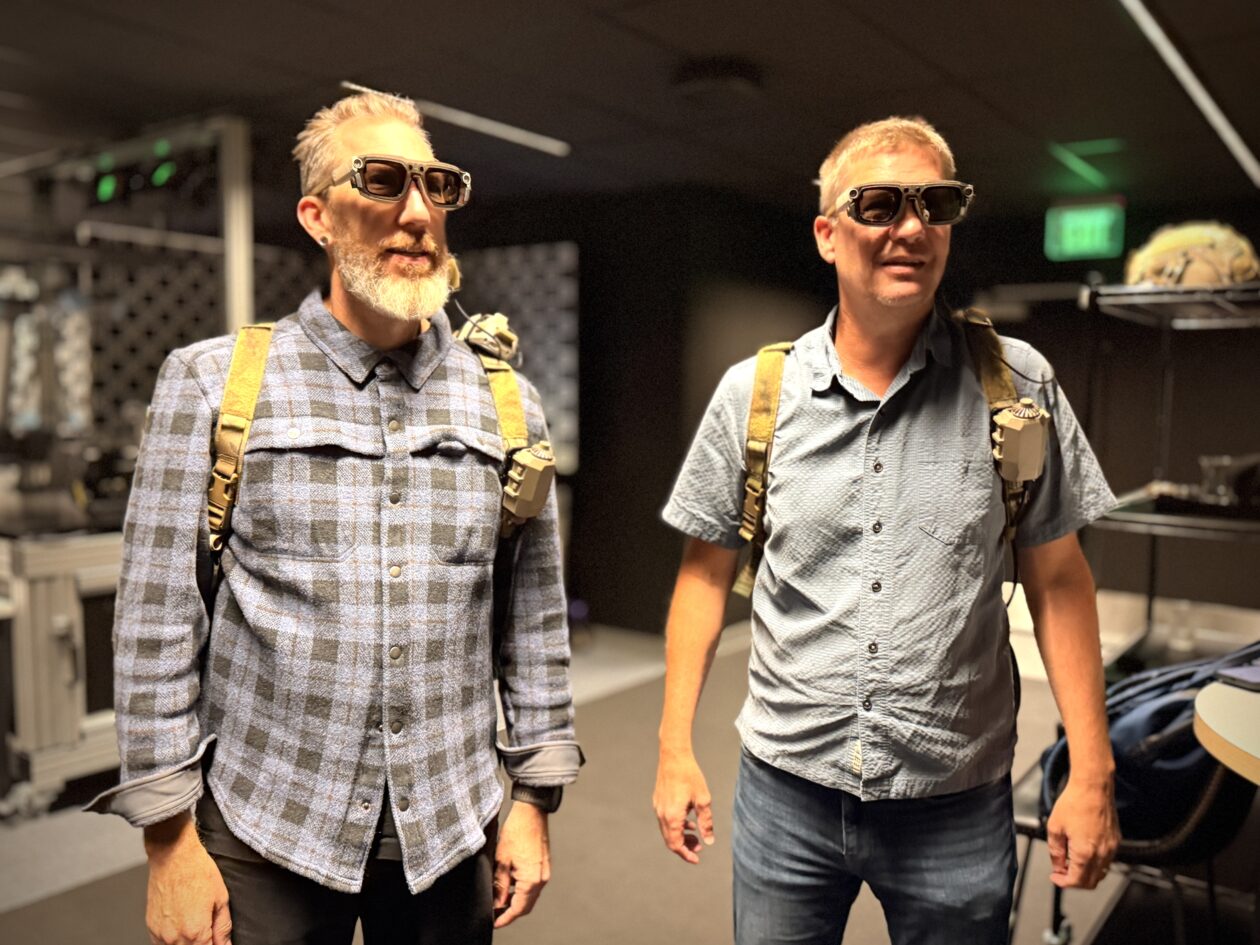
The character of Anduril’s work becomes clearest not in a boardroom, but in its testing spaces. In rural Carnation, the company operates a range with a built-out “shoot house” designed for low-light tactical exercises, giving engineers a place to iterate on code and hardware in difficult, realistic conditions. Soldiers from the Army’s 75th Ranger Regiment, based at nearby Joint Base Lewis-McChord, have recently spent time at the range testing Anduril’s EagleEye mixed-reality system on firing courses and obstacle challenges. At the Bellevue lab, principal design director Chad Pfarr guided a demonstration of that same system, which is designed to replace the heavy, fragile stacks of glass, electronics, and cables soldiers have traditionally worn on their helmets. EagleEye condenses all of that into a 115-gram pair of augmented reality glasses — about four ounces — built with help from Meta, Canon, Qualcomm, and Oakley. During the demo, the user wears a lightweight camouflage backpack connected to the glasses and a small handheld controller. Three operational scenarios, all powered by Anduril’s core Lattice software, play out in the lenses. In the first, a tactical heads-up display projects friendly force markers, compass headings, and mini-maps directly into the user’s field of view, so soldiers don’t have to look down at a screen while moving. In the second, external AI sensors — a tower camera, an overhead drone — send real-time alerts about incoming aerial threats, which appear as highlighted warnings inside the glasses. In the third, the user takes command of autonomous technology, sending a virtual Ghost drone to a location, pulling up its live video feed, and executing a simulated strike. Every action is controlled by clicking a small button on the device attached to the backpack, and the whole experience feels less like a futuristic video game than a practical tool designed to save lives by giving soldiers better awareness without overloading them.
The tour also offered a glimpse of Anduril’s upcoming digital night vision system, which is perhaps even more striking than EagleEye. Traditional analog goggles give soldiers a narrow, tunnel-like view, often described as looking through a toilet paper roll. Anduril’s VR-style digital displays open that up to an 84-degree field of view, more than double the roughly 40 degrees found in today’s devices. Using machine learning models, the system fuses thermal imaging and low-light camera feeds in real time, making heat signatures seem to leap out of pitch-black scenes. It’s a serious technical challenge, not just because of the optics but because every pixel has to land exactly where it should in the digital display, or users can end up dizzy or disoriented. Anduril’s engineers use custom robotic arms to run geometric calibration on each lens distortion map before the device leaves the facility, a process they politely asked not to be photographed. The system isn’t fielded yet, but it’s expected to be part of the Soldier Borne Mission Command prototype delivery to the U.S. Army next year. Anduril’s ambitions extend well beyond things soldiers wear on their heads. The company also develops autonomous aircraft, low-cost cruise missiles, and counter-drone interceptors, and its maritime division continues to build a large subsea fleet, from modular survey vehicles to the extra-large, school-bus-sized Dive-XL. That maritime work recently took a hit: Anduril vacated the former Foss Maritime shipyard space in Seattle after the Navy canceled the autonomous warship program the company had been pursuing there. But the larger maritime strategy remains intact, and the company appears committed to expanding in the region even as it pivots away from that specific project.
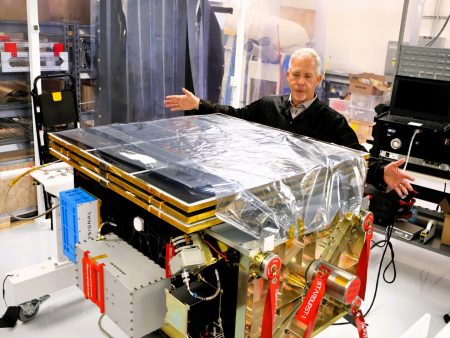
What truly humanizes Anduril, though, is the stories of the people building these systems. Drew Swanson, a lead architect at the company, spent 13 years in the military, working in communications and supporting special operations units in the field. He now helps develop a technology called Squad-A, which allows squad leaders to automatically select the best network connections and stitch together incoming intelligence feeds from multiple sources. Swanson says the appeal of Anduril is the opportunity to escape the corporate bureaucracy he sees elsewhere and work on high-stakes, physical problems. When he talks to colleagues in the Seattle tech scene, he hears a common refrain: “I want to come over there because you guys are going after really hard problems.” That sentiment carries over into how the company thinks about hardware design. Toward the end of the tour, Keane held up a prototype that looked almost like a piece of body armor. In fact, it was a body plate that integrated a soldier’s ballistic protection, battery, and edge computing device into a single unit. “Batteries are such a huge thing,” Keane said, pointing out that soldiers have historically had to carry three separate heavy items. “If you put the three of them together, you can start to get rid of stuff. You take what was historically three separate heavy things and turn it into one software-enabled platform.” It’s a small example, but it captures the broader approach Anduril takes to nearly every problem: don’t just improve an existing piece of equipment, rethink the fundamental design and how all the parts fit together.
For the Seattle area, Anduril’s rise represents a notable shift in the region’s identity as a technology hub. For decades, the local economy has been built on software, cloud services, and consumer platforms, with a culture that often prizes comfort, flexibility, and ethical positioning. Anduril feels different. It’s in-office, hardware-heavy, and unapologetically tied to the military. It moves at a speed that traditional defense contractors can’t match, and it has found a willing workforce in a region where many engineers are looking for more than another app or dashboard. The unmarked office in Bellevue, full of drones and night-vision goggles, is a reminder that technology isn’t just for scrolling or shopping; it’s also being shaped into tools meant to protect people in harm’s way. That raises complicated questions, of course, and the protests outside Anduril’s downtown Seattle office show that not everyone is comfortable with the company’s direction. But for the engineers inside, the mission is clear. They are building systems that they hope will keep U.S. and allied soldiers safer, better informed, and more effective in an unpredictable world. Keane’s vision of 1,000 local engineers in the next two years may seem bold, but given the company’s trajectory, it feels attainable. And as that growth unfolds, Seattle will increasingly become not just a center for Big Tech, but a proving ground for the next generation of defense technology — built quietly, tested in the rain, and carried into the field by those who need it most.