


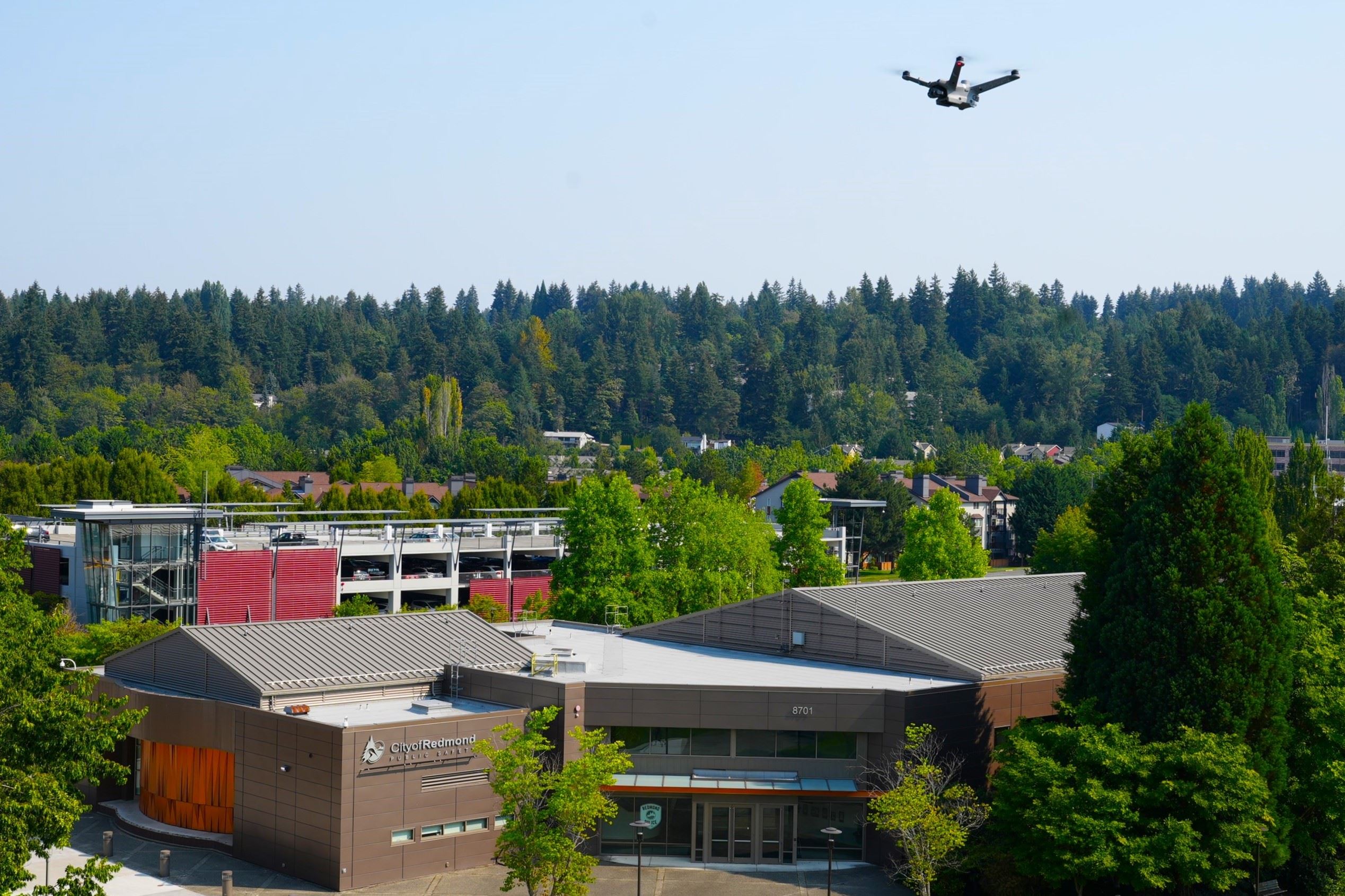
In an era dominated by instantaneous digital media, our social feeds have become flooded with chaotic, real-time recordings of retail theft. We watch, fascinated yet uneasy, as shoplifters boldly walk out of department stores with armfuls of designer clothes or basic necessities, easily brushing past helpless store employees, bewildered shoppers, and sluggish security systems to escape into the busy city streets without a trace. While these viral videos are typically characterized by a sense of lawless frustration and sudden, unresolved vanishing acts, a recent retail incident in Redmond, Washington, demonstrated a dramatic departure from the norm, introducing an unexpected aerial actor into the equation of local crime prevention. On a Monday morning on June 22, 2026, at approximately 11:50 a.m., what started as a routine emergency call from a local Target department store quickly escalated into a high-tech pursuit that looked more like science fiction than standard suburban law enforcement operations. A store employee reported a male suspect actively removing security tags from merchandise and concealing the items within a stolen backpack. For many police departments struggling to cope with acute staffing shortages, such a standard, lower-priority shoplifting call might have taken hours of waiting before a physical officer could be dispatched to take a formal, retrospective report. In Redmond, however, the response was virtually instantaneous, initiated not by a squad car navigating heavy midday traffic, but by a silent, high-tech eye in the sky. Within seconds of the dispatch call being logged by the 911 operator, the Redmond Police Department deployed its sophisticated Drone as First Responder (DFR) system. This mechanical sentinel was airborne and hovering over the Target parking lot long before ground officers could even turn on their sirens, signaling a fundamental transformation in how local municipalities monitor, react to, and deter property crimes within their communities.
The dramatic subsequent pursuit, captured from a bird’s-eye perspective and later shared by the police department on social media, reveals a fascinating operational choreography between human operators and advanced aerial robotics. As the male suspect dashed through the exit doors of the Target, completely unaware of the artificial intelligence tracking his ascent into the bright afternoon sun, he sprinted desperately across an expansive maze of asphalt parking lots, frantically trying to put distance between himself and the store he had just pilfered. High above the urban canopy, completely out of the suspect’s normal line of sight, the agile quadcopter pivoted effortlessly to track his frantic scramble, executing a steady, smooth orbit that kept the fleeing figure perfectly centered in its high-definition optical frame. Rather than losing the suspect in the complex layout of the suburban commercial district, a remote drone pilot, safely stationed in a high-tech flight dispatch control room miles away, calmly analyzed the live aerial feed and relayed the fleeing man’s exact geographical coordinates, physical heading, and changing body language directly to responding officers. The suspect desperately sought refuge in a nearby hotel courtyard, only to realize he was still exposed, prompting him to run toward a neighboring municipal park-and-ride facility where he boarded a stationary public transit bus in a final, frantic attempt to blend in with the commuting populace and make a clean getaway. However, the eye in the sky never lost track of him, remaining parked directly overhead and recording the entire unfolding sequence; when ground officers finally arrived, equipped with real-time intelligence on his exact location, the drone operator guided them straight to the bus. The video smoothly transitions to ground-level police body-camera footage as coordinated officers calmly boarded the public transit vehicle, identified the suspect without incident, and safely placed him under arrest, recovering approximately $330 in stolen retail goods.
At the heart of this incredibly swift, fluid, and successful arrest is the visionary leadership of Redmond Police Chief Darrell Lowe, who has consistently championed the integration of cutting-edge technology into daily civic security operations. In an era where police recruitment is at an all-time low and traditional departments are forced to do far more with significantly fewer human resources, the Redmond Police Department—which maintains a relatively modest force of about 85 active officers—views advanced technological toolkits not as a luxury, but as an absolute structural necessity. Chief Lowe has spent his tenure actively advocating for the strategic deployment of modern solutions, previously speaking with leading tech publications like GeekWire about the immensely practical benefits of utilizing everything from autonomous flight platforms to complex artificial intelligence algorithms. Rather than relying on static, outdated policing tactics, the department utilizes two incredibly specialized, full-time drone pilots who operate in a centralized flight command center, commanding autonomous drone fleets built by premier Seattle-based aerospace innovators Brinc and Skydio. These robotic systems are far more than glorified remote-control toys; they are deeply integrated into the department’s primary computer-aided dispatch system, allowing them to instantly self-launch from physical docking stations scattered strategically throughout the city, reaching active emergency scenes in less than two minutes from the moment a call is received. This rapid response completely redefines the concept of localized safety, helping to bridge the critical gap between emergency notification and physical police arrival with a neutral, highly precise, and completely objective witness that can de-escalate situations simply by monitoring them from a distance.
The sophisticated operational flexibility enjoyed by the Redmond Police Department today was not built overnight, but is instead the result of years of meticulous preparation, regulatory compliance, and pioneering administrative efforts in Washington state. The agency first began incorporating basic drone flights into its overall policing operations in 2019, initially using the tools for forensic crime scene mapping, search and rescue missions, and localized accident reconstruction. Recognizing the immense potential for broader public safety applications, the department worked rigorously to meet the incredibly strict safety guidelines of the Federal Aviation Administration (FAA) to expand their operational envelope. This intensive testing and diligent regulatory coordination culminated in a historic milestone in November 2024, when the FAA officially granted the Redmond Police Department a rare and highly coveted authorization to operate its drones without the typical requirement of an on-the-scene human visual observer. By allowing flights Beyond Visual Line of Sight (BVLOS), the FAA essentially unlocked the true potential of Redmond’s automated drone system, permitting a single pilot sitting miles away in a climate-controlled command center to dispatch and fly drones across the entire city layout. This momentous regulatory breakthrough made Redmond the very first law enforcement agency in the state of Washington to obtain such an advanced operational status, establishing a critical, highly watched legal and operational precedent for other municipal police forces across the Pacific Northwest and the wider United States looking to implement similar remote patrol structures.
This high-tech chase is far from an isolated or obscure event in Redmond; rather, it is part of a deliberate and highly transparent effort by the police department to make their technology visible, demystified, and directly accountable to the public they serve. The agency has repeatedly capitalized on the viral nature of modern social media, sharing intensely engaging, educational videos of their drone-led operations—such as a previous, widely viewed chase where multiple coordinated drones were deployed by a single remote pilot to track a reckless driver weaving through city streets—to visually demonstrate the immense utility of their aerial assets. Underneath this public relations approach lies a deeply rooted commitment to civic transparency, ensuring the community feels secure, respected, and fully informed rather than constantly surveilled by an invasive, unseen authority. To achieve this delicate balance, Redmond maintains a highly detailed, publicly accessible web dashboard that displays real-time, comprehensive data from their active Drone as First Responder program, tracking metrics like response times, overall call volumes, and the number of suspects who were successfully located through aerial support. According to the public database, Redmond’s DFR program has responded to 1,360 emergency calls so far in 2026, with shoplifting calls representing 82 of those incidents, demonstrating how a technology once reserved exclusively for high-stakes tactical operations has become a highly practical, everyday tool for resolving commonplace municipal crime.
Ultimately, the Redmond Police Department’s pioneering use of the Drone as First Responder program represents a profound, highly influential turning point in the broader conversation surrounding the evolution of modern municipal public safety, automation, and community trust. By taking a simple, potentially volatile misdemeanor like shoplifting and resolving it calmly, quickly, and without a dangerous physical confrontation on the streets, the technology proves that modern law enforcement can be both highly efficient and deeply empathetic. The seamless integration of autonomous robotics, real-time data tracking, and visual transparency allows Redmond to protect its local businesses and citizens while mitigating the inherent physical risks that ground officers face when responding blindly to unpredictable situations. As other municipalities across the nation look to Redmond as a shining beacon of functional, ethical tech-led modern policing, the program serves as a powerful reminder that the ultimate goal of implementing cutting-edge technology is not to replace the human element of public service, but to deeply empower it. Through the balanced, deliberate combination of robotic precision and human oversight, Redmond is actively crafting a safer, more transparent, and remarkably connected urban environment, proving that the future of public safety lies not in heavy-handed enforcement, but in the intelligent, visible, and highly accountable use of the sky above.