


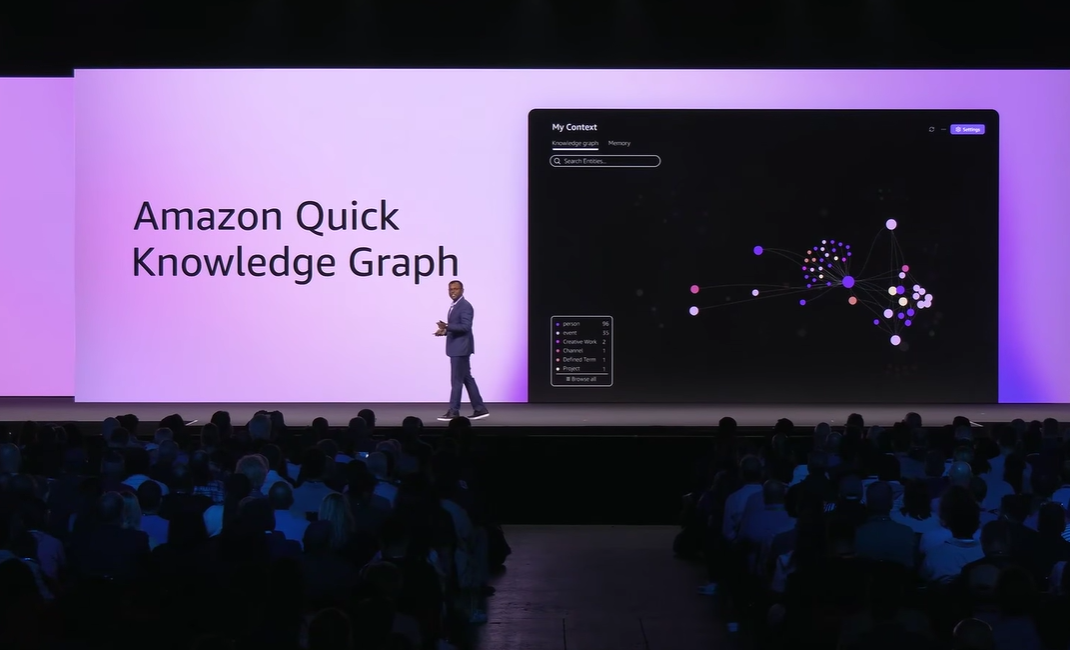
At the bustling AWS Summit in New York, Swami Sivasubramanian, the Vice President of Agentic AI at Amazon Web Services, walked onto the stage to unveil a vision of the future that feels both thrilling and deeply reassuring. Pointing to a complex diagram of the Amazon Quick knowledge graph on the screen behind him, he introduced a suite of highly advanced, autonomous AI agents designed to seamlessly handle the exhausting background noise of modern operations. These agents represent a profound evolution in technology, moving far beyond the simple, reactive text boxes that dominated the early days of generative AI. Instead of waiting around for a user to type a specific prompt, these new tools are designed to work quietly in the background, proactively identifying security threats, sorting through messy digital workspaces, and cleaning up legacy computer code. Yet, as AWS launches this bold technological leap, they are emphasizing a deeply human-centric design philosophy. In an industry currently swept up in a fierce race to release increasingly autonomous systems—with tech giants like Microsoft, Google, OpenAI, and Anthropic competing for dominance—Amazon is making a distinct promise: these agents are built to maximize everyday productivity, but they will always keep human judgment in the driver’s seat, ensuring that machines remain helpful partners rather than unsupervised decision-makers.
To make this technology accessible to everyone, AWS has fundamentally transformed Amazon Quick from a standard corporate assistant into an intuitive platform where ordinary employees can design their own customized digital helpers using everyday, conversational English. Imagine a busy marketing manager or a sales representative who is tired of losing track of loose ends; they can now simply tell Amazon Quick to create a background agent that monitors stalled business transactions or alerts them the moment a critical regulatory rule changes. To ease the mental exhaustion of managing modern communication, Amazon has introduced a beautifully redesigned, centralized activity feed within Quick. This feed serves as a quiet harbor in the storm of daily notifications, automatically sorting chaotic emails, urgent chat messages, and crowded calendar schedules into a single, gracefully prioritized view. Furthermore, this assistant no longer operates in isolation; it now features deep, seamless integrations with widely used industry tools such as Figma, Adobe, Snowflake, and WhatsApp. By weaving these disconnected services together into a single, unified cognitive map, an employee can ask a single, highly complex question and watch as Amazon Quick effortlessly coordinates across multiple platforms to deliver a comprehensive, accurate answer.
Behind the scenes of software development, where technical professionals are increasingly overwhelmed by the rapid pace of modern technology, AWS is deploying its coding assistant, Kiro, to tackle the relentless grind of maintenance. Deepak Singh, the AWS Vice President who guides the Kiro team, pointed out a fascinating and stress-inducing paradox of the modern AI era: as artificial intelligence makes it faster and easier to write fresh code, it inadvertently buries human developers under an overwhelming mountain of secondary chores. Workers are now spent reviewing, testing, patching, and maintaining a constant onslaught of new software, leading to widespread burnout. To solve this problem, Kiro’s new specialized developers-in-the-background will take over the exhausting grunt work of evaluating newly written code, testing for bugs before anything goes live, and meticulously cleaning up outdated legacy systems. Highlighting this shift toward flexibility, AWS has launched a brand-new iPhone application for Kiro, allowing developers to kick off massive automated code runs, monitor system health, and oversee complex migrations from their phones while standing in line for coffee or commuting. Crucially, the system is designed so that the AI can never push code directly into production on its own; the final, decisive action to merge or launch software remains entirely in human hands.
To help larger enterprises build and customize these intelligent systems at scale, AWS has introduced major upgrades to AgentCore, its dedicated platform for building customized AI tools, alongside a revolutionary new service called AWS Context. For any autonomous agent to perform effectively within a business, it needs to understand the deep, unique history and operational logic of that specific enterprise. AWS Context addresses this challenge by functioning as an elegant organizational library, gathering and structuring vast oceans of messy, internal company data so that AI agents can actually reason over it with human-like comprehension. Rather than simply pulling up random search results, an agent powered by AWS Context can connect the dots between an old client contract, a recent engineering report, and a current balance sheet, understanding the subtle relationships between these pieces of information. This infrastructure transforms raw company data into a living, breathing internal resource, allowing businesses to create highly tailored digital assistants that understand the precise cultural, operational, and financial nuances of their specific organization.
The absolute necessity for this advanced, human-supervised technology is most apparent in the high-stakes world of cybersecurity, where AWS has unveiled a highly sophisticated new security guardian called AWS Continuum. The launch of this autonomous security agent comes at a time of escalating digital tension, as highly advanced AI systems—most notably Anthropic’s Claude Mythos model—possess the unprecedented ability to discover delicate software vulnerabilities and rapidly chain them together into devastating attacks far faster than any team of human engineers could hope to defend against. This rapid evolution of offensive AI has sparked intense national conversation, especially following reports that Amazon itself raised serious alarms with federal officials regarding the national security risks of Anthropic’s most advanced models, leading to a temporary government halt on their newest releases. In this hostile environment, AWS Continuum is designed to act as a tireless, round-the-clock digital sentry. The agent begins its work by meticulously analyzing code lines, identifying potential flaws, testing whether those flaws are actually vulnerable to real-world exploitation, and then generating a precise fix complete with an upfront estimate of how the repair might impact other parts of the network.
While the capability of these automated defense systems is astonishing, AWS has engineered a strict, brilliant protocol to maintain human trust and safety through a specialized “learn mode” within the AWS Continuum platform. When first deployed, the security agent is completely restricted from making actual changes on its own; it operates as a quiet apprentice, watching how human engineers work and presenting its proposed security fixes for manual approval. Only over time, as human security teams gain deep confidence in the AI’s accuracy and behavior, can they gradually grant the agent the authority to automatically apply patches and push them through the deployment pipeline, category by category. Neha Rungta, the AWS Director of Applied Science who spearheaded the development of Continuum, explained that this cautious, collaborative approach is vital to raising the defensive bar against modern cybercriminals who use AI to combine minor, low-severity flaws into catastrophic system breaches. Ultimately, this new wave of agentic AI from AWS is not about replacing the human workforce, but about building a reliable digital shield and a helpful companion—allowing people to step away from repetitive fire-fighting and exhausting digital chores so they can focus their energy on creativity, strategic thinking, and building a better future.