



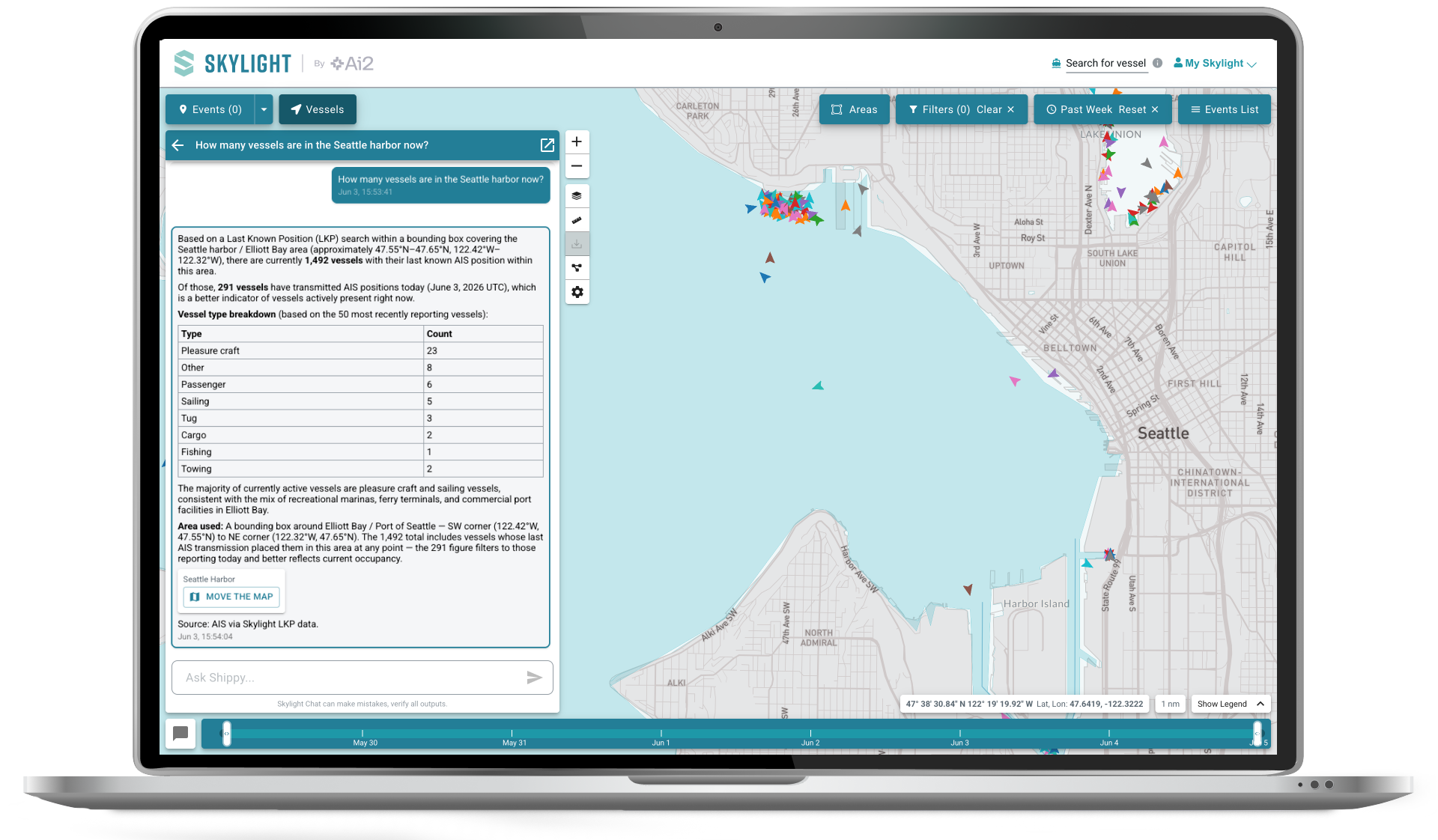
For centuries, the world’s oceans have represented a vast, untamable frontier—an expansive wilderness covering over seventy percent of our planet where enforceability fades and monitoring becomes nearly impossible. In these deep waters, bad actors have long exploited the horizon, engaging in illicit activities ranging from piracy and human trafficking to devastating ecological plunder, sheltered by the sheer scale of the sea. However, Seattle’s Allen Institute for AI (Ai2) is systematically shrinking this lawless expanse by introducing “Shippy,” an innovative artificial intelligence agent integrated into their open-access maritime tracking platform, Skylight. Shippy acts as a sophisticated, multilingual translator for the oceans, transforming billions of points of raw, intimidating satellite telemetry and transponder signals into straightforward, plain-language conversations. Rather than forcing overextended analysts to spend hours decoding complex spreadsheets and raw geospatial datasets, Shippy allows users to simply ask, “What suspicious vessels are currently operating near Seattle’s harbor?” or “Which ships have recently turned off their tracking transponders in this marine protected area?” Almost instantly, the AI provides a comprehensive visual and textual breakdown of the situation, pairing live interactive maps with clear, synthesized explanations. This breakthrough shifts the paradigm of maritime defense from reactive post-mortem investigation to real-time, proactive stewardship, helping the world’s most vulnerable shorelines defend themselves against the invisible threats hiding on the high seas.
The lineage of this remarkable technology is deeply rooted in the late Microsoft co-founder Paul Allen’s visionary philanthropy and his lifelong commitment to oceanic conservation. Long before artificial intelligence became a ubiquitous buzzword, Allen recognized that protecting our oceans required a harmonious marriage of cutting-edge data science and boots-on-the-ground environmental activism. Skylight began its journey under the umbrella of Vulcan Inc., a holding company created by Allen to manage his diverse business and philanthropic endeavors. Following his passing, the project transitioned smoothly in 2021 to the nonprofit research institute he founded—the Allen Institute for AI (Ai2). This transition allowed the Skylight platform to benefit from some of the brightest minds in machine learning and computer vision. Over the years, the software engineers at Ai2 have dedicated themselves to cataloging the subtle, behavioral signatures of illegal maritime exploitation. By combining free public satellite data with high-resolution commercial imagery and real-time Automatic Identification System (AIS) tracking feeds, they built a highly responsive digital tapestry. The release of Shippy represents the realization of Paul Allen’s ultimate dream: democratizing advanced technology so anyone, regardless of their resources or technical expertise, can act as an effective guardian of our global commons.
To understand the profound human stakes of Shippy’s mission, one must look at the devastating, real-world impact of Illegal, Unreported, and Unregulated (IUU) fishing, a shadow industry that drains billions of dollars from the global economy every year. Far from being a victimless crime, IUU fishing directly threatens the food security and economic survival of coastal communities, particularly in developing nations that rely on artisanal fisheries to feed their families and sustain their local economies. When industrial-sized, predatory commercial vessels illegally systematically strip these waters of marine life, local fishermen are left with empty nets and collapsing ecosystems. To avoid detection, these illicit vessels often engage in “going dark”—deliberately turning off their mandatory AIS transponders to mask their locations—or conducting clandestine “transshipments,” where they meet other vessels in the dead of night to transfer illegally caught fish. Shippy is specifically trained to identify these exact behavioral deviations. By continuously scanning massive datasets for sudden anomalies, such as a ship vanishing from tracking maps or two vessels lingering suspiciously close to each other at sea, Shippy instantly alerts maritime authorities. The AI does not just flag these anomalies in isolation; it explains why the behavior is suspicious, linking every conclusion back to verifiable historical records so analysts can immediately cross-reference the data and confidently deploy scarce patrol resources.
The democratization of this technology is perhaps its most revolutionary aspect, embodying a strong commitment to global equity and transparency. While wealthy superpowers can afford proprietary satellite constellations and armies of defense analysts to monitor their exclusive economic zones, small island nations and regional fisheries bodies are often left completely blind to the exploitation occurring right off their shores. To bridge this digital divide, Skylight and the Shippy AI agent are offered entirely free of charge to governments, regional fisheries management organizations, and qualifying non-profit groups worldwide. Currently utilized by over 300 organizations across more than 70 nations, this open ecosystem actively levels the playing field against highly organized maritime exploiters. Furthermore, in an industry dominated by proprietary, black-box algorithms, Ai2 has made the bold decision to open-source the computer-vision models powering Skylight. This radical transparency ensures that researchers and conservationists worldwide can inspect, improve, and adapt the underlying technology to their own localized needs. By sharing these advanced tools openly, Skylight empowers regional authorities to claim digital sovereignty over their own territorial waters, turning local ocean advocates into powerful, high-tech defenders of their native marine habitats.
Despite the immense power of Shippy, its creators at Ai2 have designed the system with precise, ethical guardrails to ensure it remains a safe and trusted tool for conservation rather than a weapon of geopolitical escalation. Mindful of the risks associated with AI errors and algorithmic bias, the development team has programmed Shippy to firmly resist speculative answers, choosing instead to halt and state its limitations whenever a user’s query outstrips the available data. Unlike typical generative AI models that can confidently produce “hallucinations” or false realities, Shippy meticulously documents its analytical trail, ensuring that every answer is fully auditable and reproducible. Furthermore, the tool operates under strict behavioral boundaries: it handles only peaceful, maritime-focused questions, completely declines military or defense-related requests, and refuses to issue legal judgments regarding whether a ship has officially broken the law. Shippy focuses entirely on presenting clear, verifiable facts, leaving any tactical decisions—such as whether to dispatch a physical patrol boat or issue a legal citation—firmly in the hands of the human operators. This design philosophy emphasizes that artificial intelligence should never replace human empathy, judgment, and legal accountability, but should instead serve as an incredibly clear-sighted ocular assistant to those tasked with protecting our natural world.
Beyond its immediate impact on ocean conservation, the launch of Shippy signals a pivotal strategic shift for the Allen Institute for AI. Founded during an era when the primary benchmark of AI research was building massive, general-purpose models, Ai2 is now charting a distinct, highly practical course aimed at solving concrete, existential crises. As tech giants like Microsoft, Google, and OpenAI invest billions in a relentless computational arms race, Ai2 has deliberately chosen to step off that expensive treadmill. This evolution recently culminated in the departure of former CEO Ali Farhadi and several key researchers, who transitioned to Microsoft as the Ai2 board refined its mission to emphasize applied, mission-driven AI rather than theoretical model-building. Shippy stands as a shining proof of concept for this new direction, illustrating how specialized, small-scale AI agents can deliver profound real-world benefits when applied to specific domains like ecology and environmental justice. By shifting their focus from competing in abstract digital arenas to addressing tangible planetary crises, the researchers at Ai2 are proving that the true value of artificial intelligence lies not in its size or conversational flair, but in its ability to protect the delicate, real-world systems that sustain life on Earth.