


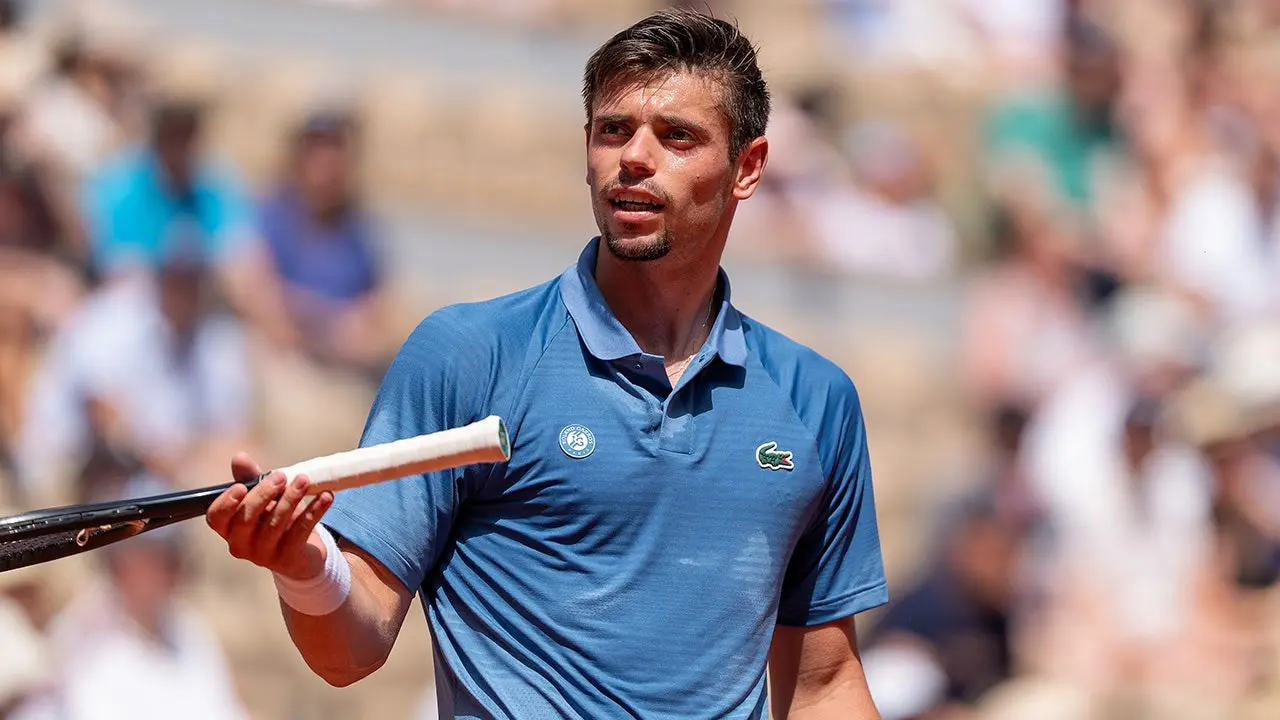
For a young French tennis player like Arthur Gea, receiving a wild-card entry into the main draw of Roland Garros is the realization of a lifelong dream, a golden ticket to walk among the giants of the sport on the red clay of Paris. The atmosphere at the French Open is legendary for its intense passion, demanding crowd, and the historic weight of the matches played under the shifting Parisian sky. Stepping onto Court Suzanne-Lenglen to face the formidable, experienced Russian powerhouse Karen Khachanov in the very first round was already a monumental task for the young Frenchman, requiring every ounce of his focus, physical conditioning, and mental fortitude. In the opening moments of the match, as Gea adjusted to the blinding lights, the roar of the home crowd, and the blistering pace of his opponent’s groundstrokes, he was not just fighting for a spot in the second round; he was fighting to prove he belonged on this grand stage. However, as the first set progressed and Khachanov began to carve out a 4-2 lead, an entirely different, incredibly cruel battle began to rage within Gea’s own body. The immense psychological pressure of the moment collided with a sudden, devastating physical affliction that no amount of intense athletic training could have prepared him for. Instead of worrying about his service placement or his opponent’s heavy topspin, Gea found himself locked in a desperate struggle against his own biology, feeling a wave of acute physical distress that threatened to strip away his composure, his athletic performance, and his dignity on live international television. The dream of a lifetime was rapidly unraveling, not because of a tactical error on the clay, but because of a quiet, agonizing internal crisis that was about to burst into the public view in the most humbling way possible.
The physical demands of professional tennis are notoriously brutal, requiring players to push their bodies to the absolute limit for hours on end, but the sport’s rigid regulatory framework often overlooks the unpredictable, basic realities of human physiology. Under the Grand Slam rulebook, bathroom breaks are strictly regulated, typically permitted only during set breaks to maintain the flow of play and prevent strategic disruptions. While these laws are designed to stop players from using gamesmanship to break their opponent’s momentum, they leave very little margin for genuine medical emergencies that strike without warning. As Gea stood on the clay, trailing in the first set, his stomach began to churn with a violent intensity that made it physically impossible for him to execute his movements. The fluid, explosive footwork required to slide on clay and chase down Khachanov’s powerful shots evaporated, replaced by a rigid, agonizing posture of pure survival. In that moment of sheer desperation, the traditional decorum of the sport crumbled as Gea approached the chair umpire, pleading for an emergency reprieve from the unyielding rules. The stark contrast between the pristine, hushed environment of a Grand Slam tennis match and the raw, biological urgency of Gea’s situation highlighted a profound tension in professional sports: the expectation that athletes must perform like flawless, indestructible machines, even when their human bodies are desperately failing them. The rules of the tournament, designed to maintain order, suddenly felt like an oppressive barrier to a young man dealing with an excruciating, deeply personal health crisis in front of thousands of spectators. Gea was trapped in a nightmare where the boundaries of professional protocol and basic human necessity collided head-on, forcing him to choose between obedience to the sport’s rules and the preservation of his own bodily integrity.
Faced with the imminent threat of a highly public catastrophe, Gea threw aside all notions of polite vocabulary and spoke with a raw, unfiltered honesty that stunned the court. “I need to go to the bathroom. I can’t move anymore. I’m going to s— on the f—ing court,” he desperately implored the chair umpire. This visceral plea, born of sheer panic and physical agony, immediately cut through the usual polite cadence of tennis dialogues. The sheer vulnerability of having to declare such an intimate and embarrassing ailment—diarrhea brought on by sudden, severe stomach problems—to the umpire, tournament officials, and eventually the entire world, is a fate few would wish on their worst enemies. As a pair of tournament officials arrived on Court Suzanne-Lenglen to assess the situation and inquire about the legitimate “medical reason” for the requested timeout, Gea had to defend his compromised physical state, supported by a trainer who confirmed the acute nature of his gastrointestinal distress. There is a deep, agonizing loneliness in suffering a highly embarrassing medical emergency under the intense, magnifying lens of international media. Every camera angle, every spectator’s gaze, and every whisper in the crowd became a source of compounding psychological pressure, transforming a standard first-round match into a grueling exercise in public humiliation and physical suffering. For Gea, the pristine red clay of Roland Garros had ceased to be a field of dreams, transforming instead into a high-stakes amphitheater where his most private, vulnerable struggle was laid bare for the public to witness. This moment revealed the profound psychological burden of elite athletics, where a player’s most vulnerable physical moments are broadcast globally, leaving no room for privacy or quiet recovery. The arrival of the medical staff and officials on the court, rather than providing immediate comfort, only served to prolong the agonizing delay, forcing Gea to repeatedly justify his basic human needs while his body screamed for immediate relief.
Despite his desperate and graphic pleas, the immediate bureaucracy of the tournament held sway, and Gea’s request was initially denied, forcing him to play the very next point in a state of sheer agony. It is difficult to overstate the immense physical and mental willpower required to play a high-level tennis point against a top player when one’s own body is actively rebelling, yet Gea went through the motions, driven by a lingering sense of duty to the game. However, the moment that point concluded, the human instinct for self-preservation and basic dignity overrode any commitment to tennis protocol or fear of official penalties. Recognizing that his body could no longer tolerate the delay, Gea made a swift, decisive exit from the court, fleeing toward the locker room in search of a restroom. This sudden departure, though technically a breach of standard timing rules, was a profound assertion of human dignity over institutional rigidity. By walking off the court, Gea reminded everyone watching that athletes are not merely characters in a televised drama, but flesh-and-blood human beings subject to the same sudden illnesses and vulnerabilities as anyone else. Back in the locker room, away from the prying eyes of the cameras and the murmuring crowd, Gea was finally allowed a moment of absolute privacy to attend to his illness, receive urgent stomach medication to calm the painful spasms, and collect his shattered thoughts. This courageous act of walking away, despite the potential threat of fines, point penalties, or public ridicule, demonstrated that there are moments in life where playing by the rules becomes secondary to protecting one’s personal wellness and self-respect. In the quiet sanctuary of the locker room, Gea was finally able to escape the suffocating heat of the spotlight and address his medical needs with the gravity they deserved, far removed from the cold calculus of tournament points and match schedules.
When Gea finally emerged from the tunnel to return to Court Suzanne-Lenglen, he did so with the quiet determination of a competitor who refused to let illness completely define his Roland Garros experience. Equipped with medicine to settle his stomach and having cleared the immediate physical crisis, he stepped back onto the red clay to resume his battle against Karen Khachanov. However, the physical toll of such a severe stomach ailment is not easily managed by quick medication, especially when facing an opponent of Khachanov’s caliber. The loss of fluids, the sheer physical exhaustion of cramping and spasms, and the emotional depletion from the high-stakes drama on court left Gea physically compromised, stripped of the explosive power and stamina needed to compete at the highest level. Despite a brave and spirited effort to claw his way back into the match, the Frenchman was unable to overcome the immense deficit, ultimately falling to the steady tennis of the Russian pro in straight sets. It was a heartbreaking end to his tournament journey, a stark reminder of how quickly a promising athletic opportunity can be derailed by forces entirely beyond a player’s control. Gea’s early exit from the tournament was a painful sporting defeat, but the true story of his match lay not in the final scoreline, but in the immense bravery it took to return to the court at all after suffering such a public and distressing ordeal. His willingness to walk back out in front of the crowd, pick up his racket, and continue to fight for every point showcased a deep reservoir of resilience and athletic pride that transcended simple wins and losses on a statistics sheet. Even in the face of inevitable defeat, Gea demonstrated a quiet heroism, choosing to face his opponent and the spectators with his head held high, proving that his spirit remained unbroken even if his physical body had temporarily faltered under the intense strain of the day.
In the aftermath of the match, Gea reflected openly on the sudden onset of his illness, explaining that he had felt completely healthy the night before, only to be struck down by the debilitating stomach problems on the morning of his match. This unpredictable timeline reminds us of the delicate, fragile nature of our health and how easily our grandest plans can be disrupted by the sudden whims of biology. The global sports community’s reaction to Gea’s ordeal highlights a growing need for greater empathy, understanding, and modernized rules when it comes to the health and well-being of professional athletes. Rather than viewing players as superhuman gladiators who must suffer silently for the sake of public entertainment, we should celebrate their vulnerability and advocate for institutional changes that protect their dignity in moments of extreme physical distress. Arthur Gea’s sudden exit from the court at Roland Garros was certainly an unconventional and startling moment in tennis history, but it serves as a powerful, deeply humanizing story about the limits of human endurance and the vital importance of compassion in sports. Ultimately, the young Frenchman’s ordeal reminds us that beneath the sponsorships, the high-speed serves, and the glory of Grand Slam stages, tennis players are simply human beings—fragile, mortal, and deserving of grace and dignity when their physical boundaries are reached. As the sporting world continues to evolve, stories like Gea’s serve as critical touchstones, prompting important conversations about how athletic governing bodies can better accommodate the unpredictable nature of human health. By choosing to speak honestly about his illness rather than hiding behind vague excuses, Gea helped dismantle the stigma surrounding common, embarrassing medical issues, showing that true strength lies not in pretending to be invulnerable, but in facing our human limitations with honesty, courage, and self-respect.