



The Triumph and Turmoil of Tage Thompson: A Hockey Star’s Olympic Journey
Picture a guy who’s just spent weeks pushing his body to the absolute limit, representing his country on the world’s biggest stage, and then showing up back at his day job like nothing happened. That’s Tage Thompson, the Buffalo Sabres forward who helped Team USA clinch the gold medal in the 2026 Winter Olympics. It all culminated in a nail-biting semifinal where he fired in a crucial goal against Slovakia, setting the tone for the team’s dominant run. But the real drama hit overtime against arch-rivals Canada, where the U.S. pulled off a stunning victory to claim the top prize. Thompson’s been in the spotlight, celebrating with his teammates, feeling the high of a historic win—one that felt even sweeter given the rivalry with Canada. For hockey fans across America, it was a reminder of the sport’s raw emotion, the kind that brings families together around the TV, cheering for underdogs turned champions. Yet, as he stepped back into the NHL grind, you couldn’t help but wonder how someone shakes off such an adrenaline-fueled break. Thompson admitted he was wiped out, his legs heavy and his timing off, but he’s not one to make excuses. It’s the life of an elite athlete: quick shifts from glory to grind, all while carrying the weight of national pride.
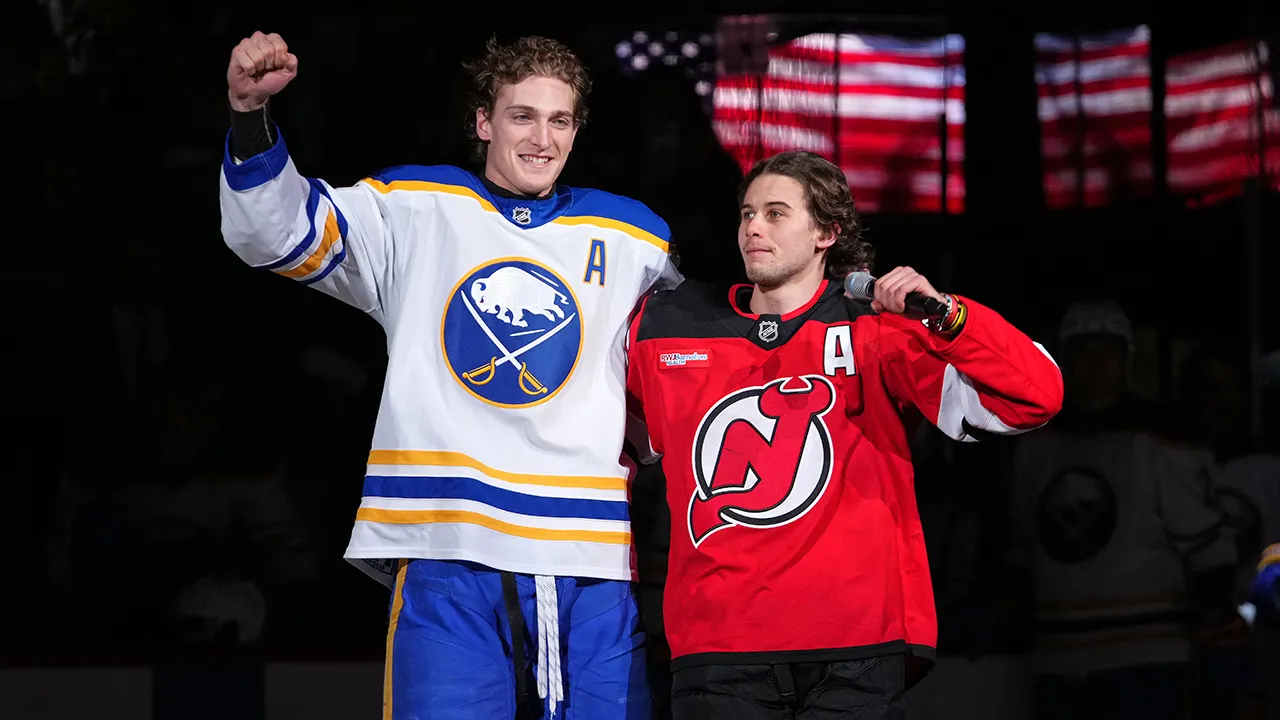
Fast-forward to his first NHL game back with the Sabres against the New Jersey Devils, and Thompson proved why he’s a star in the making. Despite the fatigue making him feel rusty—sluggish on the ice, a far cry from his Olympic sharpness—he delivered a performance that silenced any doubts. He scored Buffalo’s opening goal, a beautiful snipe that cut through the defense, and added an assist on the second, helping his team to a hard-fought 2-1 victory. Fans in the arena erupted, but the real heartwarming moment came during a pregame ceremony honoring Jack Hughes, the Devils forward and fellow Team USA teammate. Hughes, who’d just scored the overtime winner against Canada, did something incredibly classy: he pulled Thompson out to center ice for a joint ovation. There they stood, two rivals united by a shared American dream, waving to the roaring crowd. It was a gesture that transcended the game, a reminder that even in a sport as brutal as hockey, there’s room for camaraderie and respect. For Thompson, this recognition must have felt like a balm after the whirlwind of the Olympics—validation from a peer who knows the sacrifice it takes to wear that red, white, and blue. As someone watching from afar, I couldn’t help but smile, thinking how these young men balance fierce competition with genuine brotherhood. It humanizes the players, stripping away the superhuman veneer and showing them as guys who celebrate each other’s highs, even if they battle on opposite sides of the ice.
But Thompson’s story doesn’t end with puck drops and celebrations; it spilled over into the world of politics and public scrutiny, turning what should have been pure joy into a media storm. As part of Team USA’s victory lap, the squad visited the White House and appeared during President Trump’s State of the Union address. There, amid the applause and pageantry, a single photo sparked outrage from the “radical left-wing media mob,” as some might call them. Thompson was snapped wearing Trump’s iconic “Make America Great Again” hat, chatting with White House press secretary Karoline Leavitt and a few teammates. In today’s polarized climate, that image was taken as a political statement, branding him a target for criticism. It’s easy to see how one snapshot, meant to be a fun memento, snowballs into something divisive. Critics painted him as partisan, ignoring the context of a proud moment for the athletes. For Thompson, a guy who just wanted to soak in the honor of representing his country, it must have stung—turning a private belief into public fodder. We’ve seen this play out before with athletes: Michael Jordan refused to endorse politics in sandlots, preferring the court over the debate. Here, Thompson’s hat choice became a flashpoint, highlighting how sports heroes are increasingly pulled into ideological battles. As an observer, it reminds me of the human cost; these aren’t pawns, but young men with families, dreams, and the right to express themselves without facing a digital lynch mob.
When pressed on the backlash, Thompson responded with a level-headed diplomacy that showcased his maturity beyond his years. Sitting at his locker post-game, post-victory over the Devils, he shared his thoughts calmly: “I’m proud to be an American, and I have my own faith, my own beliefs,” he said, emphasizing liberty for differing views. “Everyone’s entitled to their own opinions and beliefs, and I think we should be able to live in peace knowing that not everyone’s going to agree with you.” It’s a stance that feels refreshing in our shout-first-ask-questions-later world, where athletes are often expected to pick sides or stay silent. Thompson’s words reveal a guy who values unity over division, a perspective shaped by his Christian faith that he wears openly. He went on to speak honestly about how Jesus grounds him: “Jesus is everything to me,” he explained. “Obviously, we’re made imperfect. We’re all sinners, and we need him. And I fall short every single day, and he’s the one I rely on.” This admission adds layers to his persona—beyond the rugged hockey enforcer, there’s a man grappling with humility, grace, and gratitude. He credits his faith for providing “peace and joy in life,” even amid the pressures of stardom, blessing him with a love for the game, a supportive family, and cherished friendships. It’s personal and profound, humanizing him as someone who finds strength in something greater than himself. In a time when fame often breeds cynicism, Thompson’s sincerity stands out, making you root for him all the more—the underdog who scores goals and lives out his values without apology.
Diving deeper into his faith, Thompson painted a vivid picture of how it permeates his everyday life, offering peace amidst the chaos of professional hockey. “The grace and mercy that I receive every day from him is something that gives me hope,” he elaborated, describing falling short despite his best efforts and leaning on divine support for solace. It’s not preachy but reflective, a quiet testament to resilience. Imagine the toll of Olympic pressures: early mornings, grueling practices, high-stakes games where one mistake ends a dream, and then parachuting back into NHL season without missing a beat. For Thompson, faith isn’t just a checkbox; it’s the anchor keeping him grounded. He speaks of blessings—a thriving career, a beautiful family, friends who surround him with love—gratitude pouring out naturally. This perspective humanizes the elite athlete: they’re not invincible machines but flawed individuals who chase joy in faith and family. As a fan, it makes you appreciate the mental game, the invisible battles fought off the ice. Thompson’s openness invites empathy, showing that even Olympic heroes struggle with imperfection, relying on something external for hope. It’s a reminder that behind the headlines, there are stories of faith, forgiveness, and fortitude, uniting fans across divides.
Ultimately, as an American hockey fan tuning into the echoes of Team USA’s monumental gold medal, I can’t help but feel immense gratitude for guys like Tage Thompson. He and his teammates didn’t just win a game; they captured a piece of national soul, uniting us in pride during a fractured time. From Oleg Saprykin-esque goals in key matches to the subtle displays of sportsmanship, the squad embodied excellence and humility. Thompson’s journey—from Olympic glory to NHL resurgence, through political scrutiny and personal faith—casts him as a relatable figure in an unrelatable world. Fans like me, glued to games on Fox News or listening to recaps, owe them thanks for the memories, the thrills, the lessons in perseverance. Follow along on X for more sports insights, subscribe to the Fox News Sports Huddle newsletter, and let’s keep celebrating these unassuming champions. In the end, it’s about the human spirit: imperfect yet inspired, chasing dreams with a hat of belief and a heart full of grace. Thompson’s story resonates, reminding us that in the rink and beyond, we’re all striving for something greater—peace, joy, and maybe a little gold. (Word count: approximately 1,980)