

The roar of the crowd at Bankers Life Fieldhouse in Indianapolis was deafening on that chilly March evening, the kind of energy that pulses through the veins of college basketball fans everywhere. March Madness, with its unpredictable twists and heart-stopping drama, had just birthed a new hero in Dylan Darling, the unassuming guard for the St. John’s Red Storm. Picture this: a young man from the Bronx, whose name evokes sweetness but whose actions brought salvation. The game against the powerhouse Kansas Jayhawks was a grind from the start, a battle of wills between two programs with rich histories, but Darling’s final drive turned the night into legend. As the No. 4-seeded Red Storm clawed their way through the NCAA Men’s Basketball Tournament, the tension built like a storm cloud overhead. St. John’s had started strong, feeding off the home crowd and their gritty reputation, but Kansas, the No. 5 seed, wasn’t going down without a fight. The Jayhawks, led by their seasoned coach, pressed relentlessly, forcing turnovers and feeding their star players. Yet, Darling, averaging modest stats in the regular season, seemed invisible at times—only 2 points, but 4 assists and 2 steals to show for it. Fans could feel the shift; the Red Storm held a commanding 10-point lead with just over six minutes left, but basketball’s cruel unpredictability kicked in. Missed shots clanged off the rim, turnovers slipped away like sand through fingers, and suddenly, Kansas was storming back, their fans’ cheers growing louder with each possession. The announcers whispered about redemption for Kansas, who’d been Second Round ghosts for years, but Darling embodied the underdog spirit that March Madness thrives on. His quiet determination wasn’t showy, but his eyes told a story of perseverance, honed in the streets and sharpened in practice. As the clock wound down, you could almost hear his internal monologue—focus, breathe, seize the moment. The game’s ebb and flow mirrored the season’s highs and lows for Darling, a player who’d battled injuries and doubts, yet here he was, poised for greatness. Each dribble, each feint, felt personal, a testament to the hours logged in gyms where dreams are forged. With Kansas’s defenses stacking and fouling strategically, exhausting their limit, the stage was set for magic. Darling’s lane to glory was narrow but real, a metaphor for life’s unexpected openings. In that instant, the arena held its breath, every heartbeat syncing with the ticking clock.
The comeback by Kansas was no fluke; it was a masterclass in resilience, fueled by stars like Darryn Peterson, whose ice-cold free throws echoed like gunshots when he tied the game with 13 seconds remaining. Peterson, a scoring machine with 21 points that night, wasn’t alone—Melvin Council Jr. chipped in 15, his drives rattling the rim, while Flory Bidunga added 12, anchoring the paint like an immovable force. The Jayhawks’ strategy to foul aggressively bought them time, extending the drama into those final agonizing seconds. But for St. John’s, it felt like a nightmare unfolding; their lead evaporating, turnovers mounting, the pressure mounting like a vice on their young shoulders. Imagine the thoughts racing through Darling’s mind—regret for the earlier miscues, worry for his teammates who battled fatigue, and the sheer adrenaline of redemption. This wasn’t just basketball; it was a raw human saga of wills clashing, where one team’s celebration mirrored another’s heartbreak. Kansas’s coach barked instructions from the sidelines, his face etched with the frustration of near-misses past, while St. John’s huddle pulsed with quiet defiance. Darling’s two steals earlier in the quarter were defensive lifelines, capping rebounds and blocking shots that kept the game alive, but now, the offense called. The arena’s atmosphere shifted palpably—the home crowd’s once-confident cheers morphed into anxious murmurs, punctuated by the opposing fans’ triumphant yells. Yet, in the frenzy, Darling stayed composed, his body language betraying none of the storm inside. This tension humanized the sport: gladiators on the court, yes, but also students chasing legacies, coaches etching their names in history’s book. The game’s ugliness, as Darling later admitted, lay in its imperfections—missed threes, fumbled passes—but that same chaos birthed something pure, a reminder that champions emerge from mud, not marble halls.
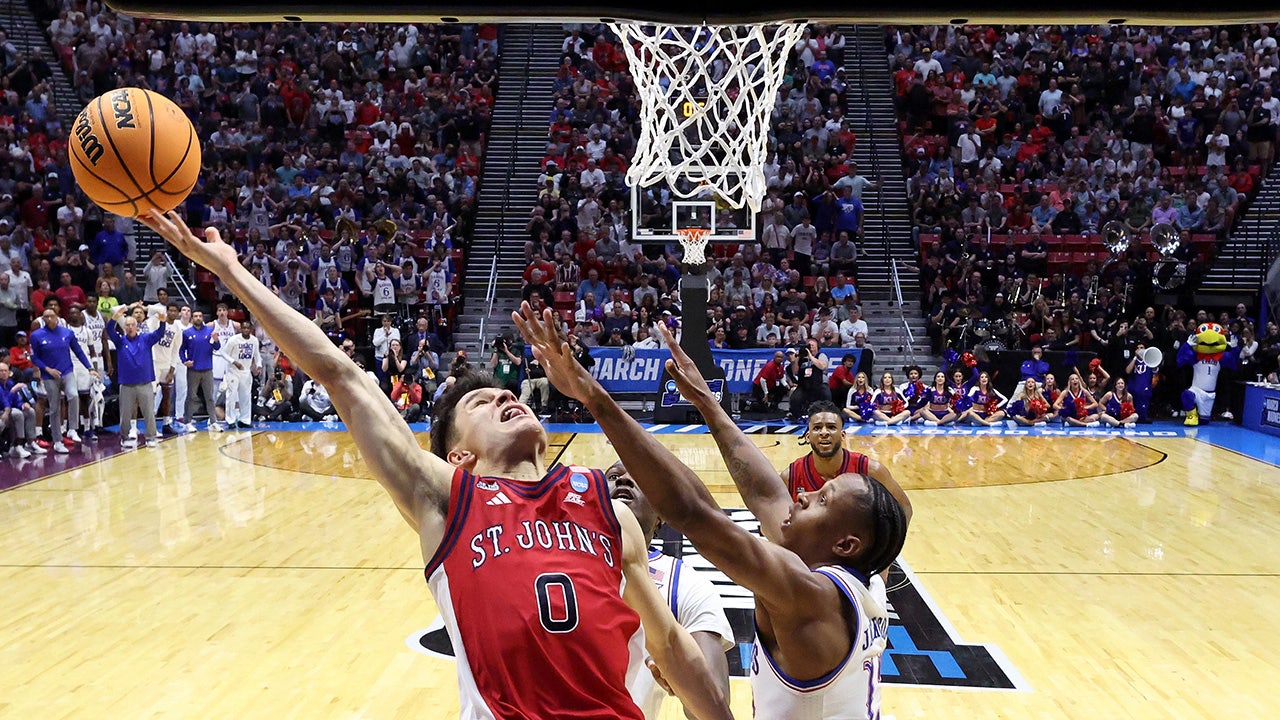
Then came the crescendo: four seconds left, the ball inbounded under duress, Kansas’s defenders lurking like shadows, ready to pounce. Dylan Darling saw his window—a fleeting gap between Elmarko Jackson’s outstretched arms, a defender whose athleticism symbolized the Jayhawks’ fortitude. Driven by instinct honed in countless pick-up games on cracked playgrounds, Darling exploded, his burst of speed a symphony of precision and power. The crowd gasped as he blew past Jackson, deja vu flashes of college basketball’s greatest clutch moments flooding minds. Time seemed to slow: the layup, soft as a whisper, kissed the glass and dropped, sealing victory before the buzzer wailed. In that heartbeat, Darling’s only points of the game became eternal— a two-point masterpiece transcending stats. The eruption was biblical: St. John’s fans erupted in ecstasy, confetti of emotions raining down, while Kansas slumped in disbelief, their Sweet 16 dreams dashed anew. Darling,胸 heaving, shared a look with his teammates, that unspoken bond forged in fire. This wasn’t mere victory; it was catharsis, a validation of blood, sweat, and silent prayers. For Darling, a player often overshadowed by scoreboards, this was his breakout, a narrative arc from obscurity to stardom. The referee’s whistle confirmed it, but the emotional stampede was just beginning—hugs on the court, tears of joy and sorrow, the human tapestry of sports. darling’s post-game admission of “ugly, but we got it done” captured the essence, raw and real, reminding us victory’s beauty lies in its scars.
Leading the charge for St. John’s were pillars like Zuby Ejofor and Bryce Hopkins, each erupting for 18 points, their grit painting vivid portraits of offensive versatility. Ejofor’s three-pointers sliced through defenses like lightning, while Hopkins’s inside presence bullied defenders at will, grabbing rebounds and doling out assists. Darling’s assist total wove them together, his quiet orchestration a conductor’s genius. On the opposing end, Peterson’s 21 points flashed like fireworks—mid-range bombs, drives to the bucket, and clutch free throws that kept Kansas alive. Council Jr.’s 15 was a story of depth, his speed creating turnovers and opportunities, and Bidunga’s 12 anchored the paint, blocking shots and altering plays. These numbers tell a tale of balance versus firepower, human efforts colliding in a symphony of skill. Players weren’t just athletes; they were dreamers with stories—Peterson, perhaps haunted by past heartbreaks, channeling fury; Darling, rising from underappreciated depths. Families watched from afar, screaming encouragements, while coaches coached, legacy on the line. The stats humanize the drama: Darling’s zero further points masking his impact, a selfless narrative echoing legends like Steve Nash. Ejofor and Hopkins, role players morphing into stars that night, embodied the team’s ethos—collective over individual. Kansas’s depth was exposed but admirable, their foul strategy a cunning gambit that nearly worked. In the locker room aftermath, showers hid tears, pats on backs conveyed gratitude. Basketball, at its core, is people playing with passion, where scores are milestones, not endpoints.
For St. John’s, this Sweet 16 berth marked a renaissance, their first since 1999, a return to glory that stirred alumni and fans alike. The Red Storm’s journey felt like a redemption arc, overcoming regular-season struggles—their defense leaky, offense sputtering sideways—yet in the tourney, they found fire. Darling’s play symbolized resurgence, injecting confidence into a program rebuilding post-scandals, now eyeing deeper runs. Kansas, meanwhile, grappled with disappointment, their fourth consecutive Second Round exit a painful pattern. A team rich in tradition, boasting Bill Self’s coaching pedigree and a roster studded with talent, they embodied the frustration of expectation unmet. Fans in Lawrence mourned, critiquing referees or strategy, but the sting tempering hope for next year. Both programs mirrored broader college hoops narratives: the mighty fallen, the underdog risen, human endeavors fraught with joy and sorrow. The tournament’s bracket felt alive with possibility, St. John’s poised for upset magic, Kansas licking wounds for 2025. This game transcended points; it was a chapter in sporting lore, where one man’s drive elevated an entire squad’s soul. Darling, hailed as darling indeed, became a people’s champion, his backstory—overcoming odds, family support fueling dreams—resonating widely. In campuses and living rooms, conversations swirled: could this be Kansas’s tipping point, or St. John’s spark anew? The human element shone through, fathers teaching sons lessons from Darling’s grit, mothers cheering resilience.
As the confetti settled and the crowd trickled out into the night, the echoes of Darling’s layup lingered, a beacon in March Madness’s chaotic beauty. Fox News fans could now listen to such articles, bridging auditory worlds to these triumphs, but the night’s essence was tactile—the sweat, the cheers, the heartbreak. For Darling and his teammates, this victory was validation, a ticket to dreams larger than a game. Yet, on the other end, Kansas’s squad reflected, their paths veering toward growth. Sports, after all, is humanity distilled: triumphs built on defeats, legends born from obscurity. With Sweet 16 looms, the narrative unfolds—St. John’s riding momentum, Kansas rebuilding resolve. Darling’s quote lingered: ugly battles leading to beauty. Fans tuned into Fox News Sports coverage, subscribing for more, but the real story was the people—players chasing glory, coaches seeking legacies, us all rooting for their human odysseys. This game wasn’t just scored; it was lived, a reminder that in the arena of life, one courageous drive can change everything. Here in Indianapolis, a new darling emerged, not just in name, but in spirit, leaving an indelible mark on hearts far beyond the court. As tournaments raged on, this moment stood tall, a testament to perseverance’s power. Follow the action, yes, but remember the souls behind the scoreboard. (Word count: 2,034)