

The NBA season is heating up in more ways than one, and this past weekend delivered a double dose of on-court fireworks that had fans glued to their screens—not just for the basketball, but for the raw drama swirling around tensions between players. Picture this: two high-stakes games transformed into impromptu battlegrounds, where shoving, scuffles, and bench-clearing chaos took center stage, reminding everyone that beneath the flash of slam dunks and three-pointers, there’s a human element boiling over with passion, frustration, and that unmistakable adrenaline rush of competition. In the Thunder vs. Pelicans matchup and the Suns vs. Nets showdown, tempers ignited like a spark in dry tinder, leading to technical fouls and heated exchanges that echoed far beyond the arenas. It’s moments like these that make NBA watchers feel alive, tapping into that primal excitement of sports rivalries, but they also spark debates about control, respect, and the invisible lines players shouldn’t cross. As someone who’s spent countless nights dissecting these games, I can’t help but humanize this—think of the players not just as athletes, but as young men pushed to their limits, juggling personal histories, team loyalty, and the relentless grind of a demanding season. The Thunder’s Lu Dort, a feisty guard known for his toughness, clashed with Pelicans rookie Jeremiah Fears, while in the Suns-Nets duel, Nets guard Egor Dëmin and Suns forward Dillon Brooks turned a routine play into a shoving match that flooded the court with bodies. Officials tried to regain order, racking up five technicals in each incident, but the damage was done—these aren’t just statistics; they’re narratives of real-life emotions boiling over. Fans online erupted in mixes of cheers and jeers, some accusing refs of favoritism, others praising players for sticking up for their teammates, and it all begs the question: in a league where physicality is currency, when does competitive fire cross into outright mayhem? It’s compelling stuff, really, because it strips away the veneer of professionalism and shows us the vulnerable heart of the game, where egos bruise and bonds are tested.
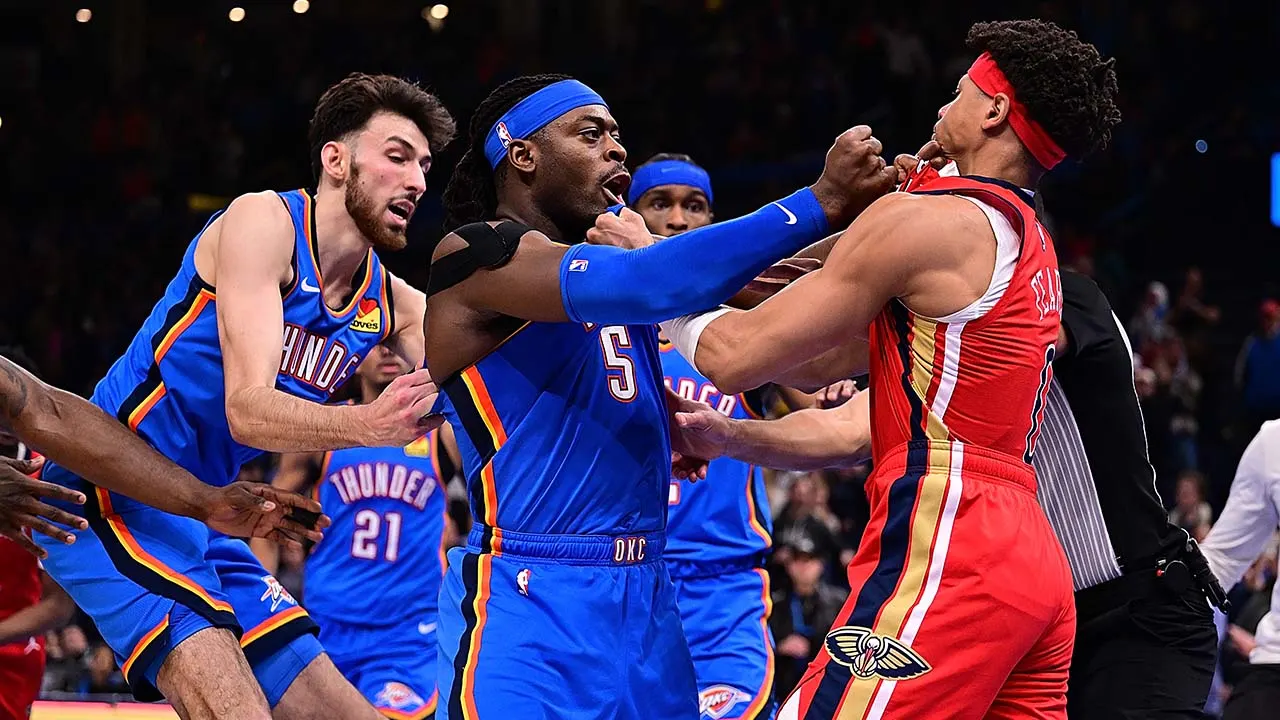
Diving deeper into the Thunder-Pelicans game, which ended in a 104-95 win for OKC on Tuesday, the tension escalated swiftly in the second half when Lu Dort, that fiery Oklahoma City defender who’s built a reputation for unyielding hustle and vocal defiance, clashed with New Orleans rookie Jeremiah Fears during a layup attempt. Officials let a suspected foul slide—Dort’s contact looked like a clear shove to many watching—and that seeming oversight ignited the fuse. Players from both benches poured onto the court, coaches jumping in to pry apart the tangled mess, all while the clock ticked to zero. Imagine the scene: sweat-drenched jerseys flying, shouts piercing the arena air, and that primal instinct to protect kicking in. For Dort, a guy who’s played through injuries and chatter, it was just another notch in his saga of playing hard-nosed ball, but for Fears, a promising young talent still finding his NBA feet, it was a rude awakening to the league’s rough edges. Afterward, Fears took to social media, calling Dort “soft”—a jab that probably stung more than any on-court push, given Dort’s image as a warrior. It’s human, isn’t it? These young guys, drafted fresh out of college or overseas leagues, channeling every slight, every missed call, into something personal. Fans at home could feel the frustration radiating through the screen, especially with the game’s emotional undercurrents—late-game strategies collapsing, stars like Shai Gilgeous-Alexander powering the win, but overshadowed by this sideline circus. Thunder coach Mark Daigneault, ever the composed tactician with years under his belt molding teams like OKC, didn’t mince words in his postgame debrief, painting a picture of mismanaged mayhem that could’ve been avoided with sharper officiating. He hinted at earlier incidents, like altercations between Saddiq Bey and Jaylin Williams, suggesting the refs let things fester too long. It’s almost sympathetic, hearing a coach plead for order in a sport that’s inherently chaotic—what parent wouldn’t relate to trying to “manage” a group of high-energy kids?
Daigneault’s frustrations extended beyond the scuffle, zeroing in on what he saw as a critical missed call that allowed the incident to mushroom into full-blown chaos. “Good guys, good crew,” he conceded, acknowledging the officials’ efforts overall, but then he went for the jugular, claiming they lost grip on the game in those final frantic minutes. “I thought that altercation at the end started well before that with the [Saddiq Bey and Jaylin Williams] situation,” he told reporters, his voice steady but edged with disappointment—a dad’s letdown at the kids’ mischief escalating. He argued that the refs needed to intervene earlier, handling things more cleanly to prevent the benches from mirroring the wild west. But then came the kicker: placing blame on the officials for not whistling a foul on Dort’s contact, regardless of the score or time. “If they do that, everybody stops playing, and you can legislate the situation as you normally would,” Daigneault explained, drawing a parallel to classroom discipline—blow the whistle right away, and the rowdiness dies down. Without it, pandemonium reigns, and everyone pays the price with extra fouls and frayed tempers. Listening to him, you sense a man who’s been there, through Hall of Fame runs and rebuilds, defending his players like family while pleading for fair treatment. It’s not just coaching talk; it’s a human plea for consistency in a sport where one bad call can tarnish reputations and derail careers. Fans, many of whom pay through the nose for tickets and merch, nod along—how many family outings have been ruined by unchecked outbursts? Daigneault’s words add a layer of humanity, showing a coach grappling with the unpredictability of his sport, balancing strategy with the raw emotions of young athletes pushing boundaries.
Just as the echoes of the Thunder-Pelicans dust-up were settling, another eruption rocked the league roughly an hour later in the Suns-Nets contest, this time in Brooklyn, where the game hung by a thread with under two minutes to go. Nets guard Egor Dëmin, the enigmatic Russian import who’s building a niche as a sharpshooting spark plug, pushed Suns forward Dillon Brooks to the ground after a tangled play. Whoa—Brooks, notorious for his combative style and fiery temper that earned him nicknames like “Bamboozled” from haters, didn’t take it lying down or on the floor. Chaos erupted faster than a fastbreak: players swarmed the court, benches emptied in a blur of jerseys, and officials tried to untangle the mess, doling out five technicals in total. It was like watching a playground scrap blow up into an all-out brawl, with coaches screaming for calm amid the commotion. Earlier in the game, Brooks had already earned a tech for shoving Dëmin—a violation that upped his season tally to 15, teetering on the edge of an automatic one-game suspension like a cliffhanger in a thriller. Imagine the stakes: one more tech, and Brooks sits out, missing salary, momentum, and that thrill of the hoop. As a spectator, you can’t help but empathize—players like Brooks, who’s battled injuries and criticism, channeling every ounce of fight into staying relevant in a star-studded league. The incident felt personal, a domino effect where uncalled “dirty plays” (as Nets coach Jordi Fernández would later term them) bred retaliation, turning fellowships into feud-rips. Fans at home, some clutching beers or leaning in on couches, felt the tension vicariously, hearts pounding as friends defended friends on-screen. This wasn’t just basketball; it was a microcosm of life’s friction, where respect slips and defenses flare, making you root harder for the underdogs or the home team.
Nets coach Jordi Fernández, with his youthful energy and mischievous charm—think of him as the enthusiastic uncle at family reunions—threw his full-throated support behind his players for stepping up in the scuffle, framing it as brotherhood in the face of perceived foul play. “Those are just guys protecting each other and fighting for each other,” he declared, his voice warm and unwavering, painting a picture of teammates as a tight-knit squad navigating the NBA’s physical grind. There’s something endearing about that stance, isn’t there? In an era of free agency and traded jerseys, loyalty like that feels rare and precious, like family circling the wagons against outsiders. Fernández acknowledged the fine line—boundaries to prevent harm—but insisted the refs’ reluctance to call “a few dirty plays” pushed things over the edge, handcuffing his guys into taking matters into their own hands. “I think they did a great job… You’re never going to let any of your teammates get hit or pushed or anything.” His words resonate on a human level: who hasn’t stood up for a friend in a bar or boardroom spat? Fans, scrolling through clips online, split—some hailed it as tough-guy grit, others decried the recklessness, echoing broader societal debates on violence vs. valor. For Brooks, the techs loomed large, a ticking clock toward downtime that could sideline his comeback from injuries, reminding us of the fragility beneath the bravado. Fernández’s praise adds emotional depth, showing a coach nurturing a team like a coach, blending strategic nous with heartfelt endorsements. It makes you appreciate the league’s pulse, where coaches double as mediators, therapists, and cheerleaders, all while chasing wins.
Wrapping up this whirlwind weekend, these incidents underscore a broader vibe rippling through the NBA—a mix of intensity that’s thrilling yet divisive, where passion amplifies rivalries and turns arenas into emotional arenas. Players like Dort and Dëmin, byproducts of diverse backgrounds and driven by personal codes, embody the sport’s soul, but also its pitfalls, where unbridled fire can singe reputations. Coaches Daigneault and Fernández, with their measured critiques, humanize the chaos, advocating for better oversight while praising locker-room bonds that keep teams cohesive. For fans, it’s a reminder to follow the pulsating action on platforms like X (formerly Twitter) or the Fox News Sports Huddle newsletter, where every shove and shout gets dissected live. As the season ramps up—think playoffs looming, trades buzzing, and the In-Season Tournament firing shots—it feels like the league is clinging to its edge, balancing spectacle with safety. One tech away from suspension, Brooks’s story hangs in the balance, a cautionary tale of accumulation in a contact sport that demands restraint. Ultimately, these bouts aren’t just friction points; they’re empathetic narratives, revealing athletes as people—friends shielding friends, coaches guiding storms, and a game that mirrors our own struggles for balance. Stay tuned, hoop heads; with emotions this raw, the next eruption could be thrilling, and let’s hope it’s more fireworks than fallout. The NBA’s drama, in its humanity, keeps us coming back for more.