


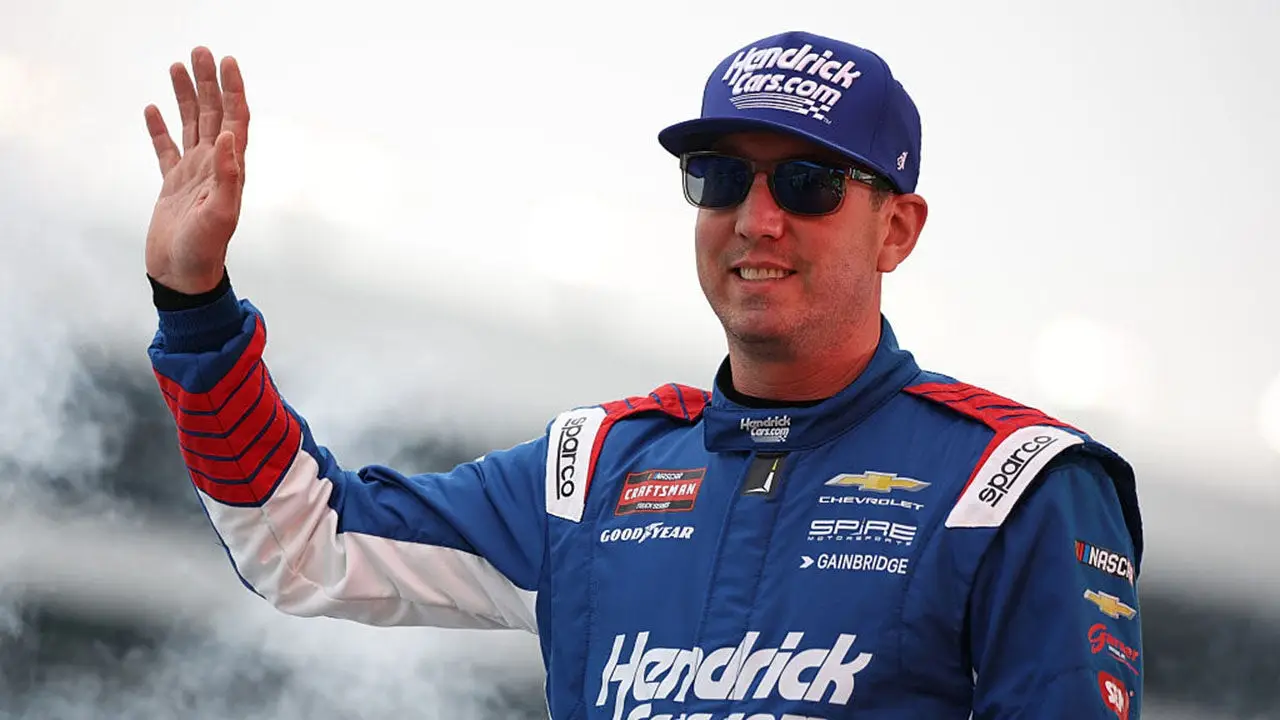
The motorsports community has always been defined by its relentless forward momentum, a world where milliseconds dictate destiny and the roar of high-octane engines drowns out the quiet anxieties of everyday life. Yet, this weekend at Charlotte Motor Speedway, a suffocating, almost surreal stillness descended upon the garage area, shattering the usual sensory assault of race day. The sudden, agonizing passing of Kyle Busch at the young age of forty-one has plunged NASCAR into a state of profound, collective grief, leaving fans, drivers, and crew members struggling to comprehend a reality without one of the sport’s most defining giants. It was revealed that Busch, who spent more than two decades cementing his reputation as one of the most fiercely competitive and talented racers of his generation, succumbed to severe pneumonia that rapidly progressed into sepsis. The speed with which this tragedy unfolded has left everyone inside the garage stunned; just a week ago, he was doing what he did best, celebrating in victory lane, completely healthy and full of the fiery passion that earned him the moniker “Rowdy.” Now, instead of preparing for the grueling physical challenge of the Coca-Cola 600, the NASCAR community is left to navigate a heartbreaking landscape of tributes, tears, and memories. For over twenty years in the premier Cup Series, Busch was the ultimate protagonist and antagonist, a polarizing figure whose undeniable genius behind the wheel demanded respect even from his fiercest critics. To lose him so suddenly, in the prime of his life and career, is a devastating blow that transcends the sport itself, reminding everyone of the fragile thread that connects us all. The news has triggered an outpouring of love and disbelief across the globe, as a community built on courage and speed stands frozen, trying to learn how to breathe in a world where Kyle Busch is no longer driving toward the next checkered flag, leaving a void that seems far too vast for a single sport to contain.
To truly understand the depth of the void left by Kyle Busch’s passing, one must look beyond his illustrious Sunday cup pedigree and examine the pure, unadulterated passion that drove him to compete in every division he could find. While many elite drivers retire to the comfort of their motorhomes or focus exclusively on the big-budget glamour of the Cup Series, Busch was a racer’s racer, a man who would drive anything with four wheels and an engine if it meant he had a shot at victory. This insatiable hunger for competition was most vividly on display in the Craftsman Truck Series, database-breaking territory where he transformed himself from a mere competitor into an absolute titan. Throughout his career, he asserted dominance in a way the sport had never seen, capturing an astonishing 69 victories in just 184 starts—a winning percentage that feels more like a typographical error than a real-world statistic. But his relationship with the Truck Series was not merely about padding his own hall-of-fame resume; it was deeply personal. For years, he poured his own resources, sweat, and soul into operating Kyle Busch Motorsports, providing a developmental gold standard that launched the careers of countless young drivers who now populate the Cup grid. It is highly poetic, yet deeply tragic, that the final victory of his legendary life occurred just under a week before his passing, in a Truck Series duel at Dover. In that race, he drove with the exact same ferocious, uncompromising brilliance that characterized his entire career, taking the checkered flag and proving, for what would be the last time, that his talent remained completely undiminished. That win, secured in the No. 7 Chevrolet for Spire Motorsports, stands as a beautiful, final exclamation point on a life defined by chasing down the horizon, leaving an indelible legacy of mentorship, raw speed, and an unmatched dominance that will be studied by generations of racers to come.
The weekend was supposed to be a grand celebration of American speed, a Memorial Day tradition centered around the grueling test of endurance that is the Coca-Cola 600 at Charlotte Motor Speedway. Instead, a heavy, somber atmosphere hung over the track on Friday, exacerbated by the gray clouds that seemed to weep alongside the thousands of fans gathering in the grandstands. It was a race night that Busch himself was scheduled to compete in, a homecoming of sorts to the high-banked 1.5-mile oval where he had so often put on clinics for his competition. In his place, a young Corey Day was tasked with the immense, emotionally taxing responsibility of climbing into the cockpit of the No. 7 Spire Motorsports Chevrolet—the very truck that Busch had piloted to victory just days prior. To add to the cinematic gravity of the evening, persistent rain had washed out Friday’s qualifying sessions, placing Day on the pole position by virtue of the rulebook, a symbolic gesture from the racing gods that put Busch’s machine at the front of the field where it belonged. Before the engines could even whisper of life, the speedway fell into a profound, arresting silence. Tens of thousands of fans stood shoulder to shoulder, crew members lined pit road with heads bowed, and rivals paused their frantic preparations to honor the memory of a fallen brother. It was a human moment of absolute reverence, a collective intake of breath that united the segmented camps of the garage in a shared, painful understanding of loss. In that quietude, the absence of Busch’s loud, colorful presence was louder than any engine note, a stark reminder of how quickly the vibrant, high-speed tapestry of life can be altered forever, leaving only the echoes of a champion in its wake.
However, the heavens seemed unwilling to let the weekend proceed with its usual brisk efficiency, as if nature itself was demanding a prolonged period of reflection for a sport that rarely stops to catch its breath. The persistent, heavy downpours that forced the cancellation of Friday’s qualifying eventually claimed the Truck Series race itself, forcing officials to postpone the event to Saturday morning, and then, as the stubborn storms refused to break, delaying it once again to Saturday night. For the drivers and crew members cooped up in their haulers, this agonizing purgatory of rain delays only amplified the emotional weight pressing down on their shoulders. In NASCAR, the frantic routine of adjustments, meetings, and warm-ups usually acts as a therapeutic shield, keeping the raw emotions of grief at bay through sheer distraction. Without the therapeutic escape of turning laps at 180 miles per hour, the garage was left with nothing but time—time to talk, time to remember, and time to cry. Every corner of the paddock held a story of a run-in with Busch, a piece of advice he had grumpily but generously offered, or a moment of sheer awe at his car control. The rain-soaked windshields of the haulers mirrored the tears shed in private, transforming Charlotte Motor Speedway from a temple of speed into an arena of collective mourning. This forced pause, while frustrating for schedules and television broadcasts, allowed a raw, human connection to solidify among the competitors, reminding them that beneath the Nomex fire suits and sponsor decals, they are a tight-knit family bound by a shared danger, an unspoken bond of brotherhood, and a deep, shared love for a fallen hero who rode the edge of control better than anyone who had ever strapped into a stock car.
The ripples of this tragedy extended far beyond the Truck Series garage, touching every corner of the sport, including the O’Reilly Auto Parts Series, another arena where Kyle Busch’s legendary talent had frequently left an unforgettable mark. On Saturday, as the skies temporarily cleared enough to attempt to get cars on the track, the atmosphere in this secondary series was equally thick with sorrow and respect. Before their scheduled race at Charlotte, officials, crew members, and drivers gathered to hold their own poignant tribute, standing together in a moment of quiet reflection to honor the man who had set the gold standard for what a professional racer should be. Busch had spent years dropping down to race in this series, constantly challenging the regular competitors, pushing them to raise their game, and showing them firsthand what it took to run at the absolute limit of physics. Though his presence on the entry list had often struck fear into the hearts of younger drivers, his participation was ultimately a gift, a masterclass of racecraft that forced everyone around him to become better. Regrettably, the chaotic weather pattern that defined the weekend returned with a vengeance, suspending the Saturday race due to another onslaught of summer rain. Yet, even as the engines were silenced and the track dripped with water, the conversations in the garage remained focused on Kyle’s legacy. Rivals who had traded paint with him for decades shared stories of his fierce competitiveness, his unexpected acts of kindness behind closed doors, and his intense devotion to his family. This shared, lingering grief proved that while rain could delay the physical execution of a race, it could not wash away the profound impact of a man who had dedicated his entire existence to the pursuit of speed, proving that some spirits are simply too large, too vibrant, and too powerful to ever be fully silenced by the closing of a garage door.
Now, all eyes turn toward Sunday evening, when the Coca-Cola 600, the longest, most physically demanding, and emotionally taxing race of the NASCAR Cup Series calendar, is scheduled to green-flag at 6:00 p.m. Eastern Time. The 600 miles of Charlotte are legendary for breaking men and machines under normal circumstances, but this year, the true test will not be the heat, the grueling length, or the shifting track conditions; it will be the heavy hearts riding along in every single cockpit. When those forty engines finally roar to life, fracturing the heavy silence of the weekend, they will carry with them the spirit of a racer who defined the modern era of the sport. The pre-race ceremonies are guaranteed to be an emotional gauntlet for everyone involved, a final, public farewell to a driver who was, in so many ways, the heartbeat of the modern garage. Yet, there is a comforting, human truth in knowing that the best way to honor Kyle Busch is not through quiet mourning, but through the loud, uncompromising, and relentless pursuit of victory that defined his forty-one years on this earth. When the green flag drops and the field thunders off into Turn One, the grief will transform into a driving force, a collective tribute written in tire smoke, drafting lines, and daring passes. Every driver on that starting grid knows that herculean effort is the required baseline from this day forward, as “Rowdy” would have wanted nothing less than a flat-out, no-holds-barred dogfight for the trophy. As the sun sets over Charlotte and the stadium lights illuminate the dark asphalt, the racing world will do what it has always done in the face of tragedy: they will press the gas pedal down, leaning into the wind, carrying the memory of Kyle Busch across the finish line, keeping his legacy alive in every rumble of the engine and every desperate, high-speed battle for glory.