



The Grit and Glory of Lindsey Vonn’s Olympic Journey
Lindsey Vonn, the legendary American ski racer, has always embodied resilience and raw courage, turning alpine skiing into a powerhouse sport for women worldwide. At 38 years old, she arrived at the 2026 Winter Olympics in Milan-Cortina with a storied career marked by victories and setbacks, including her historic 2010 Vancouver Games where she demolished records and became the most decorated female alpine skier ever. Fans like me have watched her grow from a teenage prodigy to a trailblazer who fought back against injuries and controversies, all while inspiring generations to chase their dreams on the slopes. Her latest chapter, sadly, unfolded dramatically on the snowy slopes of Cortina, where age and past battles—weighing in at every turn—made her pursuit of a medal feel both heroic and heartbreaking. On a crisp Italian morning, as the world tuned in, Vonn attempted the women’s downhill run at the 2026 Games, a race that could have capped her incredible return after a near-decade hiatus from the pinnacle of winter sports. Despite tearing an ACL earlier in her career, she had vowed to push through, and viewers couldn’t help but feel the tension, imagining the thrill mixed with fear as she sped down the unforgiving ice at speeds topping 80 mph. It’s in these moments that sports transcend competition; they reveal the human spirit’s fragility, reminding us how one wrong move can shatter aspirations built over years of dedication.
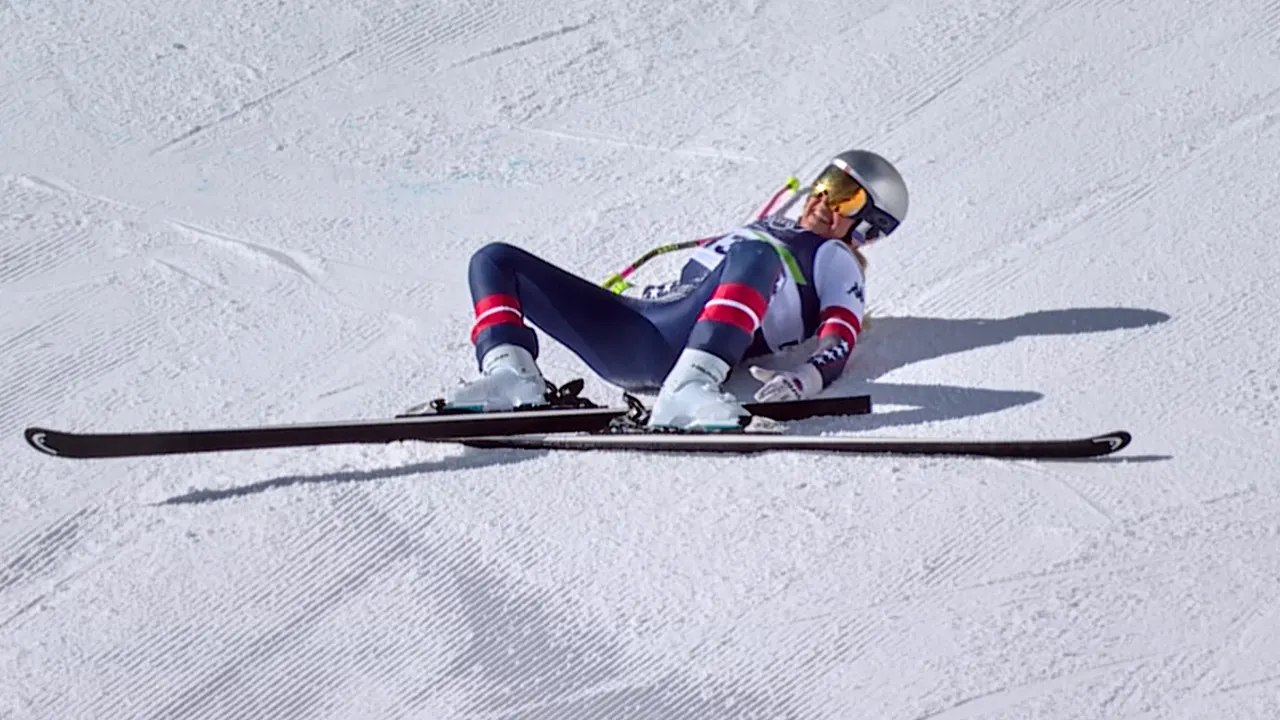
In the blink of an eye during that downhill run, everything changed for Vonn. Just seconds into her descent, she lost control in the treacherous first sector, the icy conditions betraying her expert edges and instincts honed through thousands of training runs. Her body twisted violently as she crashed hard, the skis flailing and snow flying in chaotic sprays, capturing the brutality of a sport where tiny margins separate triumph and tragedy. Those watching live or following on social media held their breath, hearts pounding, as Vonn writhed in agony on the frozen ground, her face contorted in pain that echoed through screens globally. Medical teams rushed to her side, their swift actions a testament to the Olympics’ safety protocols designed for such high-stakes risks. As she lay there, vulnerable and exposed, it was impossible not to empathesize with the terror of the moment—friends and family imagining endless “what ifs,” wondering if this was the end of her storied comeback. Vonn’s fall wasn’t just a physical tumble; it symbolized the unrelenting toll of elite athletics, where the body demands constant sacrifice, from rigorous off-season training to overcoming age-related hurdles that make every glide more precarious. Yet, in that crash, we saw echoes of her past perseverance, like the 2014 Sochi medal despite injuries, making the pain feel even more poignant.
The response to Vonn’s accident was immediate and coordinated, highlighting the professionalism that underpins Olympic operations. Officials at the scene called in a helicopter to airlift her from the mountain—a dramatic rescue that spoke to the isolation of high-altitude venues like those in the Dolomites, where access can be life-or-death in emergencies. She was first taken to a clinic in the picturesque town of Cortina, nestled amid stunning peaks and quaint Italian villages, before being transferred to Ca’ Foncello Hospital in Treviso, a journey that no doubt felt agonizing and disorienting amid the fog of pain and shock. Surrounded by a multidisciplinary team of doctors and specialists, Vonn received expert care, her stable condition announcing some relief but leaving millions to stew in worry about recovery timelines. The U.S. Ski Team’s reassurance that she was in “good hands with a team of American and Italian physicians” offered comfort, but the world couldn’t shake the visual of her being whisked away, a modern knight in shining armor turned damsel in distress, her Olympic dreams deferred by the whims of fate and physics. In empathetic terms, it’s like watching a loved one’s world crumble; Vonn’s fans, many of whom have followed her since her breakout days, felt a personal loss, grappling with the realization that even legends aren’t invincible.
Anouk Patty, the U.S. Ski and Snowboard’s chief of sport, spoke candidly about the incident, offering a voice of reason amidst the emotional outpour of sympathy. She described Vonn as stable but facing a “process” ahead, a diplomatic way of acknowledging the long road to healing that comes with such severe fractures. Patty’s words carried weight: “She’ll be OK, but it’s a bit of a process,” reminding everyone that this sport is “brutal,” with athletes hurling down mountains at breakneck speeds. Her perspective humanized the ordeal; Patty, with her own background in skiing, likely knows the intimate fears every racer harbors—the fear of the unseen ice patch or the moment when technique fails. Yet, her comment encouraged us to appreciate the athletes’ bravery, not just their triumphs, fostering a deeper empathy for those who risk everything for a country’s pride and personal glory. As a spectator, it’s easy to romanticize the Olympics as epic theater, but Patty peeled back the curtain, showing the human cost behind the medals and fireworks, making Vonn’s story one of collective awe rather than isolated heroism.
Elsewhere on the mountain, Team USA’s Breezy Johnson captured the gold in the women’s downhill, earning the United States’ first medal of the 2026 Games—a bittersweet victory shadowed by Vonn’s crash. Johnson’s reflections added layers of emotion to the day, as she shared her inability to fully comprehend Vonn’s ordeal but drew from her own experiences of Olympic heartbreak. Having missed the 2022 Games due to a severe knee injury, Johnson knew the sting of shattered dreams intimately. “I don’t claim to know what she’s going through,” she said, “but I do know what it is to be here, fighting for the Olympics, and to have this course burn you and to watch those dreams die.” Her empathy highlighted the emotional toll over physical pain, a sentiment that resonates universally; in sports folklore, these are the narratives that bond us, where one person’s loss amplifies another’s gain without diminishing the shared humanity. Johnson’s win, though joyous, was tinged with gratitude for her own comeback, and her words urged us to honor Vonn’s legacy—not just for dominating sports records but for galvanizing a generation of women skiers who see her as a beacon of perseverance. In a world obsessed with winners, moments like these remind us of the unsung courage required to step up again and again.
International Ski and Snowboard Federation president Johan Eliasch labeled the incident “tragic, but it’s ski racing,” a grounded commentary that underscored the inherent dangers of the sport while praising Vonn’s contributions. He expressed deep gratitude: “I can only say thank you for what she has done for our sport,” noting how her run had ignited global fascination, drawing massive viewership and elevating skiing’s profile at the Games. Eliasch’s perspective painted Vonn as a figure whose presence, even in failure, enriches the Olympic tapestry, blending tragedy with inspiration. For fans, this incident expanded beyond a single event, sparking conversations about athlete welfare, the need for better safety measures in extreme sports, and the psychological battles that define elite careers. Humanely, it’s akin to a beloved family member facing adversity; Vonn’s story has sparked countless messages of support, turning her into a symbol of resilience amid vulnerability. As the 2026 Games progressed, her setback became a catalyst for reflection, encouraging viewers to cherish the human elements of athletics—the friendships formed, the dreams pursued, and the lessons learned in the face of inevitable hardships. Ultimately, Vonn’s legacy endures, a living testament to why we watch, cry, and cheer for Olympic heroes who remind us that true victory lies in the heart’s enduring fight.