


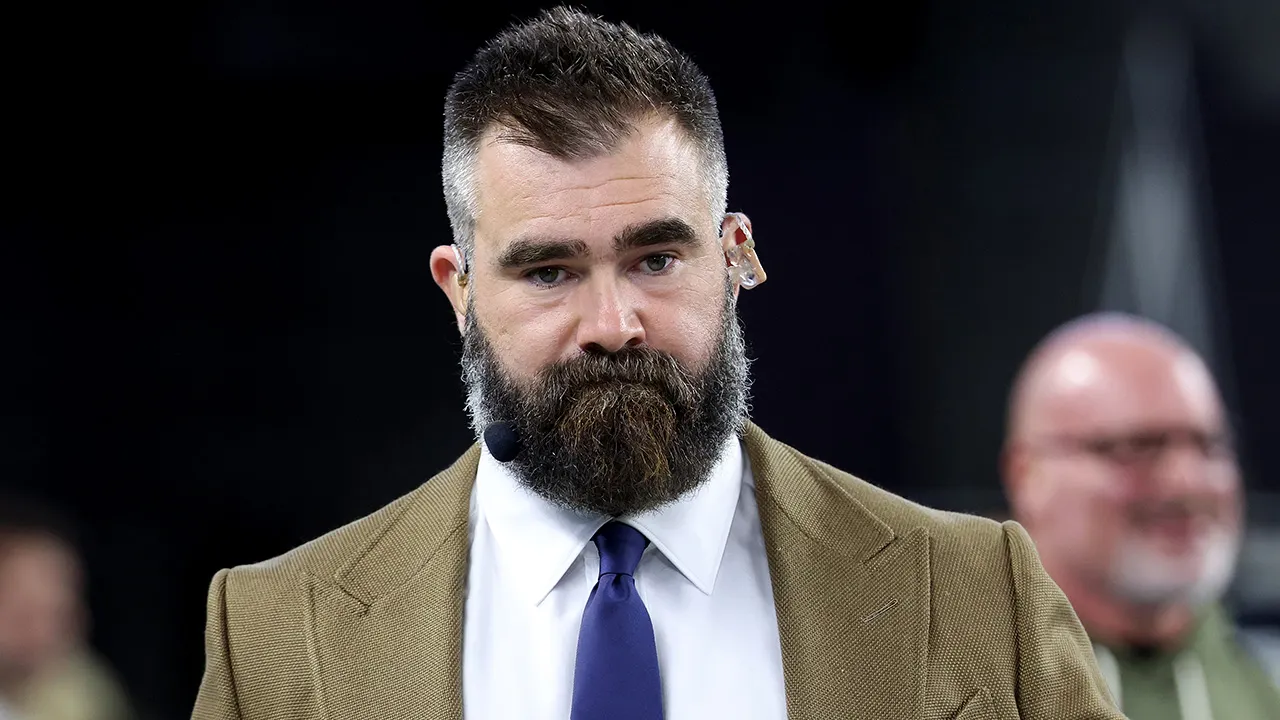
Eagles Offense and Coaching Change: Jason Kelce’s Perspective
In the wake of the Philadelphia Eagles’ disappointing 23-19 Wild Card round loss to the San Francisco 49ers, the organization made the difficult decision to fire offensive coordinator Kevin Patullo. This move came after a season where the Eagles’ offense significantly regressed from their Super Bowl-winning form. While many fans and analysts were quick to place blame squarely on coaching, former Eagles star center Jason Kelce offered a more nuanced perspective on the situation during a recent episode of the “New Heights” podcast, suggesting that responsibility should be shared between coaches and players alike.
“The bottom line is this offense didn’t live up to what it should have,” Kelce stated candidly. “Patullo, as the offensive coordinator, bears responsibility and so do the players. I don’t think the players played as good as they could have.” The recently retired seven-time Pro Bowler’s assessment carries particular weight given his intimate knowledge of the team’s inner workings and his reputation for straightforward analysis. Kelce emphasized that it would be unfair to make Patullo the sole scapegoat for the team’s offensive struggles, pointing to several underlying issues that contributed to their disappointing performance throughout the season. His comments reflect the complex reality of NFL team dynamics, where success and failure rarely have simple explanations.
According to Kelce, the primary factor behind the Eagles’ offensive regression was their diminished running game. “The main reason was the run game. The offensive line’s inability to stay healthy altogether to open up holes,” he explained. This represented a dramatic shift from the previous season, when running back Saquon Barkley nearly set NFL rushing records behind a dominant offensive line. Kelce also noted that quarterback Jalen Hurts wasn’t running as frequently this season, eliminating a threat that previously created opportunities for both the running back and downfield passing game. These observations highlight how interconnected various elements of an offensive system can be, and how the deterioration of one aspect can have cascading effects throughout the entire unit.
Interestingly, Kelce revealed that while the Eagles’ passing game struggled this season, similar issues had existed even during their Super Bowl-winning campaign. “The passing game, they struggled last year. I mean, there were all sorts of things happening last season that we like to forget because we won the Super Bowl, but the passing game has been an issue for multiple seasons now,” he admitted. This suggests that the team’s offensive challenges run deeper than just the 2023 season, potentially indicating structural or philosophical problems that transcend any individual coach or coordinator. The difference this year, according to Kelce, was that the exceptional running game that previously masked these passing deficiencies was no longer functioning at an elite level, exposing weaknesses that had been present all along.
Despite his balanced assessment of blame, Kelce did acknowledge shortcomings in the offensive scheme, particularly lamenting the lack of creativity. “I would love to see more motions. I would love to see all that stuff,” he said, suggesting that the offense had become predictable and stagnant. This criticism aligns with observations from many analysts throughout the season who noted the Eagles’ tendency to rely on a limited set of concepts rather than adapting to defensive adjustments or leveraging their players’ strengths in innovative ways. The statistical decline was stark: after averaging 29 points per game in their Super Bowl season (tied for fourth in the NFL), the Eagles dropped to just 22.1 points per game in 2023, ranking 19th league-wide – essentially scoring one fewer touchdown per contest.
Looking ahead, Kelce offered thoughtful advice on the Eagles’ search for a new offensive coordinator, recommending they bring in someone from outside the organization who could provide a fresh perspective. “It would probably behoove the Eagles to bring in somebody with a fresh perspective on where it’s at currently, because when you’re in it, you’re thinking about what you’ve done well in the past,” he explained. This insight speaks to a common challenge in professional sports – the difficulty of objectively evaluating a system when you’ve been immersed in it, particularly one that has previously achieved success. Kelce’s suggestion acknowledges that sometimes an outside voice is necessary to identify blind spots and implement meaningful changes while still preserving the team’s core identity and strengths. As the Eagles move forward with their search, finding this balance between innovation and continuity will likely be crucial to revitalizing an offense that possesses considerable talent but fell well short of expectations this past season.