





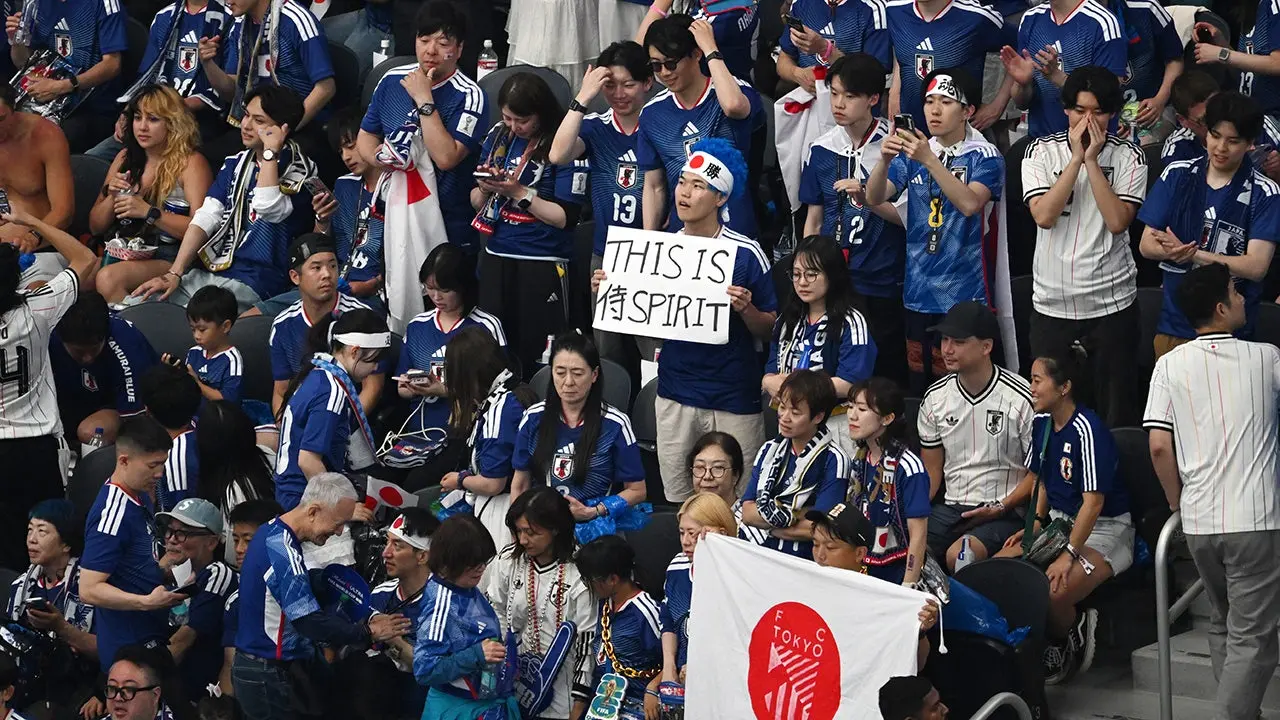
Under the sweeping, modern architectural canopy of Dallas Stadium, where the high-octane pageantry of global sports collided with deep-seated national traditions, an unexpected scene of quiet nobility unfolded long after the final whistle had blown. The intense, highly anticipated World Cup group-stage clash between the national teams of Japan and the Netherlands had just concluded in a dramatic, hard-fought 2-2 draw, leaving the cavernous venue humming with lingering adrenaline and emotional exhaustion. Yet, as the vast majority of the roaring spectators filed out into the cool Texas evening, a dedicated contingent of supporters in the blue-clad stands chose not to leave, but to gather. These were the Japanese fans, carrying forward a deeply ingrained cultural philosophy of Souji—the practice of cleaning up after oneself as an act of fundamental gratitude and respect for the space provided. Armed with large, durable plastic bags boldly emblazoned with the words “Japan Pride” in striking blue lettering, these fans began to systematically comb through the rows of seating, collecting discarded plastic cups, food wrappers, and stray papers left behind by the departing crowds. This display of civic virtue and humility quickly transcended national boundaries when Jameis Winston, the charismatic New York Giants quarterback who has transitioned into a temporary role as a FOX Sports soccer correspondent for this tournament, stepped down from his media perch to join them. Doffing the traditional boundaries of broadcast journalism, Winston rolled up his sleeves and knelt among the dusty plastic rows of seats, lifting trash alongside the traveling supporters. His unexpected presense, bridging the massive cultural architectures of American football and international soccer, highlighted a shared, universal language of human decency, proving that the true spirit of the World Cup is often found not in the violent collision of elite athletes on the green pitch, but in the quiet, supportive actions that occur in the stands when the bright television cameras begin to dim.
The backdrop to this remarkable act of communal stewardship was a football match of breathtaking complexity, tactical evolution, and sheer, raw kinetic energy that kept the crowd of thousands on the edge of their seats from start to finish. For the first half, the pitch was a grand battlefield of nerves and strategic positioning, with the highly disciplined, technically gifted Japanese side trading blows with the robust, highly structured Dutch team. The match truly ignited in the second half, transforming the green field into a theater of high drama during a wild, tempestuous fourteen-minute window that saw three goals scored in rapid succession. The Netherlands broke the deadlock through their towering captain Virgil van Dijk, who demonstrated his world-class aerial ability by latching onto an exquisite cross and directing it off the post and past the outstretched arms of the Japanese goalkeeper. Shortly thereafter, the Dutch double-downed on their offensive assault when the mesmerizing young winger Crysencio Summerville sliced through the defense, firing a brilliant, low-driven shot that clipped the upright before nestling into the side netting. The Dutch fans erupted in a sea of vibrant orange, believing the game was securely within their grasp. However, the Samurai Blue refused to crumble under the mounting pressure; instead, Keito Nakamura quickly pulled one back for Japan with a breathtaking, curling strike just minutes later, breathing new life into his teammates and setting the stage for a grandstand finish that would test the psychological limits of both world-class squads.
As the stadium clock ticked mercilessly toward the final whistle, the tension inside Dallas Stadium reached a fever pitch, with the Japanese supporters rallying behind their team with an unrelenting chorus of chants, drums, and waving flags. It was in the eighty-eighth minute of this titanic struggle that destiny intervened in the form of Daichi Kamada, who seized upon a chaotic goalmouth scramble to fire a clinical, game-tying goal past the diving Dutch goalkeeper. The stadium exploded into a euphoric frenzy, with Japanese players piling on top of each other in a celebration of pure, unadulterated relief and joy, having fought their way back from the brink of defeat against one of the tournament’s heavy favorites. Reflecting on this monumental moment of resilience during the post-match press conference, Japan’s esteemed head coach Hajime Moriyasu spoke eloquently through an interpreter, explaining that the miraculous comeback was not merely a stroke of luck, but a direct result of a carefully cultivated team identity. “Our players managed to be tenacious but at the same time be patient and just keep calm and finding and seizing an opportunity,” Moriyasu remarked, his voice radiating a calm, calculated pride. His words encapsulated the very essence of the Samurai Blue’s modern footballing philosophy: an unwavering belief in organization, tireless physical stamina, and a quiet, mental fortitude that allows them to absorb supreme pressure from elite opposition before striking with lethal, surgical precision when the opponent’s focus inevitably wavers for a split second.
Conversely, on the opposite end of the emotional spectrum, the late equalizer was a bitter, agonizing pill to swallow for a Dutch team that had twice held the lead and seemed destined to secure a vital three points in the group stage. For Virgil van Dijk, the towering defender and emotional heart of the Netherlands squad, the manner in which they conceded the late goal was particularly galling, highlighting a rare lapse in concentration from a defensive unit that prides itself on its organization and physical dominance. “It’s disappointing now because obviously conceding the lead is never good,” a visibly frustrated Van Dijk told reporters in the mixed zone, shaking his head. “It’s extra disappointing that we conceded from a set piece so late on.” This sentiment of profound disappointment was echoed by the veteran Dutch manager Ronald Koeman, who took the opportunity to address what he perceived as a systemic, disrespectful underestimation of Asian football by European pundits and fans. Koeman, who has experienced the highest highs and lowest lows of international football, fiercely defended the quality of their opponents while warning against intellectual laziness in scouting. “I’m disappointed that we didn’t win, but that’s because we were ahead twice,” Koeman asserted with characteristic bluntness, referring back to their historical 2010 victory over Japan as ancient history. “Many people underestimated Japan, but for the 100,000th time, if you underestimate them, that’s your problem. You think Japan’s strength was overexaggerated before the match? Let’s wait until the end of the tournament to see who’s right.”
Indeed, anyone who has closely followed the trajectory of international football over the past decade knows that underestimating Japan is a fool’s errand, as the nation has steadily evolved into a formidable global power. With impressive, giant-killing runs into the knockout rounds of both the 2018 tournament in Russia and the 2022 iteration in Qatar, the Samurai Blue have firmly established themselves as a team capable of dispatching traditional giants, even if they have yet to break through the psychological barrier of the Round of 16. On the other hand, the Netherlands carries its own heavy, historically complex burden as the undisputed “nearly men” of global soccer, holding the agonizing distinction of being the only nation to reach three World Cup finals without ever hoisting the iconic trophy aloft, their most recent deep run ending in a heartbreaking penalty shootout defeat against eventual champions Argentina in the 2022 quarterfinals. This historical context added a rich, multi-layered significance to their draw in Dallas, showcasing a collision between a Dutch program desperate to finally claim its rightful place at the summit of football history and a Japanese program eager to prove that its collective, highly organized style of play can consistently dismantle the sport’s old-world aristocracy. The duel on the pitch was a beautiful microcosm of this clash of philosophies, leaving both nations to ponder what adjustments must be made to turn their respective aspirations into reality as the tournament progresses.
Yet, as midnight approached in Dallas and the last of the transport buses departed, the primary narrative of the evening remained securely anchored in the stands, where the physical leftovers of a massive sporting event had been replaced by a spotless, gleaming arena. The image of NFL star Jameis Winston standing side-by-side with ordinary Japanese citizens, sharing smiles, high-fives, and heavy trash bags, served as an enduring testament to the unique, transcendent power of the World Cup to foster direct human connection across vast cultural separates. It was a reminder that while the tactical battles fought by Van Dijk, Nakamura, and Kamada are the primary engine of public excitement, the tournament’s deeper value lies in these quiet, unprompted moments of cross-cultural empathy and mutual respect. This cleaning ritual, captured in videos that quickly went viral across global social media platforms, highlighted how the fans viewed their role not just as consumers of entertainment, but as active ambassadors of their nation’s values. As the Japanese supporters packed up their remaining “Japan Pride” bags and prepared for the next leg of their tournament journey, they left behind not just a clean stadium, but a profound cultural impression on the host city of Dallas—a tangible demonstration that true sportsmanship extends far beyond the final whistle, leaving a legacy of grace, humility, and dignity that will resonate long after the goals themselves have faded into sports history.