





There is a unique kind of beautiful madness that takes hold of the sporting world during the Stanley Cup Final, an intensity so thick and unforgiving that it seems to warp the very passage of time for both the players on the ice and the fans in the rafters. The current championship series between the Carolina Hurricanes and the Vegas Golden Knights has completely transcended the typical boundaries of modern postseason drama, evolving into one of the wildest, most unpredictable, and utterly heart-stopping spectacles in recent hockey history. Having endured four exhausting, emotionally draining chapters of this grueling saga—including two chaotic, high-energy thrillers played under the glittering, neon lights of the Las Vegas strip—the two battered and bruised squads returned to the humid, thunderous atmosphere of Raleigh, North Carolina, for a pivotal Game 5. With the series deadlocked at two victories apiece, the stakes could not have been higher; this was the game that would inevitably define the narrative direction of the entire season, giving one team a clear, direct path to hockey immortality while shoving the other to the absolute brink of seasonal elimination. Historically, games of this magnitude can go one of two ways: they can become highly defensive, chess-like standoffs where neither side dares to make a mistake, or they can devolve into glorious, high-scoring chaos. As the puck dropped at the PNC Arena, the palpable tension in the air suggested a quiet, nervous beginning, a rare moment of hesitation in a series that had previously been defined by lightning-fast strikes and relentless end-to-end action. Yet, beneath this seemingly calm surface lay a familiar, simmering undercurrent that has plagued both teams throughout this postseason: the sudden, catastrophic self-inflicted wounds of unnecessary, undisciplined penalties. In the high-stakes pressure cooker of the Stanley Cup Final, physical exhaustion often manifests as mental fatigue, leading to the kinds of critical, unforced errors that can turn a franchise’s championship dreams into a heartbreaking nightmare in the blink of an eye.
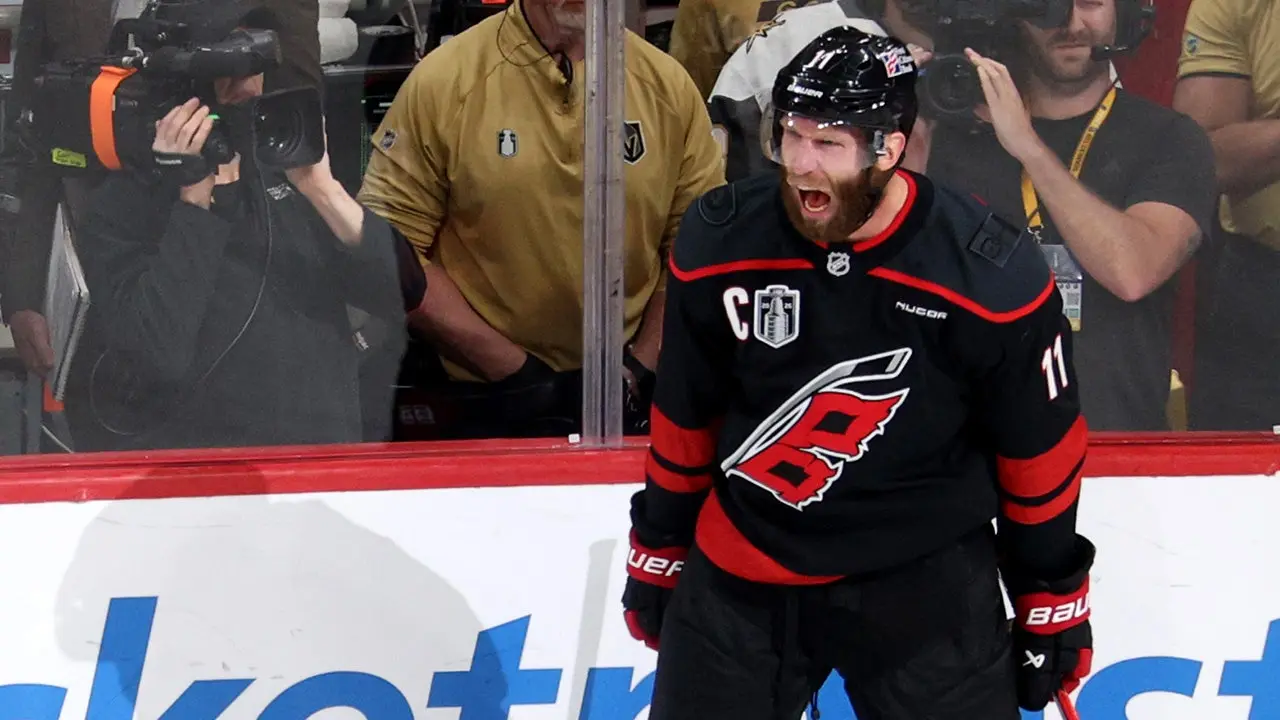
The opening frame of Game 5 initially broke the mold of the series, starting with a tentative, probing pace as both coaching staffs attempted to implement rigid defensive structure and neutralize the opposition’s speed. However, hockey’s inherent chaos cannot be suppressed for long, and it was a costly mental lapse by Carolina’s newly acquired forward, Nikolaj Ehlers, that cracked the game wide open. Finding himself under intense pressure deep in his own zone, Ehlers committed the ultimate sin of modern defensive play, carelessly lifting the puck directly over the glass to earn a devastating delay-of-game penalty. For a powerhouse Vegas power-play unit, this was the exact tactical catalyst they needed to break the ice, and they wasted absolutely no time in executing their lethal offensive blueprint. With surgical precision, superstar playmaker Jack Eichel orchestrated the attack from the half-wall, delivering a breathtakingly accurate, cross-ice pass straight onto the tape of Pavel Dorofeyev, who cleanly buried Vegas’ first official shot of the night past a helpless netminder to quiet the hometown crowd. But if there is one defining characteristic of this Carolina Hurricanes team, it is their stubborn, blue-collar resilience, a quality epitomized by their veteran captain, Jordan Staal. Staal, who has been playing the absolute hockey of his life during this final series, refused to let his team languish in self-pity, and just minutes later, the hockey gods offered a poetic moment of redemption. It was none other than Ehlers who initiated the play, firing a hard, purposeful pass toward the front of the net, where a driving Staal executed a masterclass redirection to beat the Vegas goalie and send the Raleigh crowd into an absolute frenzy. That historic marker not only tied the game at 1-1 but also saw Staal etch his name into the annals of hockey history by extending his goal-scoring streak to an improbable five consecutive games, matching the all-time Stanley Cup Final record—a truly remarkable feat for a beloved leader who had managed to find the back of the net only twice in the entire postseason prior to this series.
As the whistle blew to signal the start of the second period, the physical intensity of the contest reached a boiling point, transforming the ice into a veritable war zone where every inch of ice template had to be paid for in deep bruises. Carolina was immediately put on the defensive, forced to kill off yet another self-inflicted delay-of-game infraction, a repetitive storyline that threatened to completely derail their hard-fought momentum. Yet, the Hurricanes’ penalty killers stood tall, absorbing the Vegas pressure with defensive discipline, a successful stand that seemed to mentally break the composure of the normally cool, calm, and collected Golden Knights. What followed was a stunning and uncharacteristic collapse of discipline from the visitors, beginning when Vegas’ physical defenseman Jeremy Lauzon was sent to the penalty box for a roughing minor. Although the Golden Knights survived those two minutes, the relief was incredibly short-lived; just one single second after Lauzon stepped back onto the ice, defenseman Brayden McNabb committed a highly undisciplined, unnecessary cross-checking penalty that sent the Hurricanes right back onto the power play. This time, Carolina’s dangerous power-play specialists refused to let the opportunity slip away, as young sniper Andrei Svechnikov seized the moment, unleashing a wicked shot to give the Canes a crucial 2-1 lead. Svechnikov had been under immense pressure to break out of a frustrating offensive slump, and the relief on his face was obvious as his teammates mobbed him against the glass. The momentum had completely shifted, and just minutes later, Carolina’s premier superstar Sebastian Aho joined the party, capitalizing on a defensive lapse to score a stunning goal of his own, extending the lead to 3-1 and sending a shockwave of dread through the Vegas bench, which was further demoralized by the sight of key forward William Karlsson limping off the ice with a game-ending injury.
Entering the third period with a commanding two-goal cushion, the Hurricanes knew that the final twenty minutes of play would require a masterful display of defensive responsibility, but they were once again aided by the baffling lack of discipline displayed by the Golden Knights. Vegas, a team that had built its entire identity on execution, structure, and mental toughness under pressure, continued to unravel in a manner that shocked analysts and fans alike. The climax of this self-destruction occurred when Vegas’ highly respected captain, Mark Stone, committed a catastrophic error of judgment, catching Carolina defenseman Jalen Chatfield with an elevated high stick that drew blood, resulting in a mandatory, devastating four-minute double-minor penalty. For a team trying to mount a third-period comeback, Stone’s penalty was an absolute death sentence, and the Hurricanes’ power play made them pay dearly for the mistake. Andrei Svechnikov, suddenly playing with the swagger of a man possessed, found his spots once again, lighting the lamp for his second goal of the night to give Carolina a seemingly insurmountable 4-1 lead. Yet, in a Stanley Cup Final as wild and unpredictable as this one, no lead is ever truly safe, and the game quickly dissolved into a heart-stopping thriller. Barely had the cheers subsided in Raleigh when Vegas’ resilient young forward, Pavel Dorofeyev, scored his second goal of the game, intercepting a loose puck and burying it to cut the deficit to 4-2. This goal acted as a massive psychological adrenaline shot for the Golden Knights, who immediately launched a furious, desperate, and waves-upon-waves offensive onslaught, throwing everything they had at the Carolina defense and producing a flurry of high-quality scoring chances that had home fans biting their nails in sheer terror.
The final minutes of this classic confrontation will undoubtedly be remembered as a masterclass in athletic drama, defensive desperation, and individual heroism. With only 2:13 remaining on the clock and the Golden Knights putting on immense pressure, Carolina found themselves in the worst possible scenario when Nikolaj Ehlers was once again whistled for an incredibly ill-advised delay-of-game penalty. Sensing a golden opportunity to stage a miraculous comeback, the Vegas coaching staff immediately gambled, pulling their goaltender to create a formidable 6-on-4 man advantage that put the Hurricanes’ season-long defensive preparation to the ultimate test. The Golden Knights set up their umbrella offense with terrifying efficiency, passing the puck with blinding speed and forcing the Carolina penalty killers to scramble wildly to clog up the shooting lanes. It was during this nerve-wracking stretch that unheralded goaltender Brandon Bussi cemented his status as a local folk hero, standing tall under an absolute barrage of rubber and keeping his composure as the chaos swirled around his crease. The defining moment of the game arrived with just 80 seconds remaining on the clock, when Vegas’ veteran forward Tomas Hertl found himself unmarked in the slot and let fly a lethal, ticketed shot that seemed destined for the back of the net. In a flash of pure, instinctual athleticism, Bussi threw out his glove to make a spectacular, jaw-dropping robbery save, a moment of sheer sporting brilliance that brought the entire arena to its feet in a state of euphoric disbelief. This phenomenal save, part of a crucial 22-save performance on 24 shots, completely broke the spirit of the Vegas attack, allowing the Hurricanes to utilize their penalty kill as an offensive weapon, continuously clearing the puck down the 200-foot length of the ice to kill off the remaining seconds and secure the thrilling 4-2 victory.
When the final horn finally echoed through the rafters of the PNC Arena, it brought with it an overwhelming sense of relief, exhaustion, and pure joy for the Carolina Hurricanes and their passionately loyal fan base. With this hard-fought, dramatic Game 5 victory now secured in the history books, the Hurricanes have seized a commanding 3-2 series lead, placing themselves just one single win away from hoisting the iconic, silver-gilded Stanley Cup for only the second time in their proud franchise history. For veteran leader Jordan Staal, who has poured his blood, sweat, and tears into this organization for over a decade, the dream of championship glory has never been closer or more tangible. Yet, as the team packs their bags and prepares to fly across the country to the glittering, hostile desert environment of Las Vegas for a date at the T-Mobile Arena on Sunday, they are acutely aware that the final step of a championship journey is always the most difficult to take. The Golden Knights, though battered, bruised, and facing elimination on their home ice, are a proud, resilient franchise that will certainly not go gently into the night, and they will undoubtedly bring their absolute best, most desperate effort to Game 6. For hockey purists and casual sports fans alike, this unforgettable, penalty-filled, and emotionally charged Stanley Cup Final has provided everything one could possibly ask for in a championship series. As the sporting world shifts its collective focus back to the neon lights of Las Vegas, we find ourselves on the cusp of yet another legendary chapter in this beautiful, grueling, and deeply human quest for the greatest trophy in all of sports.