





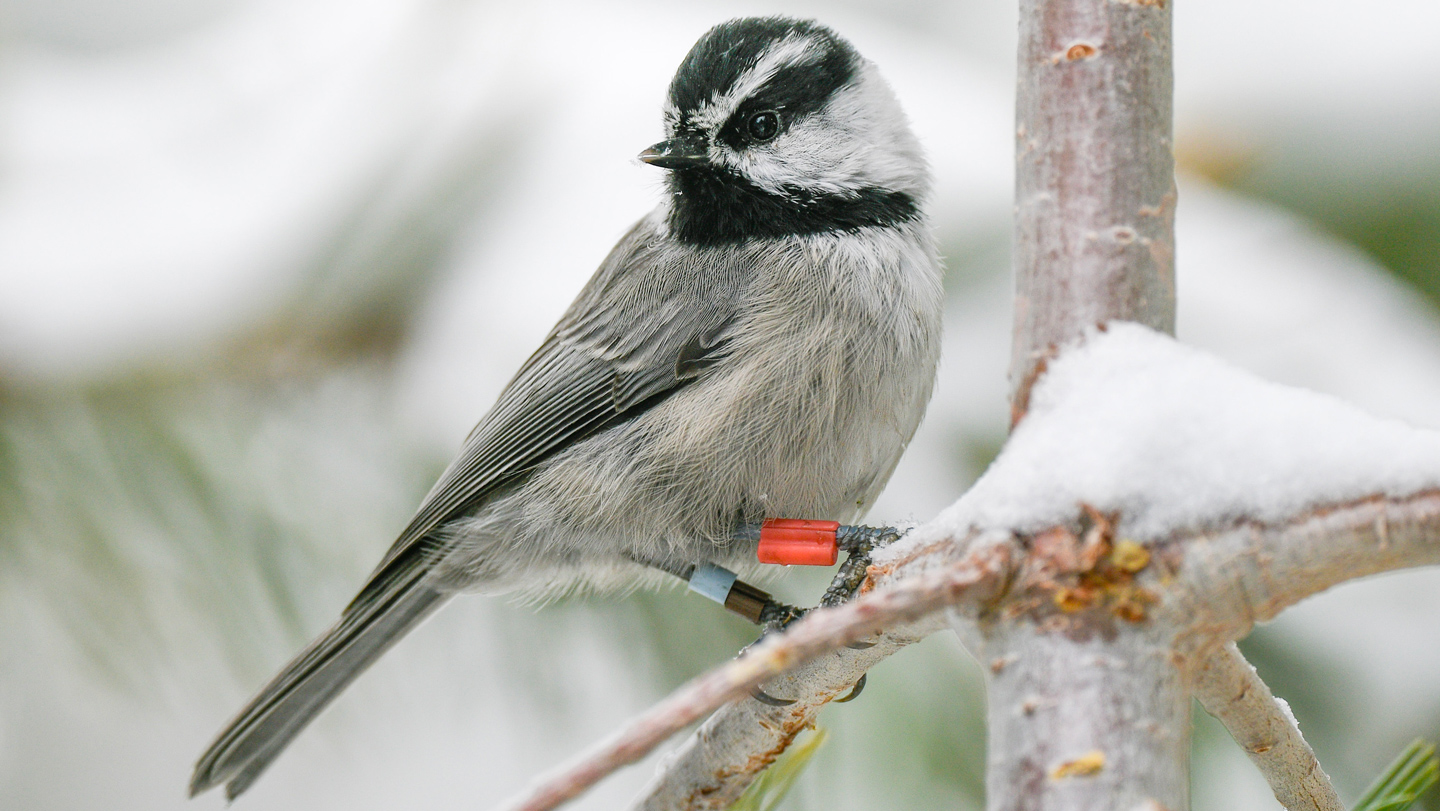
Imagine waking up on a freezing winter morning in the Sierra Nevada. You are a mountain chickadee, a round little bird no heavier than a pencil. Snow has fallen through the night and erased the familiar contours of the forest. The temperature is far below freezing, and the wind cuts through the pine branches. Your tiny body burns fuel quickly, and you have only minutes to find something to eat. There is no pantry in the ordinary sense—no single place where you stored all your food. Instead, over the previous autumn, you hid perhaps thousands of seeds in countless small hiding places: beneath flakes of bark, inside mossy cups, in cracks of dead branches, under clumps of pine needles. Each of those hiding places is now a small, secret promise of survival. And you have only one way to keep that promise: you must remember exactly where every one of them is. This is the daily life of a mountain chickadee, and it is why scientists have become so fascinated with this tiny bird. As one behavioral ecologist says, a given chickadee knows exactly where it hid each seed it stored for winter. That ability is so exact, so dependable, that it determines whether the bird lives or dies. It also makes the chickadee a remarkable model for the study of memory. The chickadee’s memory is not just an odd bit of animal behavior. It is a product of millions of winters, an evolutionary masterpiece shaped by the harsh demand to survive from one snowy morning to the next. In its small head, crafted by natural selection, is a living map of its whole world—a map that is rebuilt every year, tested every day, and trusted with absolute confidence. To understand the chickadee is to understand something deep about what memory is for, and why the brain becomes the way it is.
Mountain chickadees are food-caching specialists. In late summer and early autumn, they switch into a kind of furious harvest mode. They carry seeds and pine nuts away from cones and distribute them throughout their home ranges. They do not guard a single central store the way a squirrel might guard a burrow. Instead, they make many tiny caches, each one often holding just one or two seeds. This strategy spreads risk. If a single cache is stolen or destroyed, many others remain. But it also creates a monumental memory task. A single chickadee may produce hundreds or even thousands of caches in one season. Weeks later, in the heart of winter, it must return to these caches, often under several centimeters of snow, when landmarks have been transformed by weather. To do this, the chickadee relies on spatial memory, the ability to recall locations in relation to landmarks. It may use the shape of a tree, the angle of a branch, the color of a rock, or the pattern of light on the snow. Its hippocampus—a region of the brain that supports spatial memory—is unusually large and rich in neurons. Studies of food-caching birds have shown that species that store food tend to have larger hippocampi than species that do not. And among chickadees, individuals with better spatial memory often show stronger neural development in this region. But the chickadee does not simply follow memory like a machine. It also makes decisions. If a chickadee notices another bird watching it hide a seed, it may later return to that cache and move the seed to another spot—a behavior that suggests the bird understands the risk of theft and is able to track the movements of other animals. This is not instinct in the simple sense; it is flexible, social, and strategic cognition. Vladimir Pravosudov, a behavioral ecologist at the University of Nevada, Reno, founded a long-term chickadee study to understand why animals need good memories in the real world, not just in laboratory mazes. His research has revealed a kind of intelligence beautifully specialized for the demands of a winter landscape. It is a reminder that memory is not a separate, abstract mental ability. It is a survival tool, built by experience and shaped by natural selection.
One of the most striking discoveries from this research is that chickadees from different environments have different memories. Birds that live at high elevations in the Sierra Nevada, where winters are brutal and snow is deep, tend to have better spatial memory and a larger hippocampus than chickadees from milder, lower-elevation habitats. This pattern is exactly what evolutionary theory predicts. In a harsh environment, a chickadee that forgets a cache is unlikely to survive the winter; its mistakes are punished immediately. Over many generations, the birds that inherit sharper memories are the ones that leave offspring. Meanwhile, at lower elevations, the cost of forgetting is smaller. Other food sources may still be available, and winters are less severe. So the memory system may not need to be as precise. The result is a natural experiment in cognitive evolution. When researchers compare the brains of high-elevation and low-elevation chickadees, they see differences in the hippocampus itself. The high-elevation birds have more neurons, larger volume, and a more developed memory network. This is a powerful demonstration that the brain can evolve to match the environment—not necessarily in the span of millions of years, but in the comparatively recent time separating bird populations living at different altitudes. It also challenges a simple view of intelligence as a single, all-purpose trait. The chickadee is not necessarily better at every kind of task. It is better at exactly the kind of spatial memory that matters for its survival. In other words, cognition is not a general resource; it is shaped by life history. Pravosudov and his colleagues have emphasized that because we understand how critical memory is to chickadees, we can ask many new questions: What factors improve or harm memory? How does a poor memory affect an individual’s reproductive success? How do genes, diet, experience, social challenges, and even gut microbes interact to create a working memory? The chickadee is a model that allows scientists to connect behavior, brain, environment, and evolution in a way that few other wild animals allow.
Memory is usually expected to fade with age. For humans, forgetting a name can feel like a warning sign. But chickadees offer a surprising counterexample. Anya Parks, an evolutionary psychologist at George Washington University in Washington, D.C., has studied older chickadees and found that they remain mentally sharp. “Our old birds are sharp!” she says. This is not something scientists would have predicted by looking at many other species. In rodents, monkeys, and people, aging often brings a decline in memory and in the brain structures that support it. But for a chickadee, forgetting a cache is not a minor nuisance; it can be fatal. So the birds that survive to old age may be a selected group. They have already passed through many winters, and only those with excellent memory made it through. Therefore, when researchers examine old chickadees, they are seeing survivors—individuals whose memory systems have remained robust enough to keep them alive through years of harsh conditions. There may also be something protective about the chickadee brain. It is possible that the hippocampus continues to generate new neurons in adulthood, giving the bird a continually refreshed capacity for learning and remembering. Parks is also interested in another factor that has attracted tremendous public attention: the microbiome. The gut is home to trillions of microorganisms, and scientists are discovering that these microbes can affect many aspects of health, including the brain. Some popular accounts have claimed that supplements or diet changes can improve cognition by changing the microbiome. Parks is cautious about these claims. “There’s a lot of hype about what [it is] about the microbiome [that] can improve cognition, but no clear connections yet,” she says. Her research is trying to find out whether gut microbes really do influence chickadee memory, but she insists that the evidence is far from settled. In an age of miracle brain-boosting promises, the chickadee’s story is a reminder that complex mental abilities have deep roots, and that we should be skeptical of simple answers.
What makes this science so appealing is that it does not stay locked in a laboratory. Parks says, “I get all my ideas by watching birds in the wild.” That is how the chickadee project began and continues. Researchers catch wild birds, attach small tracking tags, and follow them through the changing seasons. They set up artificial feeders with hidden seeds to test memory in the field. They watch a chickadee fly to a branch, pause, hop to another, and then peck at a seed that is invisible to a human observer. Every movement is a clue to what the bird is thinking. Over time, these observations are combined with detailed studies of the birds’ brains. After behavioral testing, scientists might examine a bird’s hippocampus, counting neurons and measuring the structures involved in spatial memory. They can then correlate those brain measures with the bird’s environmental history and its caching behavior. This combination of natural observation, experimental design, and anatomical analysis is powerful. It lets scientists ask questions that would be impossible in a simple laboratory task: How does the actual experience of living in a snowy landscape shape the brain? Are differences in memory visible from the very first winter? Do older birds compensate for physical aging by relying on experience and established mental maps? And how do social interactions—such as watching another bird steal a seed—influence memory and decision-making? These questions are not just about chickadees. They illuminate the fundamental puzzle of why animals, including humans, have memory at all. Memory functions in the wild; it is shaped by ecology, by danger, by competition, and by the need to make decisions with incomplete information. Pravosudov wanted to understand this real-world memory, and the chickadee turned out to be the perfect guide. Its tiny brain, hidden beneath feathers and fluff, carries an atlas of the forest and a ledger of every hidden seed—a combination of memory, judgment, and social awareness.
In the end, the mountain chickadee is more than a cute bird with a good memory. It is a living reminder that the natural world is filled with intricate mental lives. A chickadee’s cache can be thought of as a library, a pantry, and a survival plan all at once. When it hides a seed, the chickadee is making a bet that its memory will not fail. When it returns to that seed weeks later, often under new snow and changed light, it is winning that bet one more time. The bird’s body may weigh less than a pencil, but its memory holds a detailed map of hundreds of places spread across a rugged landscape. It remembers not only where the seeds are, but perhaps which ones it has already eaten, which ones might have been stolen, and which locations were watched by competitors. It updates its map constantly, moving seeds, avoiding risky places, and balancing the costs of eating now against the need to save food for later. Scientists like Pravosudov and Parks are trying to understand this remarkable system, and they are learning that memory can evolve, that aging does not always mean decline, and that we should be careful about easy stories, such as the idea that changing the gut microbiome can somehow boost brain performance. The chickadee teaches humility and wonder. It shows that the most extraordinary minds are not always the largest. They may be small, feathered, quick, and always in motion. They may be the minds of creatures we barely notice as they dart through our backyards. But if we watch them with patience and curiosity, they can change the way we think about memory, survival, and the hidden lives of animals. The next time you see a chickadee—whether in the mountains or near your home—pause for a moment. You are looking at a creature that carries an invisible map of its world, a map drawn by memory and survival, a map small enough to fit inside a head that weighs less than a pencil. That is a wonder worth remembering.