

The human voice is one of the most intimate and essential things we possess. It carries not just words, but identity, emotion, humor, and connection. When illness steals it, the loss can feel absolute. Yet scientists are now racing to bring it back. Across laboratories and clinical trials, researchers are using powerful AI, brain implants, and voice cloning to restore the ability to speak to people who have lost it. This is not a distant dream; it is happening now, in small but significant steps. The Deep End: Talk to Me takes listeners into this world, through the stories of people like Casey Harrell, a man with amyotrophic lateral sclerosis who can no longer talk, and Jules Rodriguez, a comedian who performs live with a voice clone. Their experiences reveal both how far technology has come and how much further it must go. The science is awe-inspiring, but the human dimension is what truly matters. The voice is more than a tool; it is a bridge to everyone we love. To lose it is to lose a part of oneself. To restore it, even imperfectly, is to restore something fundamental.
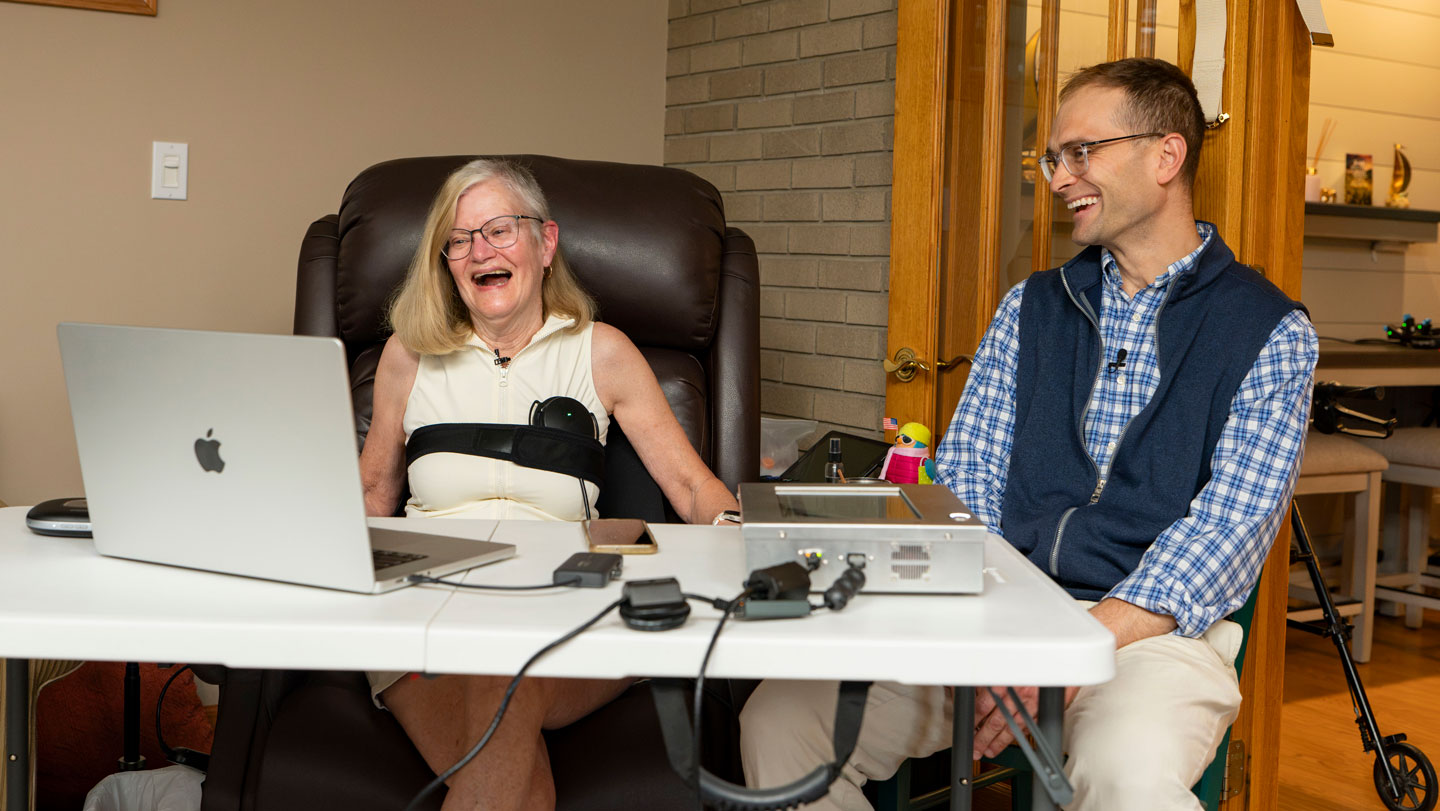
Casey Harrell’s story is a powerful example of what modern brain-computer interfaces can do. Casey has ALS, a disease that has taken away his ability to speak, and he volunteered for a clinical trial that changed his life. A device implanted in his brain detects the neural patterns that occur when he tries to say a word. Those patterns are decoded and turned into text, which is then spoken aloud by a digital voice. For Casey, this technology is nothing less than revolutionary. It allows him to parent his daughter, connect with his wife, and make jokes with friends. Timing, he says, is everything, and the ability to speak even a simple sentence in real time is a gift he never expected to have. But the system is far from perfect. It is not portable; it requires ports on his head and wires connecting to external equipment. And it is not fast enough for natural, effortless conversation. Casey must slow down, select words on a screen, and then trigger the voice. Still, the progress is astonishing. In the latest tests, researchers have been able to decode his intended speech directly into understandable sentences, reaching about 95 percent accuracy for listeners. The dream of going straight from thought to speech, without typing or selecting, is closer than ever. Casey calls this the holy grail, a seamless conversation that feels natural and automatic. That goal now drives the field forward.
Alongside Casey’s system, new devices are emerging that promise to be smaller, more elegant, and fully implantable. One such device comes from Paradromics, a neurotech company working with academic researchers. The device is about the size of a dime and sits on the motor cortex, the part of the brain that generates speech signals. Inside it are hundreds of tiny electrodes, each one smaller than a thumbnail, that listen to individual neurons. These electrodes get close to the brain cells that carry the information needed for speech, and they record the neural chatter with remarkable precision. This summer, neurosurgeon Matthew Willsey implanted one of these devices in a 68-year-old woman with primary lateral sclerosis, a disease that has severely impaired her speech. The device is fully wireless and cosmetically invisible, a stark contrast to the wires and ports that Casey’s system requires. Already, the woman has used it to talk to her grandchildren on the phone. In a video provided by Paradromics, she says a sentence in her natural, difficult-to-understand voice, and then a digital voice repeats the same words, perfectly clear. It is a moment of pure triumph. The researchers are quick to say this is only the beginning, but the trajectory is clear. The field of brain-computer interfaces has reached a tipping point. A decade ago, academic research de-risked the technology enough to attract companies. Now more than a dozen companies are pursuing their own versions of implantable devices. The pieces are coming together faster than anyone expected.
The next frontier is not just decoding words, but restoring the full richness of speech. Words alone are only part of communication. The same sentence can be a statement, a question, a joke, or an insult, depending on tone, emphasis, and rhythm. Scientists want to decode those layers too. Engineers like Vikash Gilja from Paradromics talk about capturing prosody, the pitch, stress, and timing that give speech its meaning. They want to decode whether a sentence is a question or a statement, whether a word is meant to be loud or soft, whether the speaker is happy, angry, or surprised. All of that information exists in the brain’s activity, and researchers are learning to pull it out. At UC Davis, Sergey Stavisky and his colleagues are working with Casey to decode emotional valence, whether he is trying to say something in an angry, surprised, or happy way. They are even experimenting with singing, or at least humming, as a way to explore tone and melody. The goal is to give people full control over what they communicate, not just the words but the music behind them. Another team, led by Samantha Brosler at the University of California, San Francisco, is asking whether a single brain implant can decode both speech and gestures at the same time. People naturally talk with their hands, nod their heads, shrug their shoulders, and give thumbs up. These movements add meaning and nuance. The researchers have built a digital avatar that can wave, point, and gesture while speaking. In theory, someone could say hello while waving, or say maybe while shrugging, just as naturally as anyone else. These efforts represent a profound shift. The technology is no longer just about restoring basic communication; it is about restoring expressiveness, personality, and humanity.
For Jules Rodriguez, a comedian with ALS, technology has already given him a remarkable gift: the ability to keep making people laugh. Jules types with his eyes, and his voice clone speaks the words he writes. The voice clone is not just a robotic substitute; it can insert tone, inflection, and even sass. Sometimes his wife, Maria Aleandra Fernandez, gets mad because his response comes off as cheeky. That is exactly the point. The voice is an extension of Jules, with all his humor and personality intact. In a comedy set performed in front of a live crowd, Jules wheeled onto the stage to the sound of “Walking on Sunshine.” The crowd went wild. He paused, wiggled his eyebrows, and deadpanned through his voice clone, “That is all the time I have. My Make-A-Wish covered only a few minutes. Goodnight, everybody.” The audience erupted. From there, he launched into stories about a weatherman who seemed too happy standing in hurricanes, the guilt trips lovingly crafted by his Cuban parents, and the indignities of having body parts shaved while his sister watched. It was hilarious, joyful, and heartbreaking all at once. Maria says that watching him perform feels like watching life itself. It is love, passion, and the most powerful thing she has ever witnessed. Comedy, she explains, is how people metabolize the hard feelings of life. Dave Chappelle once said that comedians are like the nation’s kidney, helping people process not just facts but the feelings around facts. Jules does exactly that. By making people laugh, he helps them face grief, mortality, and the reality of being trapped in a body that no longer obeys. He chooses not to be trapped in a larger sense. His humor is not self-deprecating or cruel; it is smart, genuine, and disarmingly honest. It heals.
The future of the human voice is unfolding faster than most of us realize. David Brandman, the neurosurgeon who implanted Casey’s device, imagines a conversation he hopes to have in five to ten years. A patient with ALS sits in his office, newly diagnosed, terrified of what lies ahead. He tells her, “I don’t have a cure for you, but I do have a device that I can implant that can help you communicate despite facing a future of paralysis. It is fully wireless, cosmetically invisible, and you will be able to use it to have meaningful conversations with friends and family.” That vision is not fantasy. The technology is already being built, tested, and refined. The barriers are real, but they are falling. Scientists are learning to decode not just words, but the emotional weight behind them. They are restoring gestures, facial expressions, and the subtle music of human speech. They are giving people back their voices, in every sense of the word. And yet, as Laura Sanders notes, the research is propelled by a simple and powerful fact: the human voice is too important to lose. Casey Harrell puts it best. Asked what his voice means to him, he says it means so much. It is the most important thing he has lost to this disease. But he has not lost it entirely. Through the work of dedicated researchers, through wires and electrodes and algorithms, through AI and voice clones and sheer human determination, his voice still reaches the people he loves. Jules Rodriguez still tells jokes, still makes his wife laugh, still connects with an audience. The technology is not perfect. It is clunky, slow, and sometimes frustrating. But it is moving. It is expanding. It is opening doors that were completely unthinkable just a few years ago. The voice is not just a biological function; it is identity, connection, and joy. Every advance in this field is a step toward restoring those things to people who thought they were lost forever. And that is something worth celebrating, now and in the years to come.