



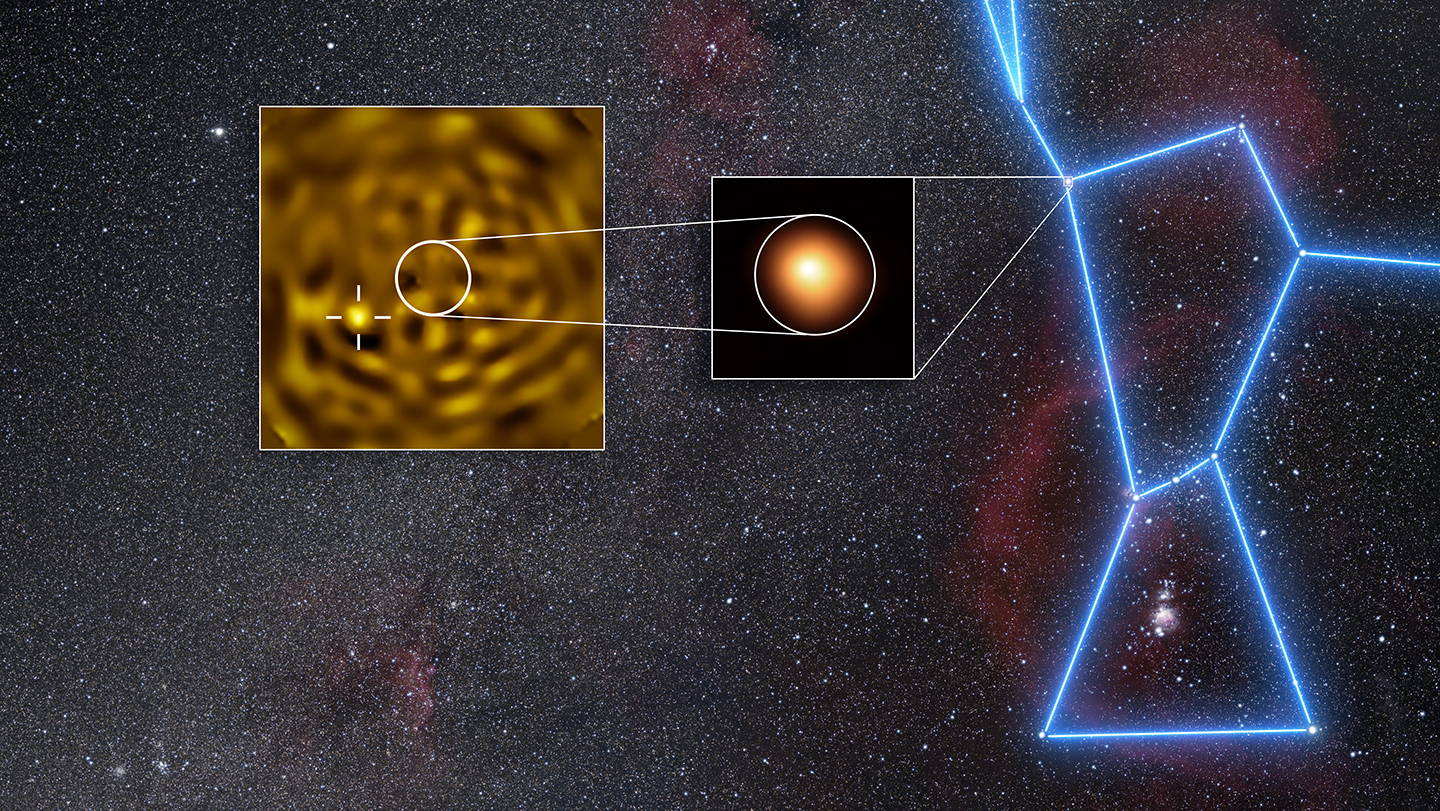
For millennia, humanity has looked up at the constellation Orion and marveled at the fiery, orange-red glow marking the hunter’s right shoulder. This celestial beacon is Betelgeuse, an aging red supergiant so immense that if it were placed at the center of our solar system, it would swallow everything up to the orbit of Jupiter. Because of its brilliant hue, staggering scale, and proximity to Earth, Betelgeuse has earned its place as one of the most thoroughly studied and culturally iconic stars in the night sky, a cosmic giant that astronomers know is destined to end its life in a spectacular supernova explosion. Yet, despite centuries of intense scrutiny, this famous stellar behemoth has managed to keep a profound secret hidden in its glaring shadow. Astronomers have recently pierced through this blinding light to capture the first clear portrait of an ordinary companion star orbiting the supergiant. This landmark discovery, achieved by adapting specialized technology originally designed to hunt for tiny exoplanets, shifts our understanding of Betelgeuse from a solitary giant to one half of a complex, long-theorized binary system.
The suspicion that Betelgeuse had a sibling is not entirely new; astronomers have spent more than a century chasing subtle clues and anomalous patterns in the giant’s behavior. Betelgeuse’s brightness is famously erratic, fluctuating on a complicated schedule that has long kept observers guessing. While rapid variations occurring over several hundred days are easily explained by the supergiant’s violent physical pulsations—essentially the star breathing in and out as gargantuan bubbles of hot plasma rise and fall on its surface—a much longer, more mysterious six-year cycle of dimming and brightening could not be attributed to these internal forces. In early 2024, a team of astrophysicists mathematically demonstrated that this slow, six-year rhythm was likely the gravitational signature of a smaller companion star clearing a path through the dust surrounding Betelgeuse. Calculating the orbit of this hypothetical partner, scientists realized that if the star truly existed, it would reach its maximum separation from Betelgeuse—and therefore its point of peak visibility from our perspective on Earth—in December 2024, opening a brief and highly anticipated window of opportunity for direct observation.
Capturing an image of this companion, however, represented an extraordinary observational challenge, akin to trying to spot a firefly hovering next to a brilliant stadium floodlight from miles away. To overcome this obstacle, a research team led by Andrea Dupree of the Harvard-Smithsonian Center for Astrophysics and Miguel Montargès of the Paris Observatory utilized the SPHERE (Spectro-Polarimetric High-contrast Exoplanet REsearch) instrument mounted on the European Southern Observatory’s Very Large Telescope in the high deserts of Chile. SPHERE is highly specialized in extreme adaptive optics and coronagraphy, allowing it to actively cancel out the atmospheric distortion of Earth’s air and physically mask the overwhelming glare of a bright target star to reveal much fainter objects in its immediate vicinity. By processing the mid-infrared and visible light data collected during the December 2024 window, the team successfully stripped away layers of stellar dust and scattered light, eventually isolating a distinct, bright pinpoint of light situated right beside the disk of the supergiant.
This breakthrough was accompanied by a moment of pure, unadulterated scientific joy that highlights the deeply human element of modern astrophysics. Andrea Dupree recounts visiting her colleague Miguel Montargès in Paris just as he finished processing the raw observations from the telescope in Chile. Suddenly, Montargès burst into the room, unable to contain his excitement, exclaiming, “Oh my god, look! Look what I just found!” On his screen was the undeniable, brilliant signature of the companion star, nestled against the supergiant’s outer envelope. The newly confirmed star was promptly named Siwarha, a beautifully poetic Arabic moniker meaning “her bracelet,” which serves as a thematic nod to the traditional Arabic origin of the name Betelgeuse, which translates historically to “the hand of the giant.”
With the image secured, astronomers immediately began analyzing the physical properties of Siwarha, uncovering details that challenged their initial assumptions about the companion’s origins and nature. By comparing the companion’s brightness to the supergiant and assuming that both stars coalesced from the same stellar nursery at the same time, the research team estimated Siwarha’s mass to be between 2.6 and 3.1 times that of our sun. This measurement is significantly more massive than astronomers had originally predicted, suggesting that Siwarha is a moderately hefty star in its own right, though still entirely dwarfed by its monstrous primary partner. This surprisingly high mass implies that the gravitational pull of Siwarha plays an even more active role in shaping the violent wind of gas and dust that Betelgeuse continually sheds into space, potentially dragging material into a disk around the smaller star and acting as a cosmic leaf-blower in the supergiant’s immediate neighborhood.
While the scientific community celebrates this monumental visual confirmation, the nature of scientific inquiry demands continued vigilance and verification before the discovery is universally accepted. Miguel Montargès, maintaining a characteristic academic caution, officially refers to Siwarha as a “strong candidate star” in the upcoming paper destined for the journal Astronomy & Astrophysics, preferring to wait for further data to eliminate any lingering shadow of a doubt. To turn this candidate into an absolute certainty, Montargès and Dupree are already planning their next major campaign for late 2027, the exact time when Siwarha’s orbital path is projected to bring it out from behind Betelgeuse and onto the opposite side of the supergiant’s disk. Andrea Dupree, however, admits she is already convinced of the reality of their find, noting with a smile that while some members of the team are naturally conservative, others are happy to declare that the stellar companion is absolutely there, forever changing how we look at the shoulder of Orion.