





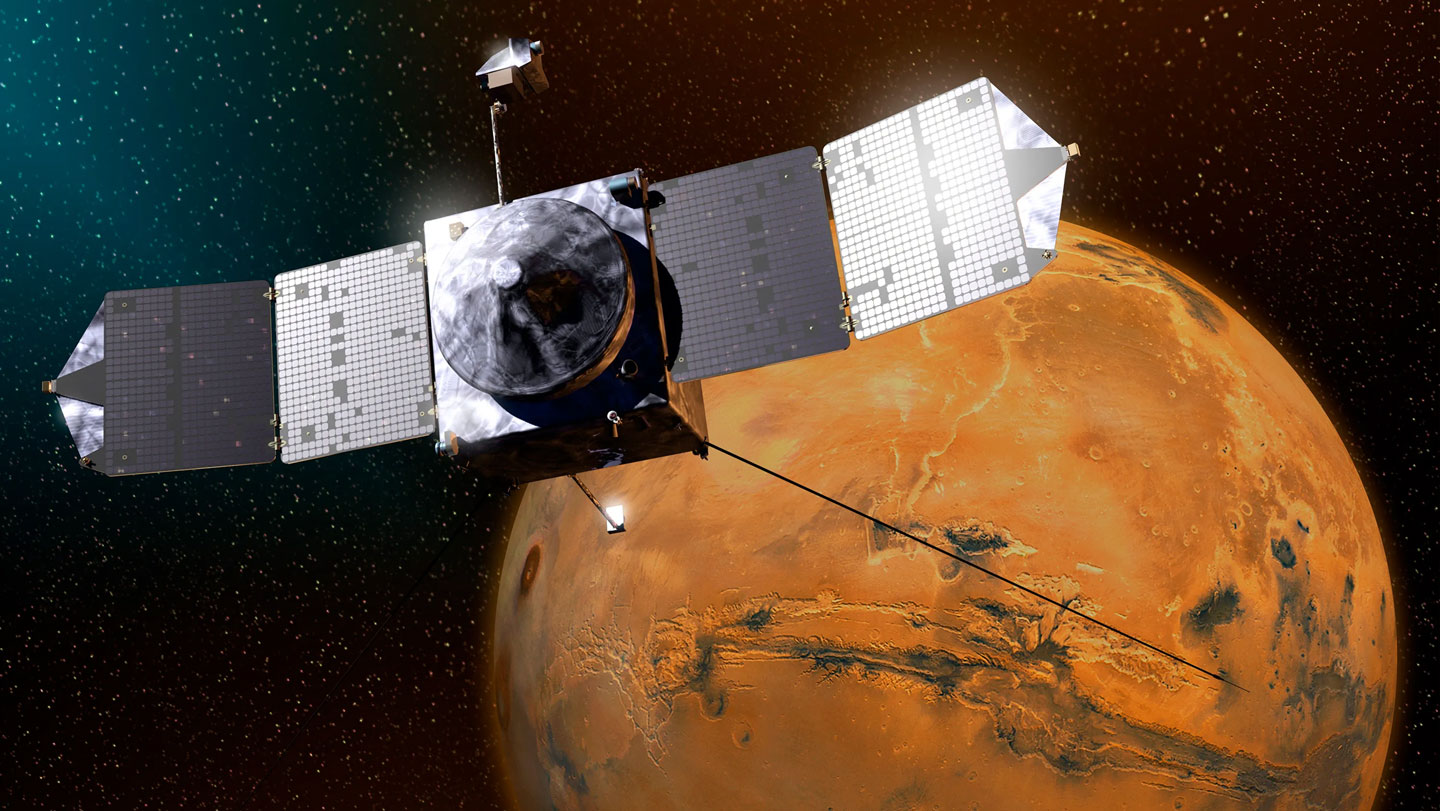
For more than a decade, a lonely robotic explorer danced along the outer fringes of the Martian sky, gently dipping its sensors into the wispy red atmosphere to taste the secrets of a dying planet. But now, that dance has ended, and the skies above Mars have grown just a little bit quieter. NASA has officially said its final, heartbreaking farewell to the MAVEN (Mars Atmosphere and Volatile Evolution) orbiter, declaring the legendary spacecraft unrecoverable after it unexpectedly went silent and drifted out of control. It was in December 2025, just as the spacecraft was preparing to slip into the shadow behind Mars, that its voice back to Earth suddenly vanished. When it finally emerged from the planet’s far side, the massive radio dishes of the Deep Space Network swept the void, met only by a cold, agonizing static. Scattered fragments of telemetry eventually trickled back to telemetry screens, revealing a deeply troubling diagnostic story: MAVEN was caught in an anomalous, uncontrolled spin, rotating slowly at 2.7 revolutions per minute in the dark. Engineers fought tirelessly to diagnose the issue, but a review board later concluded that this unexpected tumble had permanently turned MAVEN’s solar arrays away from the sun, draining its batteries and robbing the spacecraft of the vital electrical lifeblood needed to speak to Earth. At a poignant press conference, project manager Mike Moreau beautifully captured the human weight of the loss, confessing that for the scientists and engineers who had spent a third of their careers hovering over the probe’s health, the loss felt exactly like saying a painful holding-forever goodbye to a cherished, long-time family member.
To truly appreciate the grief of the team at NASA’s Goddard Space Flight Center and the University of Colorado Boulder, one must look back at MAVEN’s triumphant decade of service. Arriving at the Red Planet in September 2014, MAVEN was not designed to land on the rusty Martian dirt, but rather to perform a daring, high-altitude tightrope walk. Its unique elliptical orbit periodically brought the spacecraft on what the flight team called “deep dips,” plunging it deep into the upper layers of Mars’ atmosphere, a mere hundred or so miles above the surface. These dips were risky, challenging maneuvers that brushed the probe’s instruments directly through the thin, cold gases of the Martian thermosphere and ionosphere, gathering data that no other spacecraft could reach. MAVEN’s grand mission was to act as a cosmic detective, solving one of the most profound mysteries in planetary science: how did Mars, a world that once sparkled with vast liquid oceans, rushing rivers, and a thick, cloud-swept sky, transform over billions of years into the frozen, desolate, and hyper-arid desert we see today? For decades, scientists could only speculate about the disappearance of the Martian greenhouse, but MAVEN provided the physical evidence, painstakingly tracing the fingerprints of a long-lost atmosphere and painting a breathtakingly clear picture of planetary climate decay.
The defining scientific triumph of MAVEN’s long life was its discovery of how the Sun acts as a slow, persistent thief, gradually stripping Mars of its protective air. Unlike Earth, which is shielded by a powerful magnetosphere generated by a churning molten iron core, Mars lost its global magnetic shield billions of years ago as its interior cooled and went quiet. By measuring the interaction between the Martian sky and the solar wind—the relentless, supersonic stream of charged particles blowing outward from our Sun—MAVEN revealed that Mars is constantly losing its atmosphere directly to the vacuum of space, bleeding roughly 100 grams of gas every single second. This continuous escape rate is dramatic enough on its own, but MAVEN also observed that when the Sun occasionally erupts with violent solar storms, flares, and massive coronal mass ejections, this atmospheric erosion increases tenfold. Because our Sun was much younger, more active, and far more violent billions of years ago, MAVEN’s data allowed scientists to look backward in time and realize that Mars’ ancient atmosphere was likely ripped away in a historical blink of an eye, forever altering the planet’s evolutionary trajectory and ending its golden age of habitability.
Beyond tracking the continuous theft of Martian gases by the solar wind, MAVEN cataloged an array of exotic atmospheric phenomena that had never before been observed directly on another world. Among its most fascinating discoveries was “atmospheric sputtering,” a violent process where heavy charged ions are flung back into the atmosphere by solar forces, acting like tiny cosmic cue balls that literally smash lighter, neutral gas molecules out into the dark void of space. Yet, MAVEN also revealed moments of ethereal, fragile beauty amidst the harsh dynamics of the Martian sky, discovering entirely new types of planetary auroras that blanket the world in invisible ultraviolet glows. In a beautiful cross-mission collaboration, MAVEN worked in tandem with the Perseverance rover on the ground to capture the very first view of an aurora from the dusty surface of Mars, offering humanity a glimpse of the ghostly, dancing lights that future human explorers might one day look up and witness. The orbiter was also there to document the devastating global dust storm of 2018, revealing how these worldwide tempests lift water molecules high into the upper atmosphere, where they are easily torn apart by sunlight and lost forever, showing that even today, Mars is still actively losing its precious remaining water.
While the scientific community mourns the end of MAVEN’s atmospheric discoveries, the loss of the spacecraft represents an immediate, practical crisis for the operational infrastructure of Mars exploration. MAVEN was never just a science satellite; it was also a vital, high-capacity hub in the Mars Relay Network, an invisible telecommunications bridge suspended in orbit to translate and beam massive amounts of research data from active ground missions like Curiosity and Perseverance back to scientists on Earth. Because the rovers themselves lack the heavy transmitters and immense power required to beam high-resolution photos and physics directories millions of miles across the solar system, they rely on overhead orbiters to catch their signals and relay them home. With MAVEN suddenly gone, this crucial network has been reduced from five active satellites to just four, leaving the remaining orbiters to scramble and carry the extra communications load. While NASA officials assure the public that the network is resilient enough to adapt and keep the precious data flowing, they admit that the losses will inevitably cause frustrating delays in receiving science packages, leaving ground teams on Earth waiting longer to see what their robotic companions have discovered in the Martian dust.
The untimely demise of this orbital workhorse casts a stark and urgent spotlight on the profound fragility of humanity’s deep-space infrastructure. The remaining satellites in the Mars Relay Network are aging relics, ranging from ten to twenty-five years old, operating far past their design lifespans and vulnerable to sudden mechanical failures or being shut down entirely due to tightening federal space budgets. NASA has expressed interest in constructing a new, robust Mars Telecommunications Network to support future human exploration and the highly anticipated Mars Sample Return mission, but this next-generation comms array is not expected to be operational until 2030 or even later, leaving a dangerous five-year vulnerability gap. Planetary scientists warn that we are operating on a razor’s edge, relying heavily on old, tired machines to maintain our presence on a world millions of miles away. As MAVEN’s silent, frozen frame continues its perpetual, lonely tumble through the dark Martian skies, it stands as a monument to a spectacular decade of space exploration—and a somber warning of how quickly our hard-won eyes and ears on the red frontier can vanish into the dark.