



Imagine standing in a sun-dappled meadow, watching a fuzzy, golden-and-black bumblebee buzz lazily from clover to clover, seemingly guided by nothing more than simple, hardwired instincts. For centuries, humanity has relegated insects to the status of biological miniature robots—nature’s clockwork mechanisms operating on rigid, automated programming designed purely for survival. Yet, a startling and beautiful paradigm shift is quietly unfolding in the laboratories of behavioral ecologists, proving that our tiny, buzzy neighbors possess minds of astonishing flexibility and depth. In a groundbreaking study published in the journal Science, researchers have revealed that buff-tailed bumblebees (Bombus terrestris) possess an extraordinary capacity for spontaneous problem-solving, a cognitive feat previously thought to be the exclusive domain of large-brained vertebrates. Faced with a seemingly insurmountable physical obstacle, these brilliant little creatures managed to figure out, entirely on their own, how to use a tiny ball as a makeshift ladder to reach an out-of-reach sweet treat. This discovery, spearheaded by Olli Loukola at the University of Oulu in Finland, shatters our long-held assumptions about the relationship between brain size and cognitive capacity. By demonstrating that an invertebrate can independently devise a multi-stage physical strategy to solve a novel task without any social modeling or step-by-step training, this research opens up a mesmerizing window into the inner lives of insects. It challenges us to look on these tiny architects of our ecosystems with newfound respect, recognizing that beneath their furry, unassuming exteriors lies a highly sophisticated engine of curiosity and logic, capable of navigating the unpredictable challenges of their world with dynamic intelligence rather than just pre-programmed genetics.
Historically, science has reserved its highest praise for the cognitive superpowers of our closest evolutionary relatives, celebrating the tool-use of chimpanzees, the verbal logic of parrots, and the playful problem-solving of crows and dolphins. However, even in these celebrated studies of vertebrate brilliant minds, the subjects are almost always captive animals with a lifetime of experience interacting with human-made puzzles and toys, leaving a nagging doubt about their true raw, spontaneous abilities. What makes this new bumblebee study so breathtaking is that it represents the very first time researchers can be absolutely, one hundred percent certain that their subjects had absolutely no prior experience with problem-solving tasks before being placed in the experimental arena. It is a clean slate of discovery, showcasing a raw intellect that does not rely on a lifetime of practice or cultural transmission. While previous studies have hinted at the rich emotional lives of bumblebees—even revealing their capacity for social play and their ability to learn cooperative tasks like a miniature, six-legged version of soccer from watching their peers—this new finding elevates their reputation to an entirely new echelon. Spontaneous problem-solving on an individual level has never before been documented in any invertebrate species. It suggests that these insects are not merely great imitators or quick studies when shown what to do by a peer, but are instead active, creative thinkers capable of conceptualizing physical relationships between disjointed objects in their environment to manipulate their surroundings toward a desired outcome.
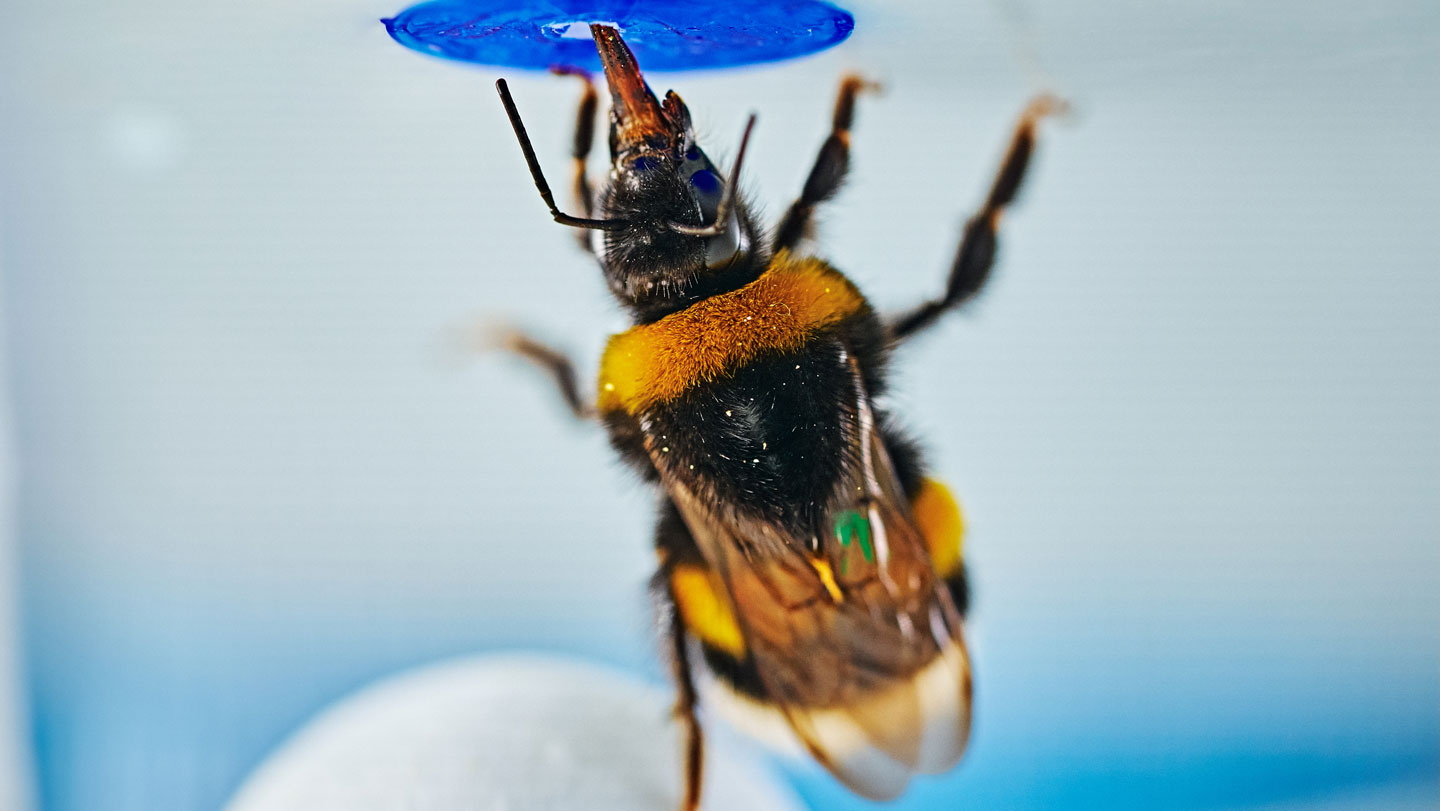
To unlock the secrets of this miniature insect intellect, Olli Loukola and his research team at the University of Oulu designed a brilliantly clever and rigorous experimental framework. They began by establishing two basic, foundational associations in the minds of the bumblebees: first, that small, lightweight balls were moveable objects that could be physically manipulated, and second, that a bright blue ring printed on a surface signified the presence of delicious, sugary food. Once these simple rules of the road were established, the real test began, and the bees were introduced to a completely novel architectural challenge. The researchers placed the bumblebees inside tiny, transparent plexiglass arenas where the coveted target—a fake flower represented by a blue ring soaked in rich sugar-water—was affixed to the ceiling, far too high for the bees to reach from the ground. Because the enclosure was deliberately designed to be too small and cramped for the bees to fly upward, they were physically grounded, staring up at an unreachable feast. Sitting nearby on the chamber floor was a small ball, an object they knew could be moved, but which had never before been presented to them as a structural tool. The question hung in the air: could a tiny insect, equipped with a brain no larger than a sesame seed, connect the dots between the distant ceiling target, the physical limitations of its own body, and the loose object resting on the floor?
The results of the experiment were nothing short of spectacular, defying the expectations of even the most optimistic animal behaviorists. Rather than running in circles or giving up in frustration, more than 70 percent of the bumblebees successfully figured out the complex, non-obvious solution, rolling the tiny ball across the arena floor directly beneath the ceiling target and clambering onto it like a ladder to happily drink the sugar reward. To ensure that this was not merely a series of happy accidents or the result of aimless, hyperactive rolling, Loukola and his co-author, behavioral ecologist Akshaye Bhambore, introduced increasingly difficult modifications to the enclosures, including complex barriers and double-room setups. In these advanced trials, the target sugar-water flower was entirely hidden from sight in a separate compartment, requiring the bees to first navigate to the hidden room, recall the location of both the flower and the faraway ball, and purposefully retrieve the ball to transport it back to the target site. The bees executed these deliberate, multi-step rescue missions with remarkable precision, leaving absolutely no room for the theory that they were acting out of simple trial-and-error or playful curiosity. As Bhambore enthusiastically observed, these tiny creatures clearly held a structured, abstract goal in their minds, demonstrating a profound understanding of the task’s mechanics and the structural utility of the objects at their disposal, transforming them from passive agents of nature into active, reasoning engineers.
While the intellectual triumph of the bumblebees is undeniable, the physical limitations of the experimental arenas left the researchers longing for a deeper, more intimate look at the exact moment of insight. Because the plexiglass chambers were so small and the action unfolded so quickly, standard recording equipment could not capture the microscopic, fleeting physical cues that signify a cognitive breakthrough—the insect equivalent of the human “aha!” moment when the pieces of a puzzle suddenly fall into place. In human psychology and primate behavior, these moments of sudden clarity are often accompanied by distinct physical gestures, changes in posture, or brief pauses in physical activity. To bridge this gap and peer directly into the spark of insect consciousness, the scientific team is currently planning their next phase of research, which will utilize ultra-high-resolution, slow-motion cameras and cutting-edge computerized video analysis. By slowing down the footage to a microscopic level, they hope to observe and document subtle behavioral tells, such as sudden pauses, changes in antennae coordination, or specific self-grooming behaviors that occur immediately before a bee successfully executes its strategy. This pioneering work aims to map the physical architecture of micro-cognition, allowing us to witness, for the very first time, the precise behavioral markers of an insect mind as it navigates the transition from confusion to sudden, triumphant comprehension.
Behind these fascinating scientific discoveries are human stories of immense passion and curiosity, led by talented scientists and writers like Dr. Erin I. Garcia de Jesus, a microbiologist and science communicator who seeks to bring these wondrous tales of non-human intelligence to the public. As we stand at a critical environmental crossroads, with our planet’s biodiversity facing unprecedented threats from climate change and habitat destruction, understanding the true depth of insect cognition is no longer just an academic curiosity—it is a vital conservation imperative. Bumblebees and other pollinators are the quiet, essential heroes keeping our global agricultural systems and wild ecosystems alive, and learning that they possess rich, problem-solving minds, and perhaps even emotional lives, fosters a deep empathy that can transform the way we approach environmental stewardship. By supporting rigorous science journalism and environmental literacy, we empower ourselves to see the natural world not as a collection of resources to be exploited, but as a vibrant, interconnected web of sentient, intelligent life worthy of our protection and wonder. The next time you spot a bumblebee navigating the flowers in your garden, remember that you are not just looking at a beautiful bug, but at a brilliant, tiny-minded pioneer of the natural world, navigating the challenges of its life with a creative spark of intelligence that mirrors the very best of our own.