



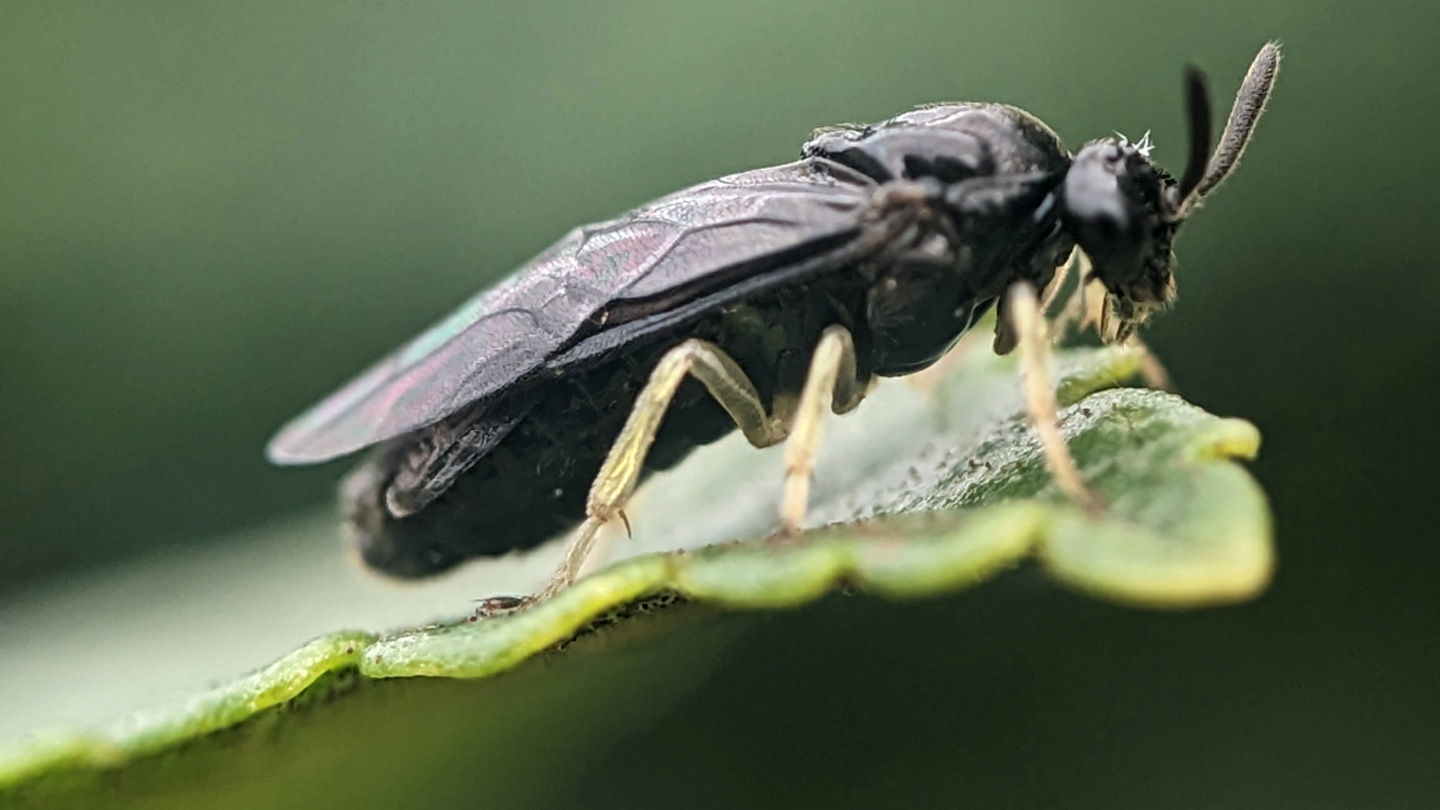
The Elm Zigzag Sawfly: A Tiny Invader with a Big Impact
The elm zigzag sawfly, a diminutive insect less than a centimeter long, is rapidly conquering North America without any male assistance. Named for the distinctive zigzag patterns it carves into elm leaves, this all-female species has become an alarming new threat to America’s elm trees, which are still recovering from the devastating effects of Dutch elm disease. First discovered in North America in 2020, this wasp (despite its name, it’s not actually a fly) originally from East Asia has expanded its territory at a pace that researchers describe as “alarming.”
In just over five years, this tiny invader has spread to fifteen U.S. states, establishing populations from New Hampshire to Minnesota and southward to North Carolina. Kelly Oten, an entomologist at North Carolina State University who maintains a tracking map of the sawfly’s expansion, recently added Indiana to the growing list of affected states. The insect’s feeding pattern starts with freshly hatched larvae cutting what Oten describes as “oddly cute” zigzagging lines into leaves. However, as these larvae mature, they can strip trees of their foliage so thoroughly that branches are left almost completely bare, putting significant stress on the trees.
What makes the elm zigzag sawfly particularly concerning to researchers is its unexpected versatility in host selection. In a surprising discovery, Oten’s research team found that the wasp can also attack Japanese zelkova trees, which many U.S. cities have been planting as replacements for American elms lost to Dutch elm disease. The researchers observed the sawfly completing its entire life cycle on zelkova saplings, which typically produce leaves earlier in spring than elms do. This ability to switch between host species is unusual among insects, according to Véronique Martel, a forest entomologist with Natural Resources Canada who first reported the sawfly’s presence in North America. She suggests this flexibility could make the sawfly even more successful by allowing it to begin reproducing earlier in the growing season, potentially producing multiple generations within a single summer.
A major factor in the zigzag sawfly’s rapid spread is its extraordinary reproductive strategy called thelytokous parthenogenesis – females lay unfertilized eggs that develop exclusively into more females. This means that even a single egg transported on firewood or a vehicle can establish an entirely new infestation. No male sawflies have ever been documented, making this all-female army remarkably efficient at colonizing new territories. The reproductive approach eliminates the need for females to find mates, allowing the population to grow exponentially as each individual can produce new generations independently.
The impact of the elm zigzag sawfly on trees remains somewhat mysterious. Researchers have observed that the larvae create only minor zigzag patterns on some elms while completely defoliating others, and the reasons for this variation aren’t yet understood. “At this point, we do not know if it’ll kill the tree or just stress it greatly,” Oten explains. What is clear is that humans have likely played a significant role in accelerating the sawfly’s spread. Oten’s research has documented cocoons containing sawfly pupae attached to truck mirrors and wheel wells, potentially transporting the insects far beyond their natural dispersal range of 45 to 90 kilometers per year. Scientists believe the pest may have initially arrived in North America hidden in the soil of an imported houseplant.
With native elm trees growing across most of eastern North America, the elm zigzag sawfly has abundant territory available for expansion. Oten predicts more reports from additional counties and likely more states by 2026, though temperature extremes may eventually limit the insect’s range. In response to this growing threat, Oten is testing various pesticides to help homeowners protect their trees, with early trials of two soil-applied insecticides showing promising results. Until more definitive solutions are available, experts recommend checking vehicles for cocoons before leaving infested areas and reporting any sightings of the characteristic zigzag patterns to local agricultural extension offices. As communities continue to recover from the devastating loss of elm canopies to Dutch elm disease, this new invader represents an unwelcome second wave of assault on America’s iconic elm trees.