


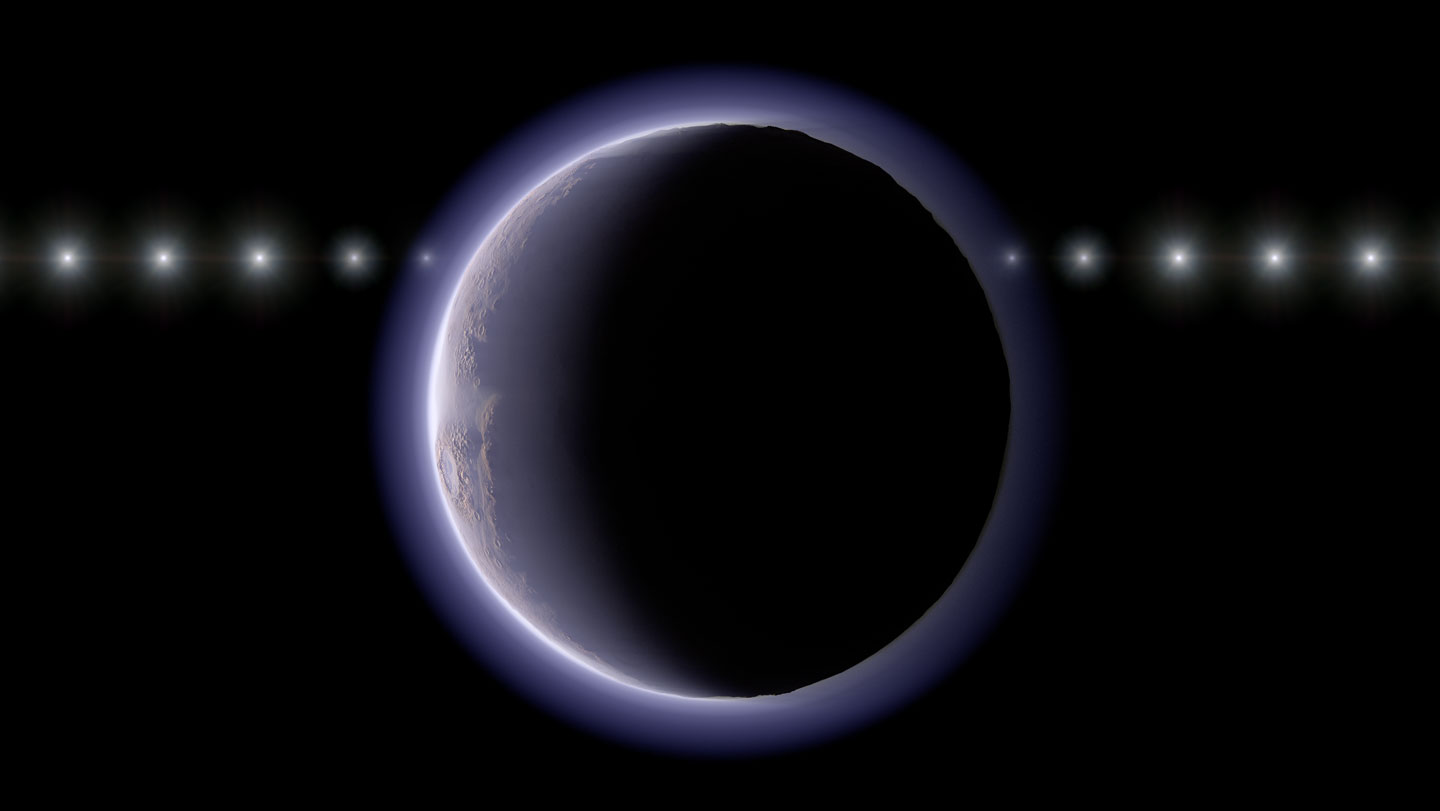
Imagine stumbling upon a cosmic whisper—a faint hint of breath on a distant, icy world that shouldn’t even be able to hold onto such a delicate veil. Astronomers have recently glimpsed something extraordinary: a small object orbiting beyond the orbit of Neptune, farther out than Pluto, that appears to harbor a thin atmosphere. This discovery, if confirmed, marks a groundbreaking moment in our understanding of the solar system’s outer fringes. Dubbed 2002 XV93, this tiny body is challenging long-held assumptions about such remote, frozen realms, suggesting they’re not as barren and unchanging as we once thought. It’s a reminder that our solar system still holds secrets that can surprise us, like a hidden life in the most unlikely places. But what makes this find so compelling? It’s about the sheer improbability of it all—the way a speck of rock and ice, cloaked in eternal cold, might actually have an aura of gas clinging to it. This isn’t just a scientific blip; it’s a story of exploration, innovation, and the relentless curiosity that drives humans to peer into the void, one telescopic glance at a time.
To truly appreciate this revelation, let’s zoom back and consider the broader tapestry of our solar system. Beyond the familiar planets and the asteroid belt, there’s a vast, shadowy domain known as the Kuiper Belt, teeming with icy remnants from the solar system’s formation. These trans-Neptunian objects, or TNOs, are like forgotten artifacts drifting in the abyss, many of them thought to be static lumps of ice and rock. Pluto, the dwarf planet we’ve come to know through New Horizons, was the only TNO known to boast an atmosphere—albeit a puffy, nitrogen-rich one that cycles with its seasons. But these smaller worlds, with diameters in the hundreds of kilometers, were presumed inert, their weak gravity unable to trap gases against the Sun’s distant pull or the relentless bombardment of cosmic radiation. For astronomers, finding Pluto’s atmospheric halo was a eureka moment; discovering a similar phenomenon on something even tinier feels like stumbling upon a rare bird in a desert.
Now, picture this: a team of Japanese observers, led by the diligent Ko Arimatsu from the National Astronomical Observatory in Mitaka, turned their gaze to one such enigmatic body. Using a constellation of telescopes strewn across Japan, they targeted 2002 XV93, first spotted back in 2002 and since cataloged as an unassuming Kuiper Belt resident. On a crisp January 10, 2024, as Earth basked in the early months of the year, telescopes in three different locations captured a fleeting event—a stellar occultation, where the object passed between our planet and a distant background star. These miniature eclipses are astronomical goldmines, revealing details about hidden structures like atmospheres or even rings, much like how Neptune’s rings were spotted during similar alignments.
What unfolded during those crucial seconds was nothing short of poetic. If 2002 XV93 had been nothing but barren rock, the star’s light would have vanished and reappeared like a sharp click—on, off, in an instant. Instead, the astronomers witnessed a graceful fade: the star’s glow dimmed and brightened over about 1.5 seconds, a smooth curve suggesting refraction through a hazy layer of gas. Arimatsu and his team interpreted this as evidence of a tenuous atmosphere, with pressure estimated at a mere one ten-millionth of Earth’s. For humans living under our rich, life-sustaining air blanket, it’s hard to fathom such fragility—a gas so thin it might dissipate in mere thousands of years without constant renewal. Yet there it was, bending light like a whisper in the wind, hinting at hidden processes on this 470-kilometer-wide orb, roughly the breadth of the Grand Canyon.
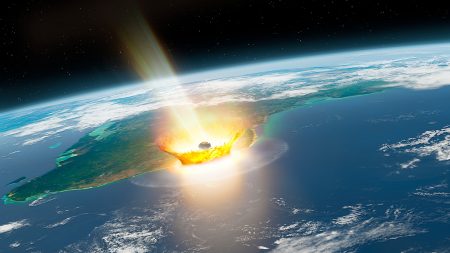
The surprise here cuts deep. 2002 XV93’s size makes it gravitationally weak; think of it as a pebble in a vast ocean, where centrifugal forces and solar radiation conspire to strip away any atmospheric pretensions. So, how does this little world hold onto its gaseous cloak? Arimatsu speculates on two tantalizing possibilities, each painting a vivid picture of cosmic dynamism. First, it could be a transient affair—a recent impact from a careening comet or icy fragment that excavated fresh gas from beneath the surface, now evaporating into the ether. Picture a cosmic collision releasing plumes of vapor, caught in the act by observant eyes at just the right moment. Alternatively, there might be ongoing geological activity, like icy volcanoes spewing fresh material cyclically. This volcanic scenario evokes visions of geysers on distant moons, where subsurface heat melts hidden ices, fueling a perpetual atmospheric refresh. Without more data, even dust particles or irregularities could mimic the effect, but the refraction points strongly to gas. It’s not just astrophysics; it’s a narrative of resilience in the harshest conditions, where life—or at least the chemistry of possibility—clings to existence.
Looking ahead, the astronomers emphasize the need for more eyes on this slippery enigma. Future occultations could track changes over time; if the atmosphere shrinks or vanishes within a handful of years, it might flag a fading impact scar, like a bruise healing on the march. But persistence, or even seasonal variations tied to the body’s 157-year orbit, would bolster the volcanic theory, inviting thoughts of active worlds in the deep freeze. Arimatsu’s tone reflects a mix of awe and caution—”I was genuinely surprised,” he admits, a testament to the human spark in science. This discovery isn’t isolated; it cascades into broader questions about the Kuiper Belt’s diversity, potentially rewriting textbooks on planetary atmospheres. As telescopes sharpen and international collaborations grow, we might uncover more such “thawed” enigmas, each one enriching our cosmic self-portrait. In the end, 2002 XV93 reminds us that exploration is about wonder, about seeing the extraordinary in the mundane, and about the quiet thrill of rewriting what we think we know about the origins of worlds. Who knows what other whispers we’ll catch next time the stars align?