


Imagine waking up one morning and realizing that the force pulling you back to Earth every time you try to float off your bed isn’t quite as strong as you thought. That’s the kind of revelation physicists are grappling with when they talk about the gravitational constant, or “Big G” as it’s affectionately called. For centuries, since Isaac Newton stumbled upon his brilliant ideas in the 17th century, scientists have been chasing the exact strength of gravity—the invisible glue that holds our universe together. Yet, G remains elusive, the weakest of nature’s four fundamental forces. It’s like trying to measure the whisper of a feather in a hurricane; even tiny disturbances can throw everything off. Recently, a team of physicists published a fresh measurement in Metrologia, the journal where top scientists share their precise findings. This new value is surprisingly smaller than what some past experiments suggested, hinting that there might be hidden tricks in the universe affecting our calculations. It’s a step forward in a long-term mystery, but it also opens up questions about whether we’ve missed something crucial in how gravity really works. As Michael Ross, a physicist at the University of Washington in Seattle, puts it, comparing G to other constants like those defining electricity, Big G is the black sheep—measured with far less certainty. While this won’t change how you weigh groceries or ride a bike, getting G right is pivotal. After all, gravity powers everything from planets orbiting the sun to the tides pulling at our oceans. A wrong value could mean cracks in our entire understanding of physics, potentially rewriting the rules of the cosmos. That’s why experts are cautiously excited; nailing down G isn’t just about numbers—it’s about ensuring we haven’t overlooked a fundamental truth of existence.
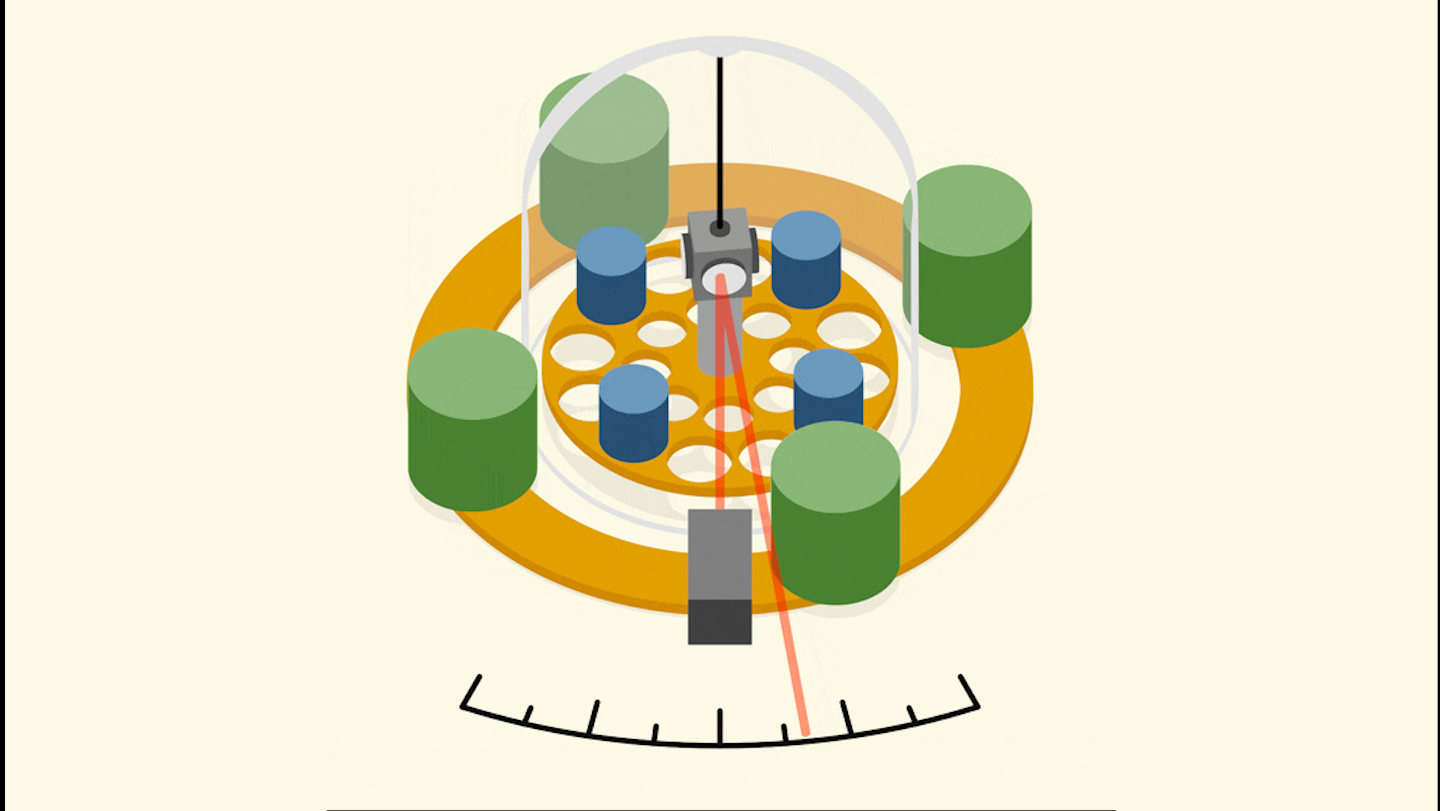
Now, picture yourself in the shoes of a curious 18th-century gent named Henry Cavendish, fiddling around with wires and weights in his London laboratory. Back in 1798, he invented the torsion balance, a clever contraption that suspended delicate fibers to measure how gravity tugged at metal spheres. It was revolutionary: by observing tiny twists as masses attracted each other, Cavendish calculated G for the first time. His setup was simple yet ingenious—think of it as a cosmic dance between four large spheres arranged on a rotating frame and a smaller set fixed to a suspended disk. The gravitational pull caused minuscule shifts, which he meticulously recorded. Over the years, scientists have built on this, refining the method to squeeze out more accuracy. But fast-forward to today, and we’ve got over a dozen high-precision experiments from the last 50 years, each claiming a slightly different G. Some values cluster together, while others drift farther apart, creating a puzzle that has frustrated researchers. These discrepancies aren’t random; they reflect subtle factors like temperature fluctuations or vibrations that can skew results. It’s like baking a cake: follow the recipe exactly, but a pinch of salt too much or humidity in the air, and the whole thing collapses. In our daily lives, these variations don’t matter much—you’ll still feel gravity’s pull the same way. But for physicists, it’s a nagging doubt. If G’s measurements keep disagreeing, it might signal a flaw in our theories, forcing us to rethink gravity’s role in the universe. That’s why Cavendish’s legacy lives on; his experiment set the stage for endless quests to chase perfection, reminding us that even the simplest forces hide profound complexities.
Zooming into the modern era, the hunt for G has become a community affair among physicists worldwide. Experiments aren’t just about dropping apples anymore; they involve laser beams, ultra-sensitive detectors, and sometimes even floating laboratories to shield against Earth’s tremors. Yet, despite all the tech, the values for G still spread out like kids at a wild party—ranging from about 6.67 to 6.73 in some units, depending on who you ask. This variation persists as a trend, not a fluke, and it’s got scientists scratching their heads. Why the inconsistency? Could it be that we’re not accounting for every tiny influence, like magnetic fields or even the composition of the metals used? These quirks make G the outlier among physical constants. For instance, the constant for electromagnetism is known with astonishing precision—about 100,000 times better than G. That disparity is unsettling because constants are supposed to be the immutable building blocks of reality. If G is off, it could ripple through everything, from cosmological models to predictions about black holes. Physicists like Michael Ross emphasize that keeping these numbers accurate is non-negotiable. Disagreements in G aren’t just academic squabbles; they could unravel our grasp of the universe, challenging whether gravity behaves exactly as Einstein described or if there’s something deeper lurking beneath the surface. People might not notice G’s wobbly value when picking up their morning coffee, but for science, it’s a call to action. Without precise constants, even satellites circling Earth could miscalculate orbits, leading to crises in navigation or exploration.
Enter the fresh experiment-led by Stephan Schlamminger from the National Institute of Standards and Technology—that brought some clarity to the chaos. Inspired by a setup first tried in France around the early 2000s, his team recreated the torsion balance method faithfully, hoping to sidestep the usual rabbit holes of inventing something brand-new. They positioned four hefty masses on a rotating ring, encircling four lighter ones on a suspended disk, much like Cavendish’s original design but with contemporary twists. The key was measuring the gravitational tug’s tiny effects: as the larger masses urged the smaller ones closer, a delicate fiber recorded the deflection. By replicating an existing technique, they aimed to build on solid ground rather than starting from scratch. Schlamminger’s group took extraordinary care, calibrating every element meticulously to avoid personal biases. They even concealed part of the data from themselves during processing—a clever trick to prevent subconscious influences from skewing outcomes. This wasn’t slapdash science; it was deliberate, patient work spanning lab hours that felt endless. The goal? To add a reliable data point to the G debate, perhaps revealing if past discrepancies stemmed from overlooked variables like air currents or material impurities. In a world where gravity seems straightforward, these experiments remind us how deceptive the fundamental can be. You’d think a force as constant as gravity would be easy to pin down, but each measurement peels back layers, showing just how much complexity hides in plain sight.
Of course, measuring G isn’t a walk in the park—literally and figuratively. Schlamminger recounts how his project dragged on for nearly a decade, a testament to the ordeal involved. One major hurdle was identifying unaccounted-for effects that could contaminate results. For example, changes in air pressure around the setup caused undetectable shifts in the masses, mimicking gravitational pulls. Then there were vibrations from distant earthquakes or even footsteps in the lab, which rattled the equipment ever so slightly. Water vapor, electrical fields, and even the Earth’s magnetic variations had to be controlled like unruly children at a birthday party. The team shielded their experiment from these intruders, using insulated chambers and precise temperature control to create a stable cocoon. It was painstaking: recalibrating instruments, running tests repeatedly, and double-checking every step to ensure no external force hijacked their data. Imagine being an astronaut in zero gravity but fighting micro-forces that mimic it— that’s the challenge with G. The difficulties underscore why Big G lags behind other constants; it’s not laziness on scientists’ part, but the sheer difficulty of isolating one of nature’s most pervasive yet subtle influences. Through all this, the researchers uncovered insights that could benefit future experiments, proving that grappling with G teaches us humility. When seen through a human lens, it’s like trying to listen to a distant melody in a noisy room; the closer you get, the more you realize the cracks in your understanding.
Finally, the payoff: after years of toil, Schlamminger and his colleagues settled on a value for G of 6.67387 × 10^{-11} meters cubed per kilogram per second squared—a figure that’s 0.0235 percent lower than the original French experiment’s result. This might sound minuscule, but in the world of ultra-precise physics, it’s significant, hinting at the precision needed. Intriguingly, their number aligns more closely with the official recommendation from the Committee on Data of the International Science Council, the gatekeepers who vet these constants for global use. While it doesn’t resolve the lingering debate—other measurements still diverge—the new data point offers hope. It suggests that with continued refinements, we might one day harmonize the values, closing the gap on one of physics’ most stubborn mysteries. For everyday folks, this means gravity stays reliable; your phone won’t suddenly float away. But for scientists, it’s a victory lap in a marathon. As Ross points out, if these discrepancies reflected something inherent in nature, it’d shatter our physics—a cosmic horror show. Instead, this step forward reassures us that the quest is worth it, gradually unveiling gravity’s true strength. In essence, these physicists aren’t just crunching numbers; they’re humanizing the cosmos, turning abstract forces into stories of persistence and discovery.