


Cosmic Mystery: Enormous Ring-Shaped Structure Challenges Our Understanding of the Universe
A spectacular cosmic discovery has astronomers questioning one of their most fundamental assumptions about the universe. Recently identified at the American Astronomical Society meeting, an enormous ring-shaped structure spanning more than 3.3 billion light-years has been detected by cosmologist Alexia Lopez of the University of Central Lancashire. This colossal cosmic formation—if confirmed—could seriously challenge the cosmological principle, the foundational idea that the universe appears roughly the same in all directions when viewed on sufficiently large scales.
Mathematical physicist Eoin ÓColgáin from Atlantic Technological University describes the cosmological principle as “the second most fundamental assumption in the field,” surpassed in importance only by Einstein’s theory of general relativity. This principle underpins virtually all modern theoretical models of the universe, assuming matter should be evenly distributed across vast cosmic scales. Without this assumption, our understanding of the cosmos would be thrown into disarray—or as ÓColgáin colorfully puts it, “all hell would break loose.”
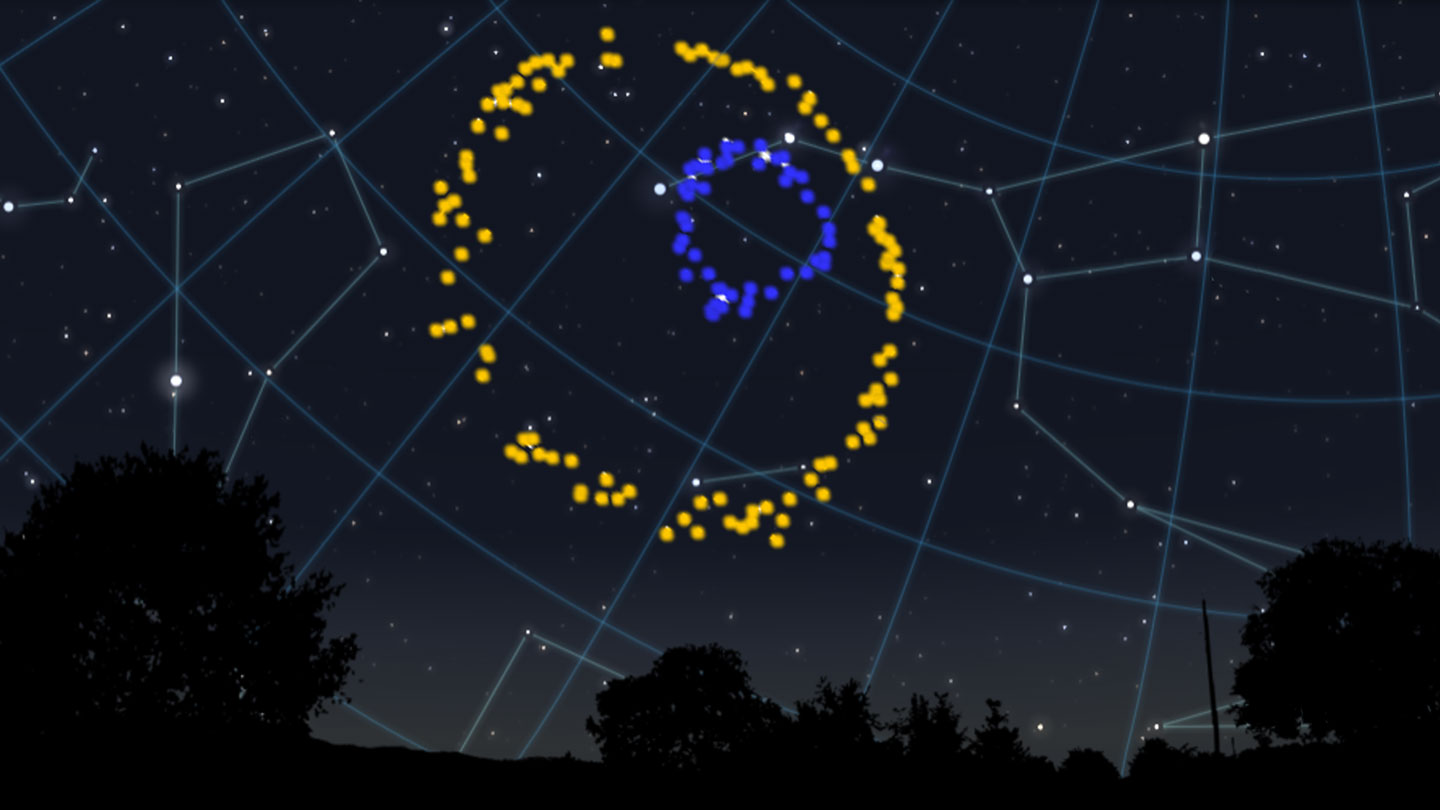
This newly discovered giant ring isn’t alone in challenging conventional cosmology. It appears to be an extension of a previously identified “giant arc” of galaxies, and remarkably, it encircles another enormous structure called the “big ring.” Together, these structures form a complex cosmic arrangement that seems improbable under current cosmological models. Lopez herself questions whether existing theories can adequately explain “something like a ring and an arc together.” The implications of these findings suggest we may need to reconsider some of our most basic assumptions about how matter is distributed throughout the universe.
The detection of these enormous structures came through a clever use of light from distant quasars—incredibly bright regions powered by supermassive black holes—captured by the Sloan Digital Sky Survey in New Mexico. As this quasar light travels billions of light-years through space, it gets partially absorbed and altered by atoms in galaxies along its path. By analyzing these subtle changes in the light, Lopez and her team have been able to map out the intervening matter. The journey of discovery began in 2021 when Lopez first identified the “giant arc” of galaxies, all positioned at approximately the same cosmic distance, with their light reaching us from when the universe was about half its current age—roughly 7 billion years ago. In 2024, she added the “big ring,” which appeared to hover above the arc “like a cyclops eye over a smile.” The final piece came when Lopez noticed a thin filament arcing above the big ring, potentially connecting with the previously discovered giant arc to form a complete circle.
To ensure these structures weren’t just chance alignments or pareidolia (the tendency for humans to see patterns where none exist), Lopez conducted rigorous statistical tests. Her analysis suggests that the probability of this ring-shaped structure forming by accident is extremely low. According to the cosmological principle, such enormous coherent structures shouldn’t exist in a homogeneous universe, which makes this discovery potentially revolutionary for our understanding of cosmic evolution and structure formation.
Not all scientists are convinced these findings necessitate a complete overhaul of cosmological theory. ÓColgáin believes that large structures alone aren’t sufficient evidence to abandon the cosmological principle, though he acknowledges it faces other challenges. Some researchers argue that computer simulations incorporating the cosmological principle can produce structures resembling the giant arc. However, Lopez counters that the simulated structures differ significantly from her observations. The debate highlights the tension between established theory and new observations that don’t neatly fit existing models.
The scientific process will ultimately resolve these questions through additional data. As Oxford University astrophysicist Subir Sarkar notes, Lopez’s work still awaits peer-reviewed publication, but he finds the ring structures particularly compelling: “That is not something one would expect to find by chance…. That does sound pretty extraordinary.” Fortunately, larger and more sensitive sky surveys are coming online, including the Dark Energy Spectroscopic Instrument in Arizona and the Vera C. Rubin Observatory in Chile. These advanced instruments should provide definitive evidence about these massive cosmic structures. Rather than endless theoretical debates, Sarkar suggests a practical approach: “We should just get more data, and more things should show up.” This patience and commitment to gathering more evidence exemplifies the scientific method at its best—allowing observations, rather than preconceptions, to guide our understanding of the universe.