


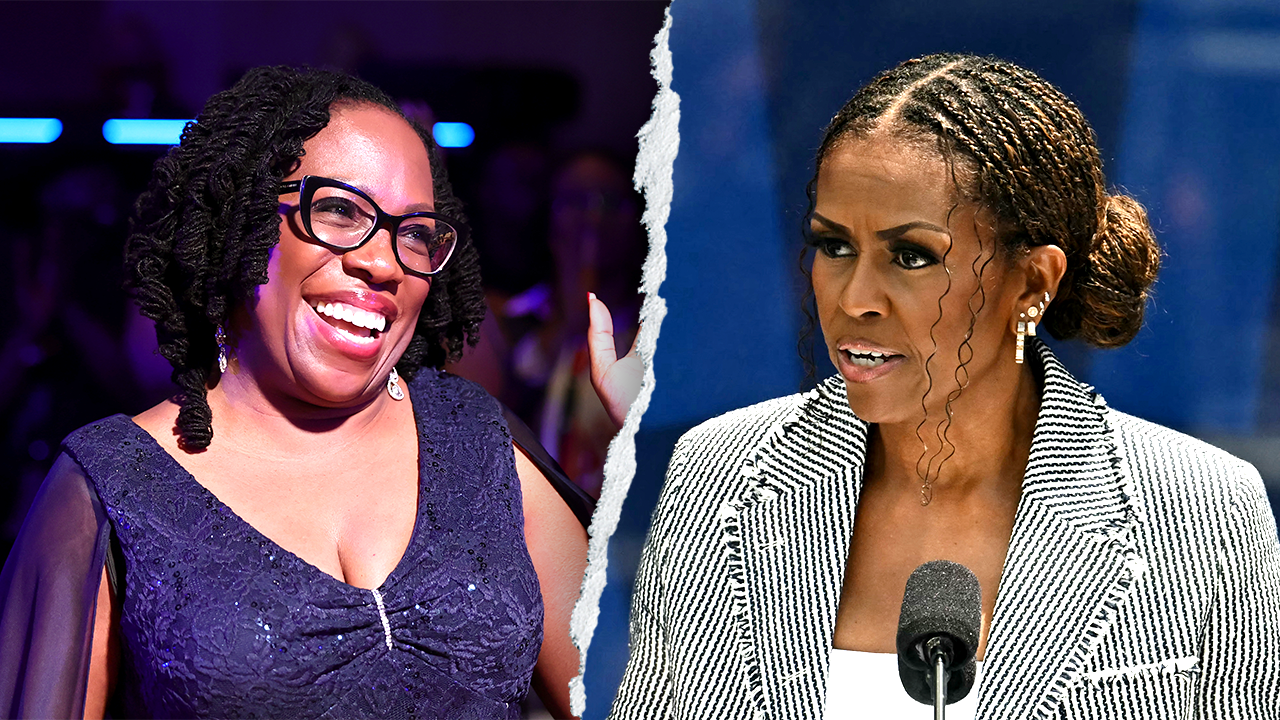
In our contemporary, hyper-connected era where public trust in national institutions is continuously tested, the boundary separating the highest court in the land from the fast-paced, politically charged world of pop culture has become increasingly blurred. This evolving dynamic was recently thrust into the national consciousness following an appearance by Supreme Court Justice Ketanji Brown Jackson on the popular podcast “IMO,” hosted by former First Lady Michelle Obama. Engaging in a deeply personal and extensive conversation lasting over an hour, Jackson, who was appointed by President Joe Biden and made history as the first Black female justice on the nation’s highest bench, opened up about the heavy weight of her responsibilities and her daily struggle to maintain an unbiased perspective. However, what was intended as an illuminating and humanizing dialogue about the rigors of her judicial duty unexpectedly transformed into a fierce lightning rod of controversy across social media. Critics and political observers were quick to point out the stark irony of a Supreme Court justice preaching the absolute necessity of maintaining a neutral, non-partisan stance while simultaneously guest-starring on a platform run by one of the most prominent, influential icons of the progressive movement. This media event quickly metastasized into a symbol of a much broader, ongoing cultural debate regarding whether it is truly possible for a modern public figure to disconnect their official duties from the highly polarized political machinery that surrounds them.
During the podcast episode, Justice Jackson discussed her judicial philosophy not as a set of cold, abstract principles, but as a deeply personal and constant daily commitment to intellectual honesty and scrupulous self-examination. In conversing with Obama, Jackson described the relentless effort it takes to remain objective, noting that the obligations of her office demand a level of discipline that is both rare and incredibly isolating. “There are lots of limits on what judges can do, and I try to be very, very mindful and scrupulous with respect to that because, as you say, our obligation is to be unbiased in our approach,” she emphasized, articulating the profound gravity of her role. She went on to explain that this strict adherence to fairness requires her to actively manage the numerous external influences that could creep into her decision-making process or, just as critically, create an “appearance of partiality” in the eyes of a deeply skeptical American public. For Jackson, the human element of being a judge involves a continuous negotiation with the outside world, a process where she must actively turn down invitations, decline prestigious engagements, and limit her social circles to protect the integrity of the bench. This window into her daily life painted a picture of a woman fighting to construct a fortress of objectivity around her mind, navigating a society that constantly seeks to pull public figures into partisan camps.
The conversation became even more revealing when Michelle Obama probed deeper, asking Jackson to share her personal defense mechanisms against the constant flood of biased media, partisan news, and conflicting outside interests. Obama, who has lived through her own share of intense public scrutiny, questioned how the justice manages her daily cognitive intake and what steps she physically takes to ensure she stays “above board” amid potential operational conflicts. Jackson’s response shed light on the structured, supportive network of the Supreme Court, revealing that her personal ethics are backed by a robust institutional apparatus. Heeding the advice of her legal advisers, she explained that she relies heavily on dedicated professionals within the court, regularly submitting her guest invites, speaking engagements, and public appearances to the legal and public information offices for rigorous ethical screening. This defensive system, Jackson argued, prevents her from inadvertently participating in fundraising activities or stepping into environments that could cast doubt on her professional independence. By revealing these behind-the-scenes mechanics, Jackson sought to reassure listeners that the integrity of the Supreme Court is maintained not just by personal willpower, but by a structured, collective commitment to ethical hygiene, illustrating the invisible guardrails designed to keep justice blind.
Despite Jackson’s earnest and detailed explanations of her ethical frameworks, the public reception of the podcast was swift, polarized, and highly critical, exposing the raw nerves of a country deeply divided over the legitimacy of its legal institutions. Many conservative and independent commentators viewed her appearance with a mixture of disbelief and frustration, arguing that the setting of the interview completely undermined Jackson’s lofty declarations of neutrality. For these critics, the irony was too glaring to ignore: here was a sitting justice of the United States Supreme Court, speaking passionately about the absolute need to avoid the mere “appearance of partiality,” while simultaneously sitting on the set of a podcast hosted by a major progressive figure who remains a cornerstone of the Democratic party. Social media platforms quickly lit up with accusations of hypocrisy, with users arguing that the choice of media outlet itself constituted a clear political statement. This reaction highlighted a fundamental tension in American civic life, where the general public is increasingly unwilling to separate the message from the medium, viewing any participation in partisan-associated spaces as evidence of a deeper, unexpressed political bias.
The backlash was punctuated by sharp, public remarks from several vocal commentators and conservative influencers who criticized the justice for what they characterized as a lack of self-awareness. Turning Point USA contributor John Amanchukwu pointedly remarked on the bizarre optical contradiction of discussing neutrality on Michelle Obama’s set, while conservative influencer Patricia Foster expressed open skepticism about whether Jackson honestly expected the public to believe her assertions under such circumstances. Commentator DeVory Darkins went several steps further, calling the situation surreal and arguing that it is impossible to take Jackson’s claims of judicial neutrality seriously when she is so visibly aligning herself with a major figure on the political left. Additionally, Harris Rigby, a writer for the Babylon Bee’s non-satirical division “Not the Bee,” drafted a blistering critique calling Jackson “the most public, loud-mouthed, self-assured judge” in American history, and describing the podcast appearance as an ironic lecture on the dignity of the courts from someone actively undermining it. These comments, while harsh, reflect a deep-seated frustration among many Americans who believe that the Supreme Court’s traditional mystique and protective isolation are being eroded by a culture of celebrity, making the justices appear more like political influencers than impartial arbiters of constitutional law.
In the final analysis, this high-profile cultural moment serves as an enduring testament to the modern paradox of public service in the United States, where the desire for transparent, humanized communication often collides explosively with the strict demands of institutional dignity. On one hand, Justice Jackson’s eager participation in a popular podcast represents a well-intentioned effort to make the Supreme Court feel less remote and more relatable to everyday citizens, explaining the complex protections and ethical processes that keep the legal system functioning. On the other hand, the intense controversy generated by her appearance signals that we live in an era where true neutrality is widely perceived as an illusion, and even an honest discussion about the mechanics of being objective can be quickly weaponized as a partisan act. As the Supreme Court continues to navigate a turbulent period of declining public trust and heightened ideological scrutiny, this episode leaves us with a profound, lingering question about the future of the American judiciary: in a digital world where every association is parsed for political meaning, can any justice truly maintain the appearance of perfect impartiality, or has the court’s sacred, non-partisan bubble been permanently popped?