


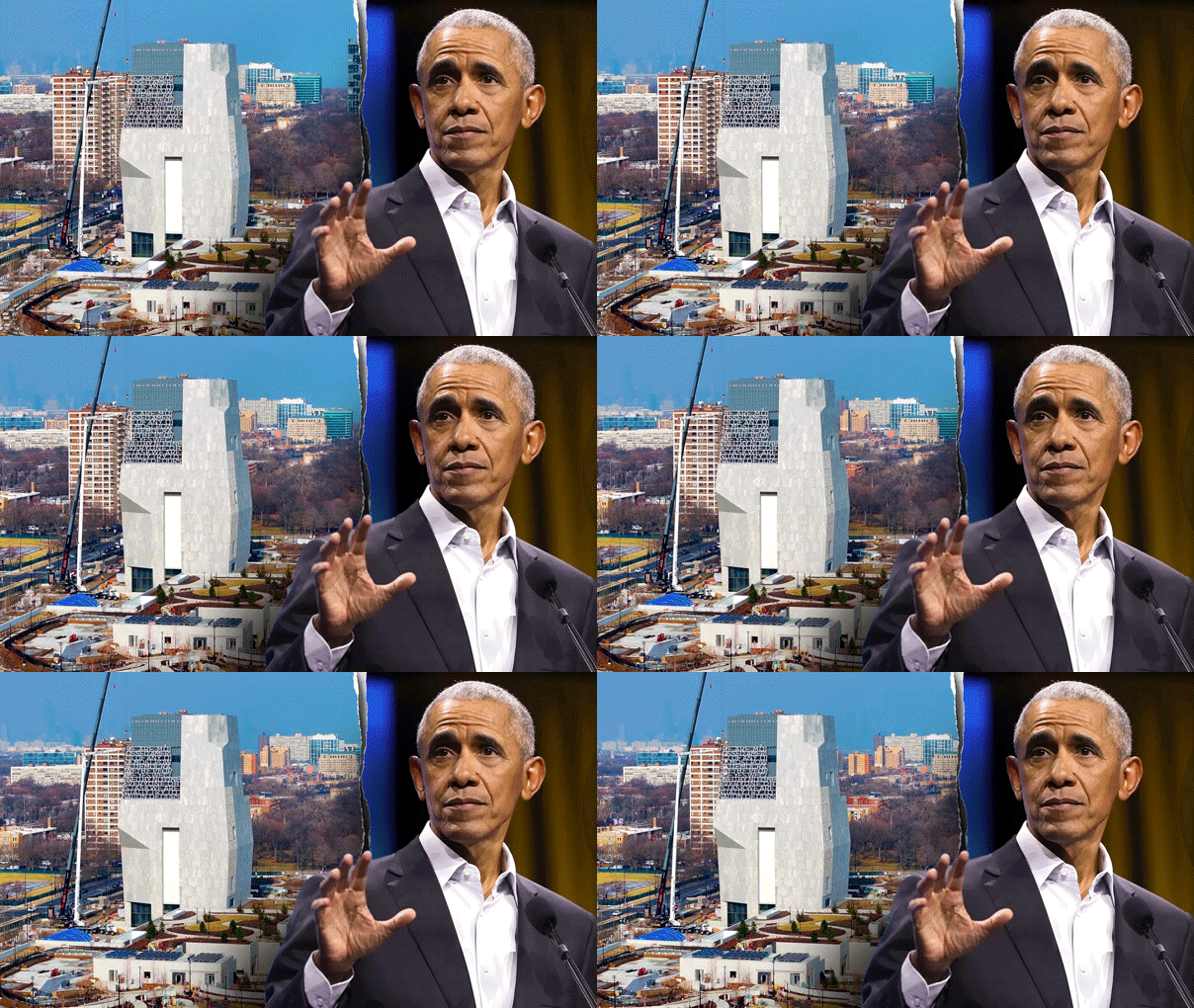
Imagine a grand vision: a former president, Barack Obama, promising Chicago a gift – a sprawling presidential center in the heart of historic Jackson Park, a place that would honor his legacy, foster community, and maybe even spark economic revival on the South Side. It sounded inspiring when announced in 2018, a beacon of hope for a city grappling with systemic underinvestment. But fast-forward to today, and that “gift” feels more like a burden, with everyday taxpayers unknowingly footing a massive bill for the hidden infrastructure costs that make this $850 million project even possible. Picture this – the Obama Presidential Center, a 19.3-acre campus that’s not your typical stuffy library with dusty archives, but a vibrant space for leadership programs, civic discussions, and digital access to Obama’s records. It’s privately owned and operated by the Obama Foundation, without any rent checks to the government, all funded by donations. Yet, the behind-the-scenes work – those redesigned roads, rerouted stormwater systems, and relocated utilities – is squarely on the public’s dime. No matter how you slice it, this wasn’t just about private money elegantly placed on a park pedestal; it demanded a full-scale public makeover to function, leaving Illinois and Chicago residents wondering when the real price tag would finally come due. As Kathy Salvi, the Illinois GOP Chair, put it bluntly to Fox News, it’s like watching a bad movie script unfold: Democrats hyping a “gift” while taxpayers get stuck with “hundreds of millions of dollars” in hidden costs, all wrapped in a culture that feels like pay-to-play favoritism. In a world where trust in institutions is already fraying, this project shines a spotlight on how big ideas can come with strings attached, turning a potential community uplift into a financial fog. And here’s the kicker – despite months of digging, no single agency can spit out a clear, reconciled total for what taxpayers are really paying. Each department holds a piece of the puzzle, but piecing it together? Frustratingly elusive, like trying to complete a jigsaw with missing corners.
Back in 2018, when the approval went through, Obama and his foundation pledged to cover the construction of this sprawling, $19.3-acre behemoth entirely through private donations. It was a noble nod to self-sufficiency, ensuring the building itself – with its innovative design and community-oriented spaces – would rise without public handouts. Projections at the time painted a rosy picture: about $350 million for the infrastructure legwork, split 50-50 between the state of Illinois and the city of Chicago. Think of it as the unsung heroes of the project – the roads that needed tweaking, the watersystems that had to drain better, and the utilities shifted to avoid chaos when visitors flood in. Cornell Drive, a once-bustling four-lane road snaking along Jackson Park’s lagoon, was supposed to handle traffic gracefully, but the plan demanded more. Legal challenges swirled around the land transfer – a controversial $10 deal on 99-year terms for that historic parkland, fought in courts over whether it truly served the public good. (Spoiler: the suits were dismissed, but the debates lingered.) Now, eight years later, the reality bites: the Illinois Department of Transportation (IDOT) tallies up roughly $229 million in state-managed spending on infrastructure, a hike from the earlier $174 million estimate. Federal transportation funds might mingle in there, blurring lines even further. On the Chicago side, officials aren’t forthcoming either – no clear update on the city’s roughly $175 million share, and whispers of overlap with state funds create a muddled math class nobody wants to ace. It’s like when you buy a fancy coffee machine expecting no extras, only to realize you need new outlets, plumbing, and a whole kitchen redo. Families paying taxes might not notice the bills trickling in, but collectively, it’s a fortune pouring into what was supposed to be a private endeavor. In human terms, this means everyday folks – teachers, nurses, retirees – are subsidizing a project that could shape futures, yet the bookkeeping feels deliberately opaque, sparking outrage over who knew what and when.
The difficulties in pinning down the true cost highlight a transparency vacuum that’s as puzzling as it is infuriating. Fox News Digital launched a barrage of Freedom of Information Act (FOIA) requests and media inquiries, hitting up everyone from IDOT and Chicago’s Department of Transportation (CDOT) to the Office of Budget and Management (OBM), the Mayor’s office, and even Governor J.B. Pritzker’s team. Month after month, the responses dribbled in: partial figures here, denials there, but not a single unified accounting of the total public infrastructure tab. No one seems to be the boss of this beast – agencies admit there’s no reconciled total, and overlaps between city and state spending remain shrouded in mystery. The Illinois Attorney General’s Public Access Counselor is now stepping in to check if transparency laws were followed, a watchdog move that’s overdue. It’s reminiscent of those family budget fights where everyone squirrels away expenses, and dad ends up digging for receipts under couch cushions. In this case, CDOT ignored a deadline extension for records, OBM claimed “no responsive records” on cost breakdowns, and Pritzker’s office delivered conflicting notes without delivering the goods. Mayor Brandon Johnson’s team? Crickets on the city’s actual commitments. The result? A “paper trail without a total,” as many might say, leaving taxpayers in the dark about a project that’s supposed to be a community asset. Imagine inheriting a family home only to discover the foundation cracked during renovations, and the repairs – paid by your own savings – weren’t tracked properly. That’s the frustration here, turning what could be a proud civic achievement into a symbol of bureaucratic dodging, where the burden falls on those least able to see the full picture.
Zooming in on the infrastructure changes reveals how transformative – and disruptive – this project truly is. We’re not talking minor tweaks like a fresh coat of paint on a sidewalk or extra lights at an intersection. This is major surgery on a beloved public park: Cornell Drive, that four-lane lifeline eastward of the site’s lagoon, was entirely removed, its traffic rerouted westernized to create a seamless campus enclosure. Trees felled, water mains dug up and repositioned, sewer lines shuffled, electrical grids repositioned – all to handle the expected flood of visitors and align with the design’s needs. In essence, the public footed the bill for amputating a chunk of Jackson Park’s artery, rerouting its lifeblood to prioritize the center’s footprint. Officials defend it as necessary for crowd control and flow, but critics see it as bending the park’s historic layout to the foundation’s preferences, potentially alienating longtime users who cherished those winding paths. Without these public-funded overhauls, the center simply couldn’t operate as envisioned – no paved welcomes, no drainage for storms, no power for lights. Compare this to other presidential libraries, like those for recent presidents, where infrastructure updates were footnotes, often just upgrades without erasing roadways or gutting park designs. Here, it’s like reimagining your neighborhood block to make room for a blockbuster store, but you’re the one paying to demolish houses and rebuild streets. The human impact echoes in stories of park lovers mourning lost trails for picnics or jogs, while the economic ripple – from jobs in construction to hoped-for tourism boosts – tries to paint a silver lining. Yet, with costs spiraling and details murky, many Chicagoans feel like pawns in a high-stakes game where the board’s rules are hidden.
The Obama Foundation, unsurprisingly, pushes back against the narrative of taxpayer woe, emphasizing their $850 million private investment as a cornerstone. In a statement to Fox News, spokesperson Emily Bittner highlighted the community gifts: catalyzing investments for jobs, housing, and better public spaces on Chicago’s South Side, long neglected in an era of economic disparity. It’s a compelling counterpoint – framing the center not as a drain, but as a catalyst, with $470 million pledged to an endowment for protection in case things falter (though, ironically, only $1 million has been deposited so far, a disclosure that undercut initial promises). Think of it as a family patriarch returning home wealthy, pledging to fund the party but outsourcing the cleanup to relatives. The foundation’s mission aligns with Obama’s ideals: education, civic engagement, policy dialogues, all accessible digitally via a non-traditional “library” setup where physical archives stay federally housed in Maryland. Private operation means flexibility – no government red tape – but it also means no official oversight over that taxpayer-involved infrastructure. Supporters see it as a modern marvel, investing in a community that shaped the Obamas’ dreams, from Hyde Park roots to national acclaim. Yet, the soaring private costs – from $330 million estimates to $850 million reality – raise eyebrows even among backers, especially amid lawsuits alleging racial disparities in DEI promises amid $40 million claims. Humanly, it’s a tug-of-war: excitement over potential uplift versus resentment at opacity, where the foundation’s gratitude doesn’t always translate to full disclosure. Families might celebrate the promised amenities – new parks, economic sparks – but wonder if the $1 million endowment drop means they’re left holding the bag if the show flops.
In the end, what started as Obama’s “gift” to Chicago morphs into a complex fixture of hidden taxpayer burdens, with total public infrastructure costs elusive and open-ended. No one can definitively say how much more Chicago or Illinois will shell out, as projections lag and reconciliations evade. The project, while privately constructed, relies on public veins – those roads and systems – making it a hybrid beast: private inputs with public lifelines, elected officials ducking accountability. Critics like Kathy Salvi decry it as “pay-to-play,” a pattern in Illinois governance that leaves voters deceived. On the flip side, the foundation touts revival for underserved communities, echoing Obama’s vision of opportunity. But without that clear total – or updated forecasts – the true cost remains a ghost, haunting budgets and eroding trust. Everyday people, balancing checkbooks amid rising expenses, might see parallels in everyday life: promising home improvements that balloon, or community projects funded by weary neighbors. As lawsuits simmer and costs balloon, the center stands as a testament to ambition’s double edge – innovative hope clashing with fiscal frustration. If transparency prevails, it could emerge as a unifier; otherwise, it’s just another reminder that big dreams often come with hefty, hidden tabs no one fully owns up to. For Chicago, the question lingers: was this gift worth the price tag no one revealed? (Word count: 2,012)