



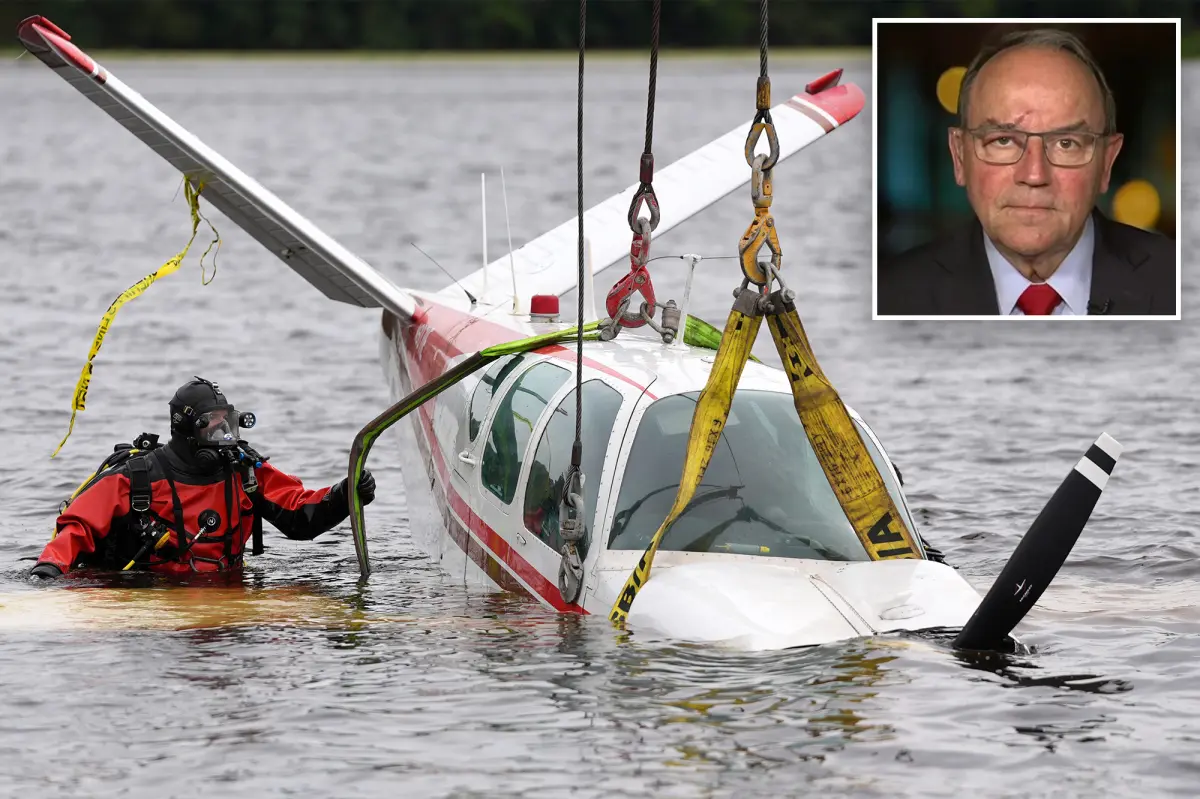
On a late-summer Saturday, the sky was bright and the flight should have been nothing more than a routine return home. Representative Tom Tiffany, Wisconsin’s 7th District congressman and a Republican candidate for governor, had spent the evening at the La Crosse County Lincoln Day Dinner, speaking with supporters, shaking hands, and feeling the hopeful energy that comes with a campaign on the move. As his small four-seat Beechcraft Bonanza carried him back toward the Wausau Downtown Airport, he had no reason to think the day would end in terror. Then, during the final approach, as the plane banked over the expanse of Lake Wausau, something went wrong. The engine suddenly lost power. There was no dramatic warning, no flashing alarm, no time to prepare for what was coming. The pilot turned to him with a calm but unmistakably serious voice and said, “Tom, we are going down, pull your seatbelt as tight as possible.” In that instant, the ordinary flight became a life-or-death emergency. Tiffany later described the moment as “staring into the abyss,” a strange and chilling stillness in which he could not tell how far beneath him the water was, only that the ground was no longer the ground and that the plane was falling. He pulled the belt until it bit into his waist, braced himself, and waited for the world to catch up with the sinking feeling in his stomach. A few seconds later, the plane hit the lake. It did not glide gently onto the water. It struck hard, a violent, jarring crash that nearly overwhelmed everything he had ever known about flying, and for a long heartbeat all he could do was hold on.
The impact was brutal, but it was not the end. In the chaos of the crash, Tiffany felt a sharp pain above his eye, blood beginning to stream down his face, but he was alive. The plane had come down hard enough to leave a gash that would eventually need twelve stitches, a vivid souvenir of a very close call. The pilot, whose name has not been made public, was also injured, receiving four stitches of his own. Yet both men were conscious and able to move, and as the damaged aircraft began to sink beneath them, they managed to look at one another and check that they were still there. “We looked at each other and said, ‘Are you okay?’” Tiffany recalled. The fact that they could ask that question at all, he would later say, was little short of a miracle. The pilot’s skill had kept the Beechcraft upright and afloat on the water, giving them the few precious moments they needed to escape. For Tiffany, that skill, combined with the sheer luck of the impact being survivable, left him with a deep sense of gratitude. He would later say that it was “by the grace of God” that he and the pilot were able to walk away, and the phrase did not feel like a cliché. It felt like the only honest way to describe the impossible reality that a routine flight had ended with a sinking plane in a lake, and two injured but breathing men still able to tell the story.
The next minutes were a blur of adrenaline and survival instinct. With the plane already taking on water and beginning to slip below the surface, Tiffany and the pilot knew they could not stay inside. They fought to force the door open, the cold lake water rushing in around them, and then they swam away from the wreckage as quickly as they could. Behind them, the aircraft they had trusted to carry them safely was disappearing, but ahead of them was the shore, and the hope of rescue. Local law enforcement and first responders arrived quickly, pulling the two men from the water and delivering them to safety. Tiffany would later say he could not thank them enough, and the gratitude in his voice was unmistakable. It was not the automatic gratitude of a politician thanking first responders at a press conference. It was the raw thankfulness of a man who had looked at the water from a falling plane and wondered if he would ever see his family again. The entire incident, he said, happened so quickly that it was hard to piece together in his mind. One moment they were coming home after dinner, and the next moment they were swimming away from a sinking plane, and then they were on solid ground again, shivering and bleeding and trying to understand what had just happened to them. The abruptness of the ordeal was part of what made it so terrifying; there was no time to be brave, no time to say goodbye, no time to make peace with the possibility that the flight might end in the water. There was only the pilot’s warning, the impact, the water, and then the strange and beautiful reality of being alive.
In the days that followed, Tiffany appeared on television with the cut above his eye still healing, a visible reminder of how close he had come to something far worse. The injured congressman was grateful for many things: the pilot’s steady hands, the quick response of local rescue teams, the fact that no one else was on board the aircraft. Amateur investigators and aviation experts would begin looking into the cause of the sudden loss of power, but for Tiffany, the precise technical reasons were almost secondary. The more immediate question was not why it happened, but how anyone survived it. He described the moment of impact as one of absolute helplessness, a feeling of dropping into an unknown depth, with no control over speed or direction or fate. It was, he said, like staring into the abyss, and the image stayed with him. In the afterglow of the rescue, as the bruise on his head throbbed and the stitches pulled at his skin, he kept returning to the same quiet conclusion: this was not something he could have done alone. It was not something he could explain by seatbelts or water landings or pilot training alone. There was a deeper current of grace running through the whole near-tragedy, and he was not shy about saying so. The experience had pushed aside all the noise of politics, all the calculations of campaigns, all the petty frustrations of the day-to-day and replaced them with a clarity that could only come from having nearly lost everything in a matter of seconds.
Behind the survival story is a political context that only makes the survival more consequential. Tiffany has represented Wisconsin’s 7th Congressional District since 2020, when he won the seat once held by Sean Duffy, now President Donald Trump’s Transportation Secretary. This year he is running for governor of Wisconsin, a high-stakes race against Democrat David Crowley, and the political stakes of that contest would have been dramatically altered if the plane had gone down in a different way. A first head-to-head poll following the August primary showed Crowley leading Tiffany 49 to 44 among likely voters, though the two were tied at 44 to 44 in a broader measure, suggesting a tight and uncertain campaign. That political landscape, however, felt far away in the minutes after the crash. On the shore of Lake Wausau, soaked and wounded, Tiffany was not a candidate and not a congressman; he was just a man who had been pulled from a sinking airplane, alive because of a pilot’s composure and a first responder’s speed. Still, the near-death experience will inevitably shape his campaign. Voters are likely to see a candidate who has been tested by something outside the normal realm of political combat, a person who has been forced to confront the possibility that his political career, and his whole life, could have ended in the middle of a lake. Whether that translates into sympathy, inspiration, or simply a louder reminder of human fragility is hard to know, but it is impossible to imagine that the crash will not be part of the conversation as Tiffany returns to the campaign trail.
Ultimately, Tiffany’s account of the crash is a story of human fragility and human strength, of the thin line between ordinary travel and total catastrophe. It is a reminder that every flight, every drive, every small movement through the world carries with it some quiet element of risk, and that survival can depend on the skill of a pilot, the strength of a seatbelt, the speed of a rescuers’ response, and, in his own words, the grace of God. He walks away from Lake Wausau with a scar above his eye and a story he will tell for the rest of his life, but more than that, he walks away with a renewed sense of what matters. The poll numbers, the campaign events, the political attacks and alliances, all of it is part of his life, but none of it can outshine the simple fact that he is still here. The cause of the engine failure remains under investigation, and there will be time for answers, time for analysis, time for all the careful technical explanations that aviation experts will provide. But for now, the deeper truth is one that no investigation can fully capture: the sheer feeling of hitting the surface of a lake at high speed, of the plane starting to sink, of fighting open the door and swimming away into the arms of first responders. Tiffany has said he cannot thank the police and rescue teams enough, and those words carry the weight of someone who understands how easily the story could have ended differently. In the bright, cold aftermath of a crash that should have been worse, the congressman is here to tell the tale, and by the grace of God, the sky still belongs to him.