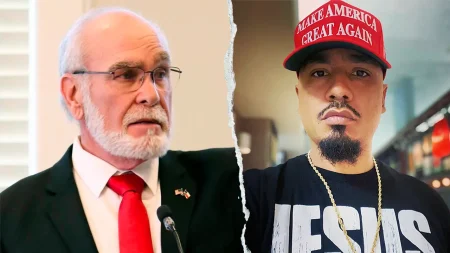








The delicate boundaries of the human experience are often defined by their starkest contrasts, a truth that became painfully and publicly evident in Lee County, Alabama, where the profound thrill of an improbable political victory collided head-on with a devastating personal crisis. Cam Hunt, a man who has dedicated his life to community service as a proud Marine veteran and a disciplined law enforcement officer, had just achieved what many political pundits considered a near-impossible feat. In a fiercely contested Republican primary election, he managed to unseat a powerful, deeply entrenched incumbent sheriff who had held the county’s reins of authority for nearly thirty consecutive years, offering voters a fresh vision of transparency and reform. However, the euphoric celebration that naturally accompanied this hard-won triumph proved to be incredibly short-lived. A mere six days after the historic ballots were cast and the local campaign offices closed, the newly minted sheriff-elect was thrust into a heartbreakingly intimate crisis that no standard political strategy could manage or resolve. In the quiet hours of midnight, Hunt’s celebratory world was shattered when his thirty-six-year-old wife, Aggie “Kalyn” Hunt, a mother of three, was arrested by local police officers and booked into the county jail on a charge of misdemeanor domestic violence. This sudden, stunning juxtaposition of events caught the entire state off guard: the very leader whom the populace had just selected to safeguard their homes, implement law and order, and protect the vulnerable was suddenly forced to navigate the traumatic fallout of an active law enforcement incident occurring within his own private household. For the community, the shocking news served as a sobering reminder of the invisible, high-stakes personal pressures that build silently behind the scenes of stressful campaigns, proving that entering public service often demands an unseen and deeply taxing human toll.
The physical mechanics and procedural reality of the arrest itself were executed with the quiet, routine detachment characteristic of a local law enforcement system striving to maintain total operational integrity while managing an incredibly sensitive situation. Kalyn Hunt was officially processed into the local detention center exactly at midnight on a Monday—a time when her neighbors were fast asleep, completely unaware of the heartbreaking booking routine unfolding behind the jail’s secure walls. Under standard domestic violence protocols designed to establish a vital emotional cooling-off period and guarantee absolute safety for everyone involved in domestic altercations, she was held in custody for a full twenty-four hours before being released. Understanding the massive public implications and the potential for unfair media exploitation surrounding the newly elected sheriff’s wife, the Opelika Police Department chose to address the situation with exemplary professionalism and compassion. Opelika Police Chief Jonathan Clifton verified the arrest to inquisitive local journalists but gracefully declined to elaborate on the specific details of the altercation or the physical evidence involved in the incident. Chief Clifton clarified to media outlets that the department maintains a strict, protective policy of withholding detailed information regarding domestic calls to protect the emotional privacy, safety, and physical well-being of all family members, particularly innocent children who did not choose to live in the spotlight. This controlled, protective silence, though frustrating to online commentators and political rivals, acted as a crucial barrier against the commodification of a family’s vulnerability, asserting that even individuals thrust into public life deserve a baseline of basic human dignity when navigating their most painful personal crises. By preserving this boundary, local authorities prioritized the long-term emotional recovery of the household over sensationalized headlines.
When confronted with a crisis that could have easily triggered defensive political maneuvering, denial, or a public relations panic, Cam Hunt chose a profoundly human and authentic path, responding with the protective, humble instincts of a dedicated family man rather than a calculated politician. As a veteran Marine and a devoted Christian who has constructed his life and campaign on the pillars of personal discipline, deep faith, and family responsibility, Hunt refused to hide behind administrative spin or avoid the difficult news. Instead, he met the public eye directly, issuing a highly candid, emotionally mature statement that appealed for basic human empathy and community prayers rather than offering defensive excuses or shifting blame. He described his wife’s arrest not as a professional catastrophe or a threat to his incoming administration, but as a “private family matter involving people I love and care about deeply,” showing absolute loyalty to his family in their darkest hour. Rather than distancing himself from his wife to preserve his hard-won political image, Hunt leaned directly into his foundational roles as a husband and protective father, confirming to concerned citizens that he was doing fine, their three children were safe, and that Kalyn was physically well. He made it explicitly clear that he would not engage in online speculation, fuel malicious gossip, or allow the complex, delicate process of his family’s personal healing to be dissected as cheap public entertainment on social media platforms. This protective, unyielding stance showed a leader who fundamentally understood that while he owed his community his professional devotion, his first and most sacred covenant remained with his wife and children, demonstrating true integrity under intense fire.
To truly appreciate the deep emotional strain and profound psychological exhaustion that may have contributed to this domestic crisis, one must examine the incredibly high-stakes, highly contentious journey that brought Hunt to the brink of the sheriff’s office. His political candidacy was not built on a traditional, peaceful upward climb; instead, it was a high-risk professional gamble that directly threatened his family’s financial stability, career security, and social standing. Up until October of last year, Hunt had been a hard-working, highly respected deputy within the very department he now leads, serving under Sheriff Jay Jones—a massive political force who had held the county’s top law enforcement role for nearly thirty consecutive years. When Hunt chose to exercise his civil right to run for the sheriff’s office himself, the incumbent sheriff reacted with swift, unforgiving administrative force, terminating Hunt’s employment under the public justification that his reformist campaign had a high probability of creating severe internal dissension and destroying team unity inside the organization. This dynamic immediately cast Hunt as a political underdog fighting against a powerful, entrenched establishment, throwing his entire household into the crucible of sudden joblessness, financial anxiety, and intense public scrutiny. The subsequent campaign became an exhaustive, agonizing endurance test for both Hunt and his wife, requiring them to survive months of relentless campaigning while keeping their family afloat. Although the election ultimately concluded with an incredibly close, razor-thin margin of 50.84% to 49.16% in Hunt’s favor, the stunning political triumph clearly came at an enormous, invisible cost paid in profound mental fatigue, sleep deprivation, and relationship stress behind closed doors.
The heartbreaking timing of Kalyn Hunt’s arrest, coming less than a week after their hard-fought political victory, highlights a painful, universal human irony: that the moments of our grandest public triumphs are often the very moments when our private realities are most vulnerable to fracturing under immense, unaddressed stress. The sheer weight of maintaining a perfect, smiling public image during an intense political race can easily mask deep-seated exhaustion, marital fatigue, and administrative pressure that build quietly behind closed doors. It is far too easy for the general public to romanticize public figures and their families, placing them on unrealistic pedestals of perpetual perfection, while entirely forgetting that they are subject to the exact same vulnerabilities, emotional breakdowns, and systemic stresses as any other household in the community. The high-risk, high-vigilance world of law enforcement, combined with the extreme, compounding pressures of public life, often creates a unique breeding ground for severe relational strain, and this unfortunate incident serves as a poignant reminder that those who seek to protect our communities are often in need of healing and grace themselves. For the residents of Lee County, this event should not be viewed as a political weapon or a tool of judgment, but as an opportunity for collective empathy, reminding everyone that true strength of leadership is built not on the absence of human struggles, but on how honestly, transparently, and responsibly we address them. It emphasizes the critical importance of supporting our elected officials as whole human beings, recognizing that behind every professional uniform stands a complex family striving to find peace, safety, and mutual understanding.
As Lee County prepares to step into a new, hopeful era under the leadership of Sheriff-elect Cam Hunt, the local community has a rare and powerful opportunity to actively demonstrate the values of compassion, accountability, and restorative healing that lie at the very heart of a truly just society. For the Hunt family, the road ahead is a delicate balancing act of public service and quiet private recovery, requiring them to rebuild their intimate world while taking on the complex, demanding responsibilities of county office. By addressing this highly volatile situation with transparency and dignity instead of seeking to bury it behind defensive statements, Hunt has provided an authentic, courageous model of leadership that values family first, paving the way for a deeper, more humanized approach to local governance. At the same time, this difficult situation serves as an important, far-reaching civic wake-up call, turning a private domestic crisis into a meaningful public conversation about the universal nature of relational conflict and the critical importance of professional mental health resources. It highlights the fundamental truth that seeking help for domestic disputes, stress, and anxiety is never a sign of weakness, but a brave, proactive step toward healing and breaking silent, painful family cycles. For anyone who currently finds themselves struggling with domestic tension, relationship conflicts, or the overwhelming weight of mental stress within their own households, invaluable and completely compassionate help is always accessible through the National Domestic Violence Hotline, which can be reached 24/7 at 1-800-799-SAFE (7233) or by texting “START” to 88788, providing a confidential, judgment-free support system to help families rebuild.