

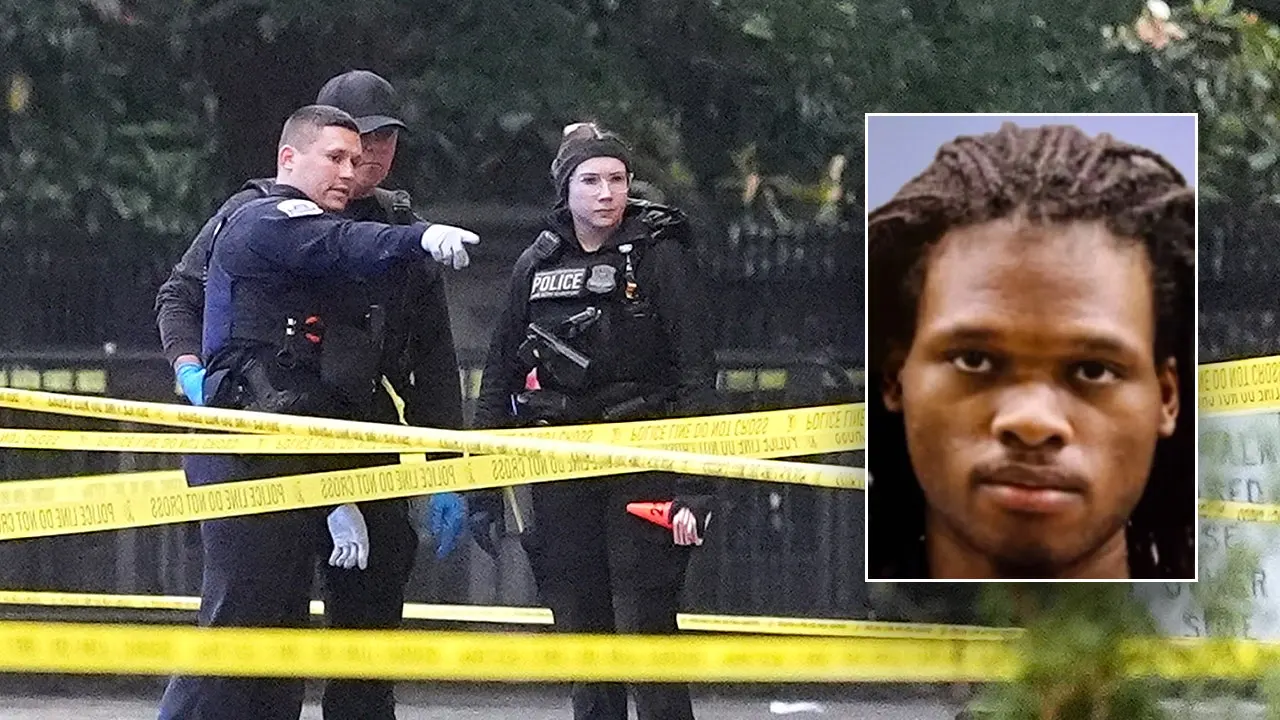
On a warm and seemingly ordinary Saturday evening in the heart of Washington, D.C., the historic intersection of 17th Street and Pennsylvania Avenue NW was filled with the typical, gentle rhythms of a spring weekend in the nation’s capital. Families, international tourists, and local joggers enjoyed the pleasant twilight air against the backdrop of the illuminated monuments, while the formidable iron gates of the White House stood as a quiet, reassuring symbol of history, democratic endurance, and high-level security. But shortly after 6:00 p.m., this peaceful, mundane tableau was violently and instantly shattered when 21-year-old Nasire Best approached a high-traffic security checkpoint, pulled a concealed firearm from a bag, and began shooting directly at Secret Service officers. The sudden, terrifying crackle of rapid gunfire ruptured the evening calm, sending nearby pedestrians screaming and fleeing in sheer panic as years of intensive tactical and defensive training instantly kicked into motion for the defending protective personnel. In a split-second, highly coordinated response, Secret Service agents drew their service weapons and returned fire, neutralizing the threat in a brief but deafening exchange of ammunition that left Best mortally wounded on the pavement and a historic street corner suddenly converted into a chaotic, active crime scene. Amidst the terrifying chaos of the gunfight, an innocent bystander was caught in the crossfire and sustained injuries, although officials remained exceptionally tight-lipped in the immediate aftermath regarding whether a service weapon or the suspect’s gun discharged the stray bullet, or what the exact medical prognosis of the wounded civilian was. None of the responding Secret Service agents were hurt physically, yet the emotional and psychological tremor of this lethal, sudden confrontation rippled outwardly through the entire executive apparatus, instantly transforming a routine weekend shift into a stark, highly visceral reminder of the constant, razor-thin line that separates administrative peace from sudden, deadly violence in the most heavily fortified, highly watched center of the federal government.
Behind the terrifying headlines of a “White House gunman” lies the deeply tragic, profoundly complex human reality of Nasire Best, a 21-year-old Maryland resident whose young life had become increasingly defined by severe, untreated psychological distress, isolation, and delusional instability. Far from a calculated, politically motivated or highly ideological assassin, Best was a young man caught in the agonizing, terrifying throes of a profound mental health crisis that had repeatedly brought him into the desperate orbit of law enforcement in the months leading up to his death. Court filings from July 2025 paint a heartbreaking, unsettling portrait of a youth utterly detached from reality, detailing an earlier incident where Best walked directly into a restricted pedestrian access control post at the White House complex, stubbornly ignored multiple orders from guards to halt, and loudly declared to the arresting officers that he was Jesus Christ and desperately wanted to be arrested. This was not a calculated act of political defiance, but rather a final, highly public manifestation of a mind rapidly unraveling from within; subsequent investigation records revealed that Best had spent weeks wandering the hot, concrete perimeter of the White House complex, inquiring at various highly secured entries about how he might gain entry, searching for some intangible salvation, guidance, or authority within the nation’s most secure residence. His erratic, repetitive behavior was a clear, escalating cry for clinical assistance and psychiatric intervention that went tragically unresolved. By framing Best not merely as an anonymous, hostile antagonist but as a deeply disturbed young soul who had entirely lost his grip on reality, his fatal end at the security gates becomes not just a triumph of rapid protective security, but a profound national human tragedy illustrating how easily vulnerable, severely delusional individuals can slip through the cracks of the social safety net and into lethal conflicts with the state.
The fatal gun battle on Saturday was the ultimate, devastating culmination of a highly fragmented public health and legal apparatus that repeatedly flagged Best’s instability but failed to provide the long-term, compassionate clinical intervention necessary to prevent a catastrophe. In June 2025, just a month prior to his unlawful entry arrest, Best had been involuntarily committed to a psychiatric facility after blocking vehicle access to the White House complex—a severe indicator of his escalating psychological obsession and geographic fixation. Although law enforcement authorities recognized the danger and successfully petitioned the court for a stringent stay-away order to legally bar him from the immediate vicinity of the executive mansion, the legal system’s blunt bureaucratic tools proved tragically inadequate against the irrational, powerful pull of a severe psychiatric delusion. When Best subsequently failed to appear for a vital court hearing regarding his unlawful entry charges, a bench warrant was quietly issued for his arrest, transforming him into a vulnerable, unmonitored fugitive wandering the margins of society rather than a patient receiving supervised, intensive clinical care. This sequence of actions highlights a recurring, deeply troubling systemic failure in the intersection of criminal justice and psychiatric rehabilitation in America, where individuals in acute, dangerous distress are cycled through brief hospitalizations, minor arrests, and court mandates without securing the continuous, empathetic support required to stabilize their conditions. Consequently, the protective barriers erected by the courts existed only on paper, completely failing to deter a young man whose internal chaos ultimately drove him back to the very gates he was legally forbidden to approach, armed and prepared to provoke a fatal, tragic end.
At the moment the sudden gunfire erupted outside the gates, President Donald Trump was inside the executive mansion and was immediately briefed on the developing physical threat as the historical residence pivoted into an emergency defensive posture. In the pre-dawn hours of Sunday morning, the President turned to his social media platform, Truth Social, to express his profound gratitude to the Secret Service and other responding law enforcement agencies for their swift, highly professional actions in neutralizing a suspect he described as having a violent history and a dangerous obsession with the White House. Yet, true to his political instincts, Trump also utilized the raw emotion of the near-miss incident to reignite a fierce administrative battle over capital security funding, explicitly criticizing the Senate’s decision to stall a massive budget reconciliation package that included critical provisions for enhancing White House safety. Trump linked the Saturday evening shooting directly to another violent episode just one month prior—the high-profile shooting near the White House Correspondents’ Dinner—using these consecutive security breaches to advocate fiercely for his controversial proposal to construct a state-of-the-art, impenetrable executive pavilion designed to be the safest space of its kind in Washington, D.C. By framing the incident not just as a localized psychiatric crisis but as a direct challenge to the national security of the United States, Trump’s response highlighted the perpetual, complicated tension between protective security, political maneuvering, and the administrative challenges of safeguarding modern presidents in an era of heightened public volatility and architectural vulnerability.
The physical echoes of the gunshots triggered a swift, terrifying protocol that put the entire White House complex into a state of immediate, high-security lockdown. Out on the North Lawn, journalists and media correspondents who had been preparing for routine evening broadcasts were suddenly rounded up by heavily armed Secret Service agents with automatic weapons drawn and hurried into the press briefing room, where they listened to the lock mechanisms engage with the sobering realization that a lethal threat was actively unfolding just yards away outside. For forty-six tense, silent minutes, the interior of the press workspace became a pressure cooker of anxiety, with reporters frantically monitoring police scanners, sending whispered updates to their networks, and contacting sources while the lockdown remained in effect until being finally lifted at 6:46 p.m. Beyond the media, the true human cost of the evening stretched to the wounded bystander, an innocent citizen whose weekend stroll was shattered by physical trauma and whose sudden victimization underscores the terrifying randomness of public violence in public spaces. The collective trauma of the event extended to the tourists who fled the scene, the local business employees who locked their doors, and the community at large, all forced to grapple with the uncomfortable truth that even the most heavily protected geographical coordinates in the free world cannot fully insulate the public from the collateral damage of a firearm discharge or the volatile, unpredictable eruptions of a society struggling to manage its deep-seated mental health crises.
In the quiet days following the shooting, a comprehensive, multi-agency investigation led by the Metropolitan Police Department in collaboration with the Secret Service, the FBI, and the Bureau of Alcohol, Tobacco, Firearms and Explosives has begun the painstaking work of piecing together the final hours of Nasire Best’s life. Detectives and intelligence analysts are left searching for a definitive motive while exploring the deeper, more unsettling questions of how a young man with a documented mental illness, an active bench warrant, and a court-ordered restriction from the area managed to obtain a firearm and carry out such an audacious attack. For the Secret Service agents involved, the professional success of their rapid response is inevitably shadowed by the quiet, personal burden of having had to take a human life—a tragic necessity of their solemn oath to protect the presidency at all costs. As the country reflects on this latest outbreak of violence at the nation’s doorstep, the incident serves as a somber catalyst for a broader national conversation, one that demands a dual focus on fortifying physical infrastructure and reforming the broken psychiatric and judicial systems that continuously fail young men like Nasire Best. Ultimately, the tragedy near the White House gates stands as a stark reminder that true national security cannot be achieved solely through higher fences and advanced weaponry, but must also be forged by addressing the deep psychological fractures within the human fabric of the nation itself.