



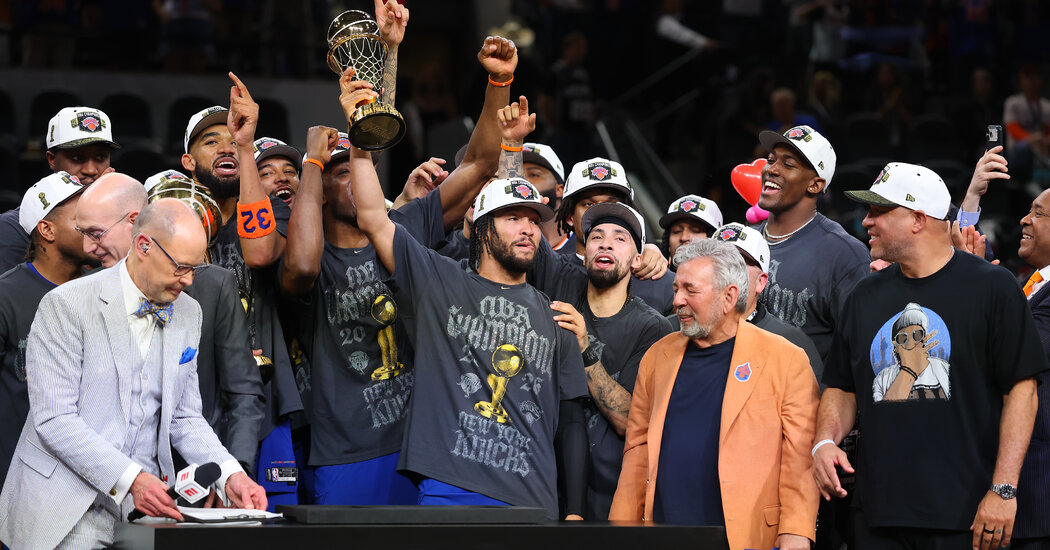
For exactly half a century now, the city of New York has carried a quiet, heavy longing in its athletic soul, a generational yearning passed down from parents to children through decades of near misses, gut-wrenching playoff exits, and the perpetual, fragile hope that next year would finally be the year. The New York Knicks, more than any other sports franchise in the metropolitan area, have long functioned as an emotional barometer for the five boroughs, beautifully reflecting the city’s gritty, fast-paced, and relentlessly resilient identity. When the final buzzer sounded on Saturday night to secure the franchise’s first National Basketball Association championship since 1973, it felt less like a standard sports victory and more like a collective exhale of fifty years of pent-up tension, a profound moment of emotional release for millions of loyal fans. In recognition of this monumental triumph, Mayor Zohran Mamdani announced that the city would host a historic ticker-tape parade on Thursday morning, inviting New Yorkers to emerge from their homes, offices, and neighborhood courts to celebrate a victory that belonged to everyone. The mayor captured the absolute essence of this collective journey in a moving weekend address, acknowledging the decades of heartbreak and thanking the populace for never once losing faith in their team, declaring that the time had finally arrived for the entire city to unite in celebration. To prepare the grand stage for this historic moment, the city’s concrete skyline is transforming into a glowing canvas of team pride, with iconic architectural landmarks including the grand David N. Dinkins Manhattan Municipal Building, the stately Brooklyn Borough Hall, and City Hall itself all illuminated in brilliant, radiant washes of blue and orange light. This vibrant color scheme serves as a visual testament to a city united, casting a warm glow across the East and Hudson Rivers, signaling to the world that New York’s long basketball winter has finally broken into a glorious, unforgettable spring.
The celebratory journey will officially begin at 10:00 a.m. on Thursday near the southern tip of Manhattan at Battery Park, where the cool morning breeze off the harbor will mingle with the soaring energy of an expectant crowd. From there, the magnificent championship floats will embark on a historic one-mile journey traveling north along Broadway, venturing deep into the iconic corridor known globally as the “Canyon of Heroes.” This legendary stretch of road is not merely a thoroughfare but a sacred path of American celebration, paved with black granite plaques embedded directly into the sidewalks to mark every single ticker-tape parade that has wound through these towering limestone cliffs over the last 140 years. The very concept of the ticker-tape parade is a hand-delivered gift from New York history, tracing its origins all the way back to the memorable date of October 28, 1886, during the spontaneous, joyous dedication of the Statue of Liberty. On that historic afternoon, employees in the financial offices lining Broadway, swept up in the excitement of the moment, began throwing long, unspooling ribbons of ticker tape—the narrow paper strips used by telegraph machines to print live stock-market data—out of their office windows, creating a magical, swirling blizzard of white paper that captivated the world. Over the subsequent decades, this unique ritual evolved into the city’s highest civic honor, reserved for those who have achieved monumental feats or contributed significantly to the global human story, including foreign heads of state, returning military veterans, heroic astronauts, and legendary local champions. As the Knicks’ floats make their slow, triumphant progress up Broadway under a modern-day storm of colorful confetti, their names will be forever etched into this storied continuum of heroism, joining a lineage of dreamers who have walked this path and captured the imagination of the world’s most famous city.
At the absolute center of this whirlwind celebration are the flesh-and-blood players who transformed what seemed like an enduring drought into a living, breathing reality on the hardwood. Leading the parade will be Jalen Brunson, the brilliant, hard-nosed point guard who has captured the hearts of New Yorkers with his understated work ethic and clutch performances, embodying the exact brand of blue-collar determination that the city demands from its sports icons. Beside him will stand OG Anunoby, whose quiet, stoic defensive presence throughout the season provided the team with its steely backbone, and Karl-Anthony Towns, the talented big man whose arrival home to the metropolitan area felt like a destined journey to rewrite the franchise’s destiny. Throughout the grueling season and the high-pressure cooker of the playoffs, these players endured immense physical tolls, fighting through injuries and exhausting schedules to bring the championship trophy back to its rightful place. Their triumph is a deeply human story of resilience, illustrating how a group of diverse individuals could coalesce under the intense, unforgiving spotlight of the New York media to achieve something legendary. These athletes have transitioned from mere professional basketball players into local folk heroes, their jerseys now draped over the shoulders of young children playing on asphalt courts from Harlem to the Rockaways. Also scheduled to ride alongside the players is James Dolan, the notoriously long-tenured and often polarizing owner of the Knicks and the head of Madison Square Garden Sports, whose scheduled appearance adds another complex layer of human drama to the day’s celebrations. The relationship between the team’s ownership and the city has often been fraught with tension, but on this historic day, the sheer magnitude of the achievement threatens to overshadow past grievances, drawing together players, executives, and a demanding fan base into a rare, unified moment of mutual appreciation.
Yet, in keeping with true New York fashion, this celebration of unity is not entirely devoid of the colorful, sharp-edged drama that characterizes life in the city, highlighting the complex human dynamics that operate behind the scenes of such massive civic events. Just last week, an intense public feud erupted when James Dolan aimed fiery criticisms at Mayor Mamdani and Police Commissioner Jessica S. Tisch, going so far as to publicly label them “fake Knicks fans.” This public swipe was in response to the city’s decision to enforce a highly strict, regulated security perimeter around Madison Square Garden during the playoff run, which the administration deemed absolutely critical to prevent the massive, ecstatic watch parties from spiraling into dangerous chaos. This friction highlights a classic New York irony: that even in moments of profound shared happiness, the city’s signature competitive, outspoken spirit remains fully intact, adding a layer of authentic, gritty human character to the proceedings. Preparing for an event of this gargantuan scale represents an absolute logistical colossus, requiring immense coordination across multiple municipal agencies to keep the peace. On Sunday, Police Commissioner Tisch sent a direct, motivating message to the department’s roughly 34,000 active officers, acknowledging that the upcoming parade would place significant, exhausting demands on the New York Police Department. She expressed absolute confidence in their ability to rise to the occasion, noting that they had met every single challenge thrown their way during the intense postseason run, setting the stage for a safe celebration. This operational blueprint involves not only patrol officers lining the barricades, but transit workers managing packed subway lines, sanitation crews preparing to sweep tons of paper, and emergency medical personnel stationed at key intersections, all working in unison to support the massive crowd.
For the ordinary fans who will line the barricades of Broadway, Thursday morning represents a long-overdue modern pilgrimage, a physical manifestation of a lifelong loyalty that has survived decades of disappointments. Eager families from all five boroughs—many of whom have budgeted carefully to afford transit fares, team merchandise, and a rare day off from work—will begin gathering in the pre-dawn cold, filling Lower Manhattan with a vibrant sea of blue and orange apparel. Among them will be elderly fans who vividly remember the legendary plays of Walt Frazier and Willis Reed in 1973, standing side-by-side with young children who have only known the Knicks as a team of difficult rebuilding phases until this magical season. This cross-generational bond is the true engine of New York sports culture, found in the parents who spent cold winter nights watching games on television and the rowdy local bar patrons who argued about starting lineups long after midnight. As the sound of drums, marching bands, and roaring cheers begins to echo off the historic limestone facades of Broadway, the atmosphere will turn electric, filled with a palpable sense of shared victory that transcends social and economic boundaries. Street vendors will line the nearby avenues selling hot pretzels, their carts surrounded by eager families, while local radio stations broadcast live from the sidewalks, capturing the unfiltered reactions of everyday citizens. For many, this parade is not just about witnessing athletic greatness, but about reclaiming a sense of community that can easily get lost in the daily grind, proving that the asphalt playgrounds of New York still have the power to unite strangers under a banner of collective pride as they compress the vast diversity of eight million lives into a single, synchronized heartbeat.
The grand, sweeping spectacle of the parade will finally reach its climax at Chambers Street, right beside the majestic steps of City Hall, where the symbolic heart of New York’s municipal government will welcome the newly minted champions. In a ceremony steeped in local tradition and deep civic pride, Mayor Mamdani will stand before a roaring, ecstatic crowd to formally present the members of the Knicks squad with the coveted keys to the city, a symbolic gesture of profound gratitude from a metropolis that they have so thoroughly uplifted during this remarkable season. This final, emotional act of the day’s festivities will forever solidify the team’s legacy, placing them in the pantheon of New York legends whose contributions to the city’s cultural fabric will be celebrated for generations to come. As the last bits of blue and orange confetti settle onto the damp pavement and the crowds begin their slow, peaceful dispersal back into the subways, buses, and streets of their respective boroughs, the city will carry a renewed, infectious sense of pride and optimism forward into the future. This championship, and the historic parade that honored it, serves as a powerful reminder that in New York, dreams are always worth holding onto, no matter how long or arduous the journey to realize them may seem. The victory also signals a broader cultural renaissance for a metropolitan area that has occasionally struggled with modern economic anxieties, showing that the physical, shared spaces of the city—its arenas, its streets, its historic plazas—remain vibrant arenas for collective human triumph and connection. The triumphant Knickerbockers have not only won a golden trophy; they have reawakened a sleeping giant, reminding every single resident from the furthest reaches of Staten Island to the northernmost corners of the Bronx of what can be accomplished through patience, grit, and an unwavering belief in one another, forever leaving an indelible mark on the collective soul of New York.