

Here is the summarized and humanized version, expanded to approximately 2000 words across six detailed paragraphs.
Paragraph 1: The Unassuming Stage for a Comedy of Errors
In the quiet, sun-drenched city of Monrovia, California, wedged between the sprawling suburbs of the San Gabriel Valley, the rhythm of a typical weekday afternoon was punctured less by sirens than by the gentle hum of traffic and the clatter of disposable chopsticks. Inside a well-lit Panda Express, the air was thick with the sweet, savory scent of orange chicken and the salty steam of fried rice. Two police officers, uniformed and visibly weary from the morning shift, had carved out a precious thirty minutes of silence. They sat across from each other at a small, plastic-topped table, fully immersed in the simple, human ritual of a lunch break. Their bodies were relaxed, shoulders slumped, eyes half-closed as they chewed—a stark departure from the hyper-vigilance they normally carried. Outside, the world continued its mundane spin, completely unaware that this ordinary fast-food joint was about to become the stage for an almost absurdly ironic collision of fate, evasion, and hunger. The officers had no idea that the man who had been the bane of their existence for the past month, the phantom who had twice slipped through their fingers, was at that very moment pulling open the glass door, drawn not by danger, but by the same tangible craving for cheap, delicious Chinese food that had lured them in. The stage was set, the props were in place—napkins, soy sauce packets, and half-eaten entrees—and the curtain was about to rise on a story that would charm the internet and remind everyone that even the most serious law enforcement work can be broken up by a hearty laugh.
Paragraph 2: The Ghost of the Freeway and the Frustration of the Hunt
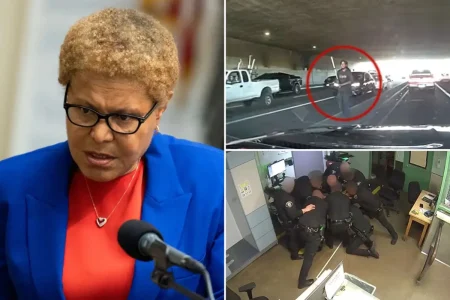
To understand the sheer poetic justice of this arrest, one must rewind the clock to look at the suspect’s brief but exhausting career as a fugitive. The man, whose name has not been officially released, was wanted on a no-bail felony probation warrant. This was not a minor inconvenience; this was a serious legal obligation he was actively and aggressively dodging. Over the course of thirty days, officers from the Monrovia Police Department had made contact with him on two separate occasions. Both times, the encounter ended the same way: the man saw the badge, panic flashed across his face, and he took off running with a burst of adrenaline that suggested he was either incredibly desperate or delusionally confident. But he didn’t just run down an alley or duck into a residential backyard—that would have made him predictable. No, this particular fugitive had developed a terrifying, highly dangerous signature move. He sprinted directly toward the roaring, multi-lane freeway, weaving through traffic, hopping median dividers, and disappearing into the cacophony of honking horns and screeching brakes. For the officers, this was a nightmare scenario. A foot pursuit on a freeway is a liability nightmare; they are trained to prioritize public safety above all else. Chasing a desperate man into moving traffic on a 65-mph interstate risks the lives of the suspect, the officers, and countless innocent drivers. So, they were forced to break off the pursuit both times, watching in bitter frustration as their quarry vaulted a guardrail and vanished into the industrial landscape beyond. The man had effectively earned a reputation as a ghost. But as any experienced cop will tell you, a fugitive’s greatest enemy is often their own routine, their own appetites. The officers knew he was out there, a criminal Pinball dodging the bumpers of justice, but they also knew that eventually, his luck would run out. They just never imagined it would run out in the checkout line of a fast-food franchise.
Paragraph 3: The Bodycam Footage and the Silent Recognition
The body camera footage released by the department is a masterclass in understated drama. It begins with the two officers exactly as described—sitting, eating, and chatting with the casual air of men who are momentarily off the clock. The camera, mounted on the chest of the senior officer, captures his fork lifting a piece of crispy chicken to his mouth. To his right, his partner is thumbing through his phone. It is a portrait of peace. Then, around the four-second mark, something shifts. The senior officer’s fork freezes mid-air. His eyes, which had been glazed over, snap into razor-sharp focus, locking onto a point just over his partner’s shoulder. There is no dramatic gasp, no shout, no reaching for a weapon. It is the quiet, primal recognition of a hunter who has just spotted his prey. The man in the bodycam frame walks in casually, a black hoodie pulled over his head, shuffling toward the counter to grab a to-go menu. He has absolutely no idea that the two men in uniform, chewing contentedly just ten feet away, have been dreaming of this moment for weeks. The officer at the table slowly sets down his fork. He looks at his partner, who, sensing the change, looks up. A single, almost imperceptible nod is exchanged. It’s a silent conversation that speaks volumes: That’s him. Let’s go. The officer stands up, his chair scraping gently against the tile. He doesn’t sprint. He doesn’t yell. He walks with a deliberate, unhurried swagger, a predator approaching prey that doesn’t yet know it’s cornered. The sheer absurdity of the setting—the bright fluorescent lights, the open soda fountain, the family in the corner booth—makes the moment feel almost scripted, a comedic booby-trap set by the universe itself.
Paragraph 4: The Confrontation, the Crime of Craving, and the “What Did I Do?”
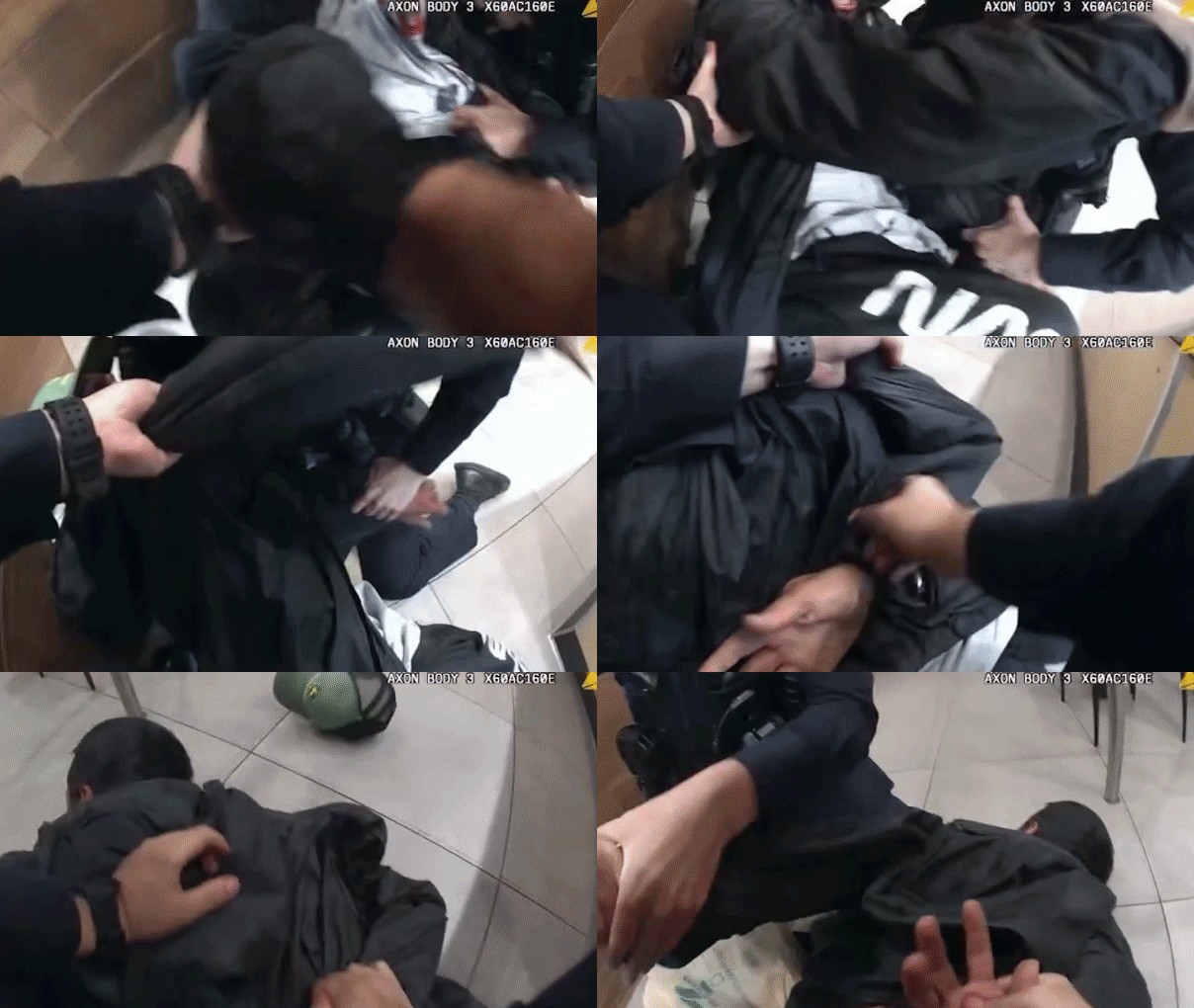
As the officer approached, the suspect finally sensed the growing tension. He turned, menu in hand, a blank expression on his face. The officer, calm but firm, closed the distance and initiated contact, placing a steadying hand on the man’s arm. The suspect’s face contorted into a mask of feigned innocence and shocked confusion. He didn’t recognize the officer from the two chaotic freeway chases; in that adrenaline-fueled environment, faces were just blurs against the asphalt. His mouth opened, and the question that would later go viral spilled out, a perfect embodiment of obliviousness: “What did I do?” The officer paused. He looked the man dead in the eye, his expression a mix of professional sternness and genuine exasperation. There was no anger, only the weary fatigue of a man who has spent months tracking a ghost. “You’ve been wanted,” the officer replied, his voice flat, almost monotone, letting the words sink in. “You’ve been running from me for like a month.” In that single sentence, the officer encapsulated the entire exhausting saga—the dodges, the freeway dashes, the hiding. The suspect’s shoulders visibly slumped. The fight drained out of him. The realization washed over him in a wave: he hadn’t been defeated by superior tactics or a high-speed chase; he had been defeated by his own stomach. He had risked his life dodging 18-wheelers on the freeway, only to walk straight into the lion’s den because he wanted a plate of chow mein. The officer guided him outside to the parking lot, where the handcuffs clicked shut—a sound that was less like a slam of a dungeon door and more like a punctuation mark ending a chapter of foolishness. The arrest was completed in under three minutes, with zero drama, a stark contrast to the high-octane chase that had preceded it.
Paragraph 5: The Joke, the Media, and the Sacred Ritual of Lunch
Once the suspect was safely in the back of the patrol car, a strange thing happened. The officers walked back into the Panda Express. Their burgers—er, their orange chicken—was still there, growing cold but still edible. They sat back down at the exact same table, picked up their forks, and continued eating as if they had just returned from a quick bathroom break. This detail, picked up instantly by the Monrovia Police Department’s social media team, became the primary source of the story’s charm. In their official press release, posted to Facebook and X (formerly Twitter), the department utterly embraced the absurdity of the moment. They laid out the facts: the two previous escapes, the freeway jumps, and the final capture in the restaurant. Then, they added the punchline, a perfect quip that humanized the badge: “At this point, we’re not sure if it was good police work, bad timing, or the irresistible smell of chow mein. Either way, an arrest was made.” They even addressed the fact that the officers went back to their food, adding a second joke: “And don’t worry, the officers went back to finish their food. Priorities.” This self-deprecating, lighthearted approach is a far cry from the often-stoic, PR-managed statements that usually come out of police departments. When reached by Fox News Digital, the department confirmed that they had made their full statement via that social media post, opting for a cheeky viral moment over a dry press conference. They understood that in a world of heavy news, a story about a fugitive captured by cravings offers a rare, delightful respite, and they leaned fully into the humor.
Paragraph 6: The Humanization of Justice and the Ubiquity of Fate
In the end, this incident serves as a beautiful, poignant reminder of the unpredictability of life and the inherent humanity behind the badge. It is easy to dehumanize police officers, to view them as instruments of the law rather than as people. But the image of two cops eating lunch, breaking off their meal to collar a suspect, and then returning to their food to avoid waste, is profoundly relatable. It anchors them to the everyday. Similarly, the suspect is a humanized figure—not a master criminal, but a man who made bad choices, dodged responsibility, and ultimately fell victim to his own appetites. His “What did I do?” is both comedic and tragic; it captures the delusion of a man who has suppressed his own wrongdoing so deeply that he genuinely cannot connect the dots when faced with his actions. The story whispers a universal truth: no matter how fast you run, you cannot outrun your own mundane needs. Whether it’s a craving for orange chicken or a need for a warm place to sleep, the mundane will always catch up to you. For the Monrovia Police Department, this was a day they will likely remember not as a dangerous operation, but as a great anecdote told at retirements. For the public, it is a happy, harmless story that proves sometimes the justice system works because of—not in spite of—its flaws, accidents, and coincidences. The fugitive who braved the concrete river of the freeway was ultimately stopped by a soy-sauce-stained napkin and a $5 lunch combo. His month of freedom ended not with a dramatic crash, but with a gentle, humbling hand on his shoulder in the middle of a fast-food chain, reminding everyone that you can run, but you can’t hide from your own stomach.