





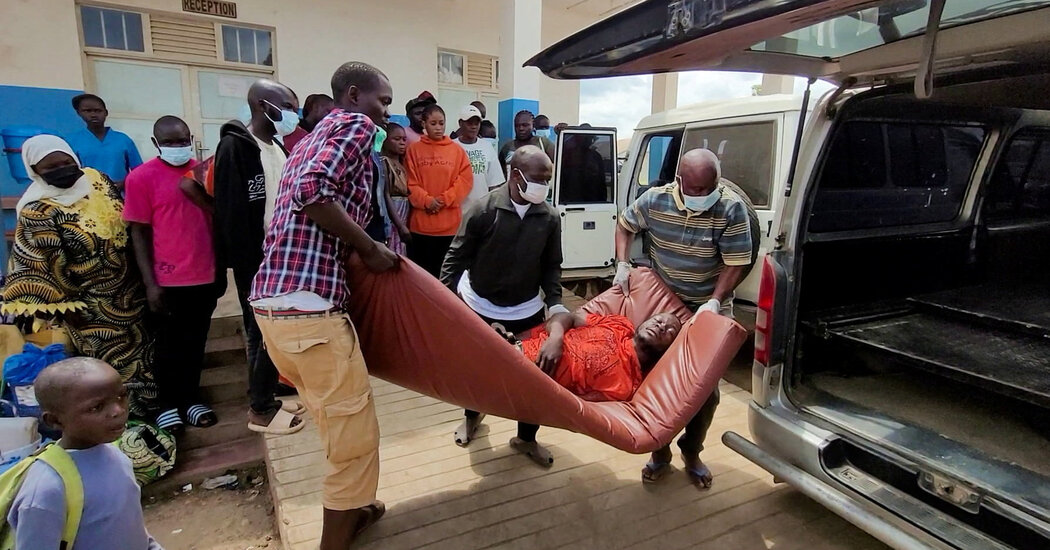
Summarize and humanize this content to 2000 words in 6 paragraphs in EnglishThe World Health Organization declared late Saturday that the spread of the Ebola virus in the Democratic Republic of Congo and Uganda was a global health emergency, a day after Africa’s leading public health authority first announced an outbreak in a province in northeastern Congo linked to dozens of suspected deaths.By Saturday, cases had also been confirmed in Kinshasa, Congo, and in Kampala, Uganda, the capital cities of each country, the W.H.O. said. In Congo’s Ituri Province, where the outbreak was first identified, 246 suspected cases and 80 deaths attributed to the virus had been reported, although only eight cases had been definitively linked to the virus through laboratory testing.The scale of the outbreak could be far larger than currently detected and reported, the W.H.O. said in declaring a “public health emergency of international concern.” Eight of 13 samples collected in various areas tested positive, the agency said.“There are significant uncertainties to the true number of infected persons and geographic spread associated with this event at the present time,” the organization said in a statement.The outbreak does not meet the criteria of a pandemic emergency, the W.H.O. said.A declaration of a “public health emergency of international concern” signals a public health risk requiring a coordinated international response. The designation is intended to prompt member countries to prepare for the virus’s spread and to share vaccines, treatments and other resources needed to contain the outbreak. The two confirmed cases in Kampala, including one death, had no apparent link to each other, but were identified within 24 hours of one another in people who had traveled from Congo, the agency said. Ugandan authorities earlier said they had identified a single case of a 59-year-old Congolese man who was admitted to a hospital in Kampala on May 11 and died three days later. The confirmed case in Kinshasa involved someone returning from Ituri Province, the agency said.In Ituri Province, the 246 suspected cases have been reported across at least three health zones, including Rwampara, Mongbwalu, and Bunia, the province’s main city, the W.H.O. said. The agency added that unusual clusters of community deaths had been reported across several health zones, and suspected cases had also been reported in neighboring North-Kivu Province.The risk of the outbreak spreading was being exacerbated by a humanitarian crisis, high population mobility and a large network of informal health care facilities in the area of the outbreak, the agency said. There is no approved vaccine or therapeutics for the Bundibugyo strain of Ebola behind the outbreak, according to the W.H.O.Ituri Province has experienced decades of violence linked to insurgent groups. Frequent cross-border movement into Uganda and South Sudan could make it more difficult to trace contacts of infected people.Some global health experts said they were alarmed that the first reports of the outbreak emerged so late in its development. Outbreaks are typically picked up much earlier by the W.H.O., other health organizations or by news reports, said Jennifer Nuzzo, the director of the Pandemic Center at the Brown University School of Public Health.Tedros Adhanom Ghebreyesus, the director general of the W.H.O., said in a briefing on Friday that the organization was first notified about suspected Ebola cases on May 5 and had sent a team to Ituri to investigate. Initial samples tested negative for the virus because field equipment could detect only the Zaire species of Ebola, the only strain for which a licensed vaccine exists, he said.Samples were later sent to the National Institute of Biomedical Research in Kinshasa, which confirmed on Thursday that some had tested positive for Ebola, Dr. Tedros said.The spread of the outbreak to the capitals of Congo and Uganda could pose a challenge for public health workers because infectious diseases can spread more rapidly in dense urban settings. Ebola is transmitted through direct contact with the bodily fluids of an infected person, putting family members and caregivers at particular risk.Matthew Mpoke Bigg and Apoorva Mandavilli contributed reporting.