


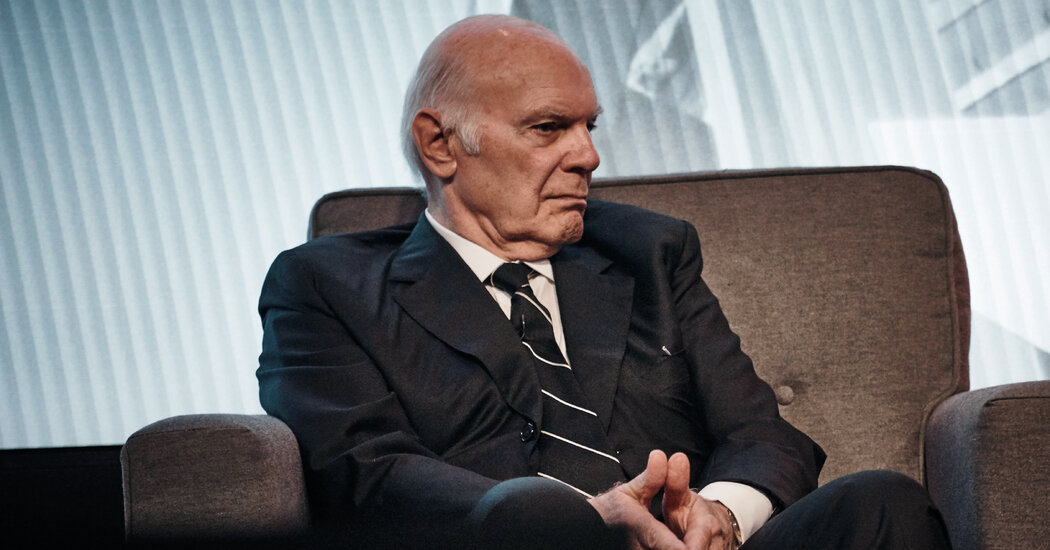
In the bustling world of New York City politics and big money, where skyscrapers touch the clouds and fortunes are made overnight, tensions often simmer beneath the surface like the steam rising from subway grates on a winter morning. Steven Roth, the seasoned chief executive of Vornado Realty Trust, has always been a man of conviction, building his empire from humble beginnings in a neighborhood where dreams were forged in the fire of opportunity. On a Tuesday earnings call that felt more like a courtroom drama than a business update, Roth unleashed a torrent of criticism aimed squarely at Mayor Zohran Mamdani, the fresh-faced 34-year-old socialist elected on promises of fairness and funding through higher taxes on the wealthy. Roth didn’t mince words; he likened Mamdani’s fiery “tax the rich” rhetoric to hateful slurs, drawing parallels to the venomous “from the river to the sea” chant that echoes in protests and ignites fears among Jewish communities of something far worse than words. Imagine Roth, with his voice cutting through the phone lines to investors, entrepreneurs, and perhaps even the mayor himself, painting a picture of the rich as not villains but heroes of the American Dream—people who clawed their way up from nothing, risking everything to create jobs, wealth, and yes, the towering buildings that define the city skyline. He argued that singling out tycoons like Kenneth C. Griffin, whose $238 million penthouse purchase in one of Vornado’s own developments announced it as America’s priciest home in 2019, was more than political theater; it was a dangerous game that painted targets on people’s backs, stoking division in a city already frayed by inequality. Roth’s face must have tightened as he recalled Mamdani’s social media video, filmed provocatively in front of Griffin’s luxury abode, celebrating Governor Kathy Hochul’s proposed pied-à-terre tax as a small victory. To Roth, this was no celebration—it was an ugly stunt that risked real harm, like calling out someone’s home address in a mob-roused crowd. And yet, beneath the anger, Roth’s words revealed a paternal tone toward the “young mayor,” acknowledging Mamdani’s intelligence and energy while gently nudging him toward moderation, as if hoping the kid could learn from an elder’s wisdom before the city crumbled further under partisan firestorms.
Ken Griffin, the hedge fund titan with a net worth nudging $50 billion, emerged as the unwitting starring character in this high-stakes drama, his life story a tapestry of ambition and controversy that reads like a modern-day Horatio Alger tale with plot twists. Born to working-class parents in North Carolina, Griffin dropped out of college at 19 to chase Wall Street’s golden ticket, founding Citadel in his Chicago apartment where the only luxury was his unyielding drive. By his teens, he was already obsessed with markets, poring over financial tomes while others played sports, turning a modest trading edge into a global behemoth that employs thousands and donates billions to hospitals, education, and arts. Now living partly in Florida for tax reasons and privacy, having sued to protect his private life, Griffin’s New York penthouse at 785 Park Avenue stands as a symbol of success—but also of exposure. When Mamdani’s video went viral with 52 million views, branding Griffin’s $238 million sanctuary as a tax haven for the elite, Griffin’s indignance bubbled over. It wasn’t just the personal jab; Griffin knew the optics, having fled Chicago after feuds with Mayor Rahm Emanuel and threats of violence amid rising crime, famously stating he’d protect his family first. Through Citadel’s COO Gerald Beeson, a calm voice relaying Griffin’s raw feelings to employees, the response was swift: a letter decrying the “tax the rich” crusade as shortsighted, citing Citadel’s $2.3 billion in city-state taxes over five years that funded schools, parks, and firefighters. Beeson hinted at mothballing a $6 billion Park Avenue headquarters plan with Vornado, a dagger to the heart of New York’s economic vitality. Griffin, ever the strategist, didn’t just fume privately; he pondered exodus, wondering aloud if cities were worth the hostility. Yet beneath the billionaire’s armor, there’s a man who remembers his roots, quietly funding leukemia research at Northwestern or wildlife preserves, pouring millions into upstate New York’s rural revival—not for headlines, but because success breeds a quiet philanthropy that echoes his mother’s Catholic values. Hearing Roth’s defense of the rich as “the epitome of the American dream,” one senses Griffin’s silent nod, a reminder that vilifying wealth ignores how it lifts societies, from the jobs created by his firm to the innovations that trickle down.
Mayor Zohran Mamdani, with his progressive fire undimmed by office’s compromises, entered this fray as the idealistic underdog against entrenched power, a story plucked from the immigrant narratives that built America. Born in Pakistan but raised in Manhattan and recalling his college days at Hampshire College where socialism sparked his soul, Mamdani campaigned as a democratic socialist in 2023, railing against billionaires while promising universal child care and affordable housing funded by higher taxes on corporations and the ultra-wealthy. He faced off against Andrew Cuomo, backed by heavy hitters like Roth pumping millions into ads painting Mamdani as a radical threat. Mamdani won the South Bronx district attorney’s race with 60% of the vote, riding waves of grassroots support from unions, migrants, and grassroots activists dreaming of a fairer New York. But reality bit hard: as DA, he discovered a city drowning in a $39 billion structural deficit, potholes in roads, underfunded schools, and a homelessness crisis that swelled shelters to bursting. No longer just ambitious puffer, Mamdani’s platform bent to necessity; those “tax the rich” pledges, once lofty ideals, morphed into fiscal lifelines to plug the gap. He pleaded with Hochul for state control over taxes or a wealth tax, wanting New York City to set its own rates like seven other states. Hochul, eyeing her own re-election amid polls showing tax fatigue, demurred, but bowed to base pressure by championing a pied-à-terre tax—sure, imposing up to 4% on second homes over $5 million in the city’s five boroughs, raising about $100 million annually. On Tax Day, April 15, Mamdani seized the moment, standing before Griffin’s Vornado-built fortress in a video that blasted across social media, savoring the partial win while calling for more. “This is an annual fee on luxury properties worth more than $5 million,” he declared, eyes gleaming, heart pounding with that mix of triumph and urgency. Behind the camera, Mamdani wasn’t just performing; he felt the weight of families scraping by, kids in subpar schools, workers living paycheck-to-paycheck while Griffins flew private jets. Yet Roth’s call for apologies stung, forcing Mamdani to navigate the tightrope, softening his tone in public—praising Griffin at a police memorial for his $1 million donation—while privately grappling with Roth’s paternal advice about “tweaks” that could make him a transformative leader.
The pied-à-terre tax, a seemingly modest policy buried in state law for years and revived now, reflects the ebb and flow of New York’s political tides, where compromises forge paths through partisan storms. Proposed in 2019’s housing bill but stalled, it targeted absent owners letting mansions sit empty while homelessness soared, taxing non-primary dwellings at 1-4% annually—say, $25,000 on a $5 million home or $100,000 on Griffin’s penthouse marvel. Hochul embraced it under pressure from New York City’s progressive coalition, including figures like Zephyr Teachout and Stephanie Miner, who pushed for it as a tool to fund transit and housing without alienating moderates. To Mamdani, it was a starting point, a victory in the war against inequality where the rich foot the bill for essentials like school lunches, veteran services, or mental health clinics. Yet critics like Roth and Griffin argue it scapegoats success, overlooking how the wealthy already fueled $70 billion in New York taxes annually, funding 10% of the city’s budget through income, property, and sales taxes. Roth, stewing on his call, dwelled on the unfairness: why demonize entrepreneurs who innovated startups, built factories, or invested in real estate that created jobs? His Vornado, a real estate giant spanning New York, Washington, D.C., and beyond, employs thousands and develops projects like Griffin’s building, contributing billions in revenue. In Griffin’s letter via Beeson, the hurt was palpable—not just over potential boycotts of the Park Avenue tower but over unappreciated civic contributions. Leaving Chicago scarred him, evoking memories of death threats that prompted fits of antiperspirant bounty on CEOs’ vacations. New York teetered on the edge, with talk of exodus mirroring departures of Heinz, Steiner, and GE’s leaders, eroding the tax base that sustains the metropolis. As Roth concluded his earnings tirade, he urged Mamdani to apologize, praising the rich as deserving thanks, not taunts—a plea from a businessman who witnessed America’s immigrant-driven boom firsthand, starting empty-handed in Brooklyn’s tough streets.
In softening his stance, Mamdani navigated the tricky waters of leadership, learning the art of balancing revolutionary zeal with pragmatic dialogue, a journey that mirrors countless politicians from fiery youths to reasoned statesmen. After the viral video’s backlash, he attended NYPD ceremonies, thanking Griffin personally for the memorial wall, a gesture bridging divides where words once widened them. Roth, ever the mentor, echoed this in his own words, calling Mamdani “young, smart, and energetic” with potential to greatness through “little tweaks” in temperament. It was almost fatherly, Roth drawing from decades in the real estate trenches, dodging recessions and scandals, yet always betting on people. Griffin, too, showed vulnerability by not retaliating publicly, instead channeling through Beeson to highlight contributions—$2.3 billion over five years—painting a picture of civic duty disregarded. This détente hints at New York’s resilience, where enmities dissolve in shared humanity: Griffin’s philanthropy, funding everything from autism research to food banks, aligns with Mamdani’s aspirations for equity. As the city grappled with billion-dollar budget holes, exacerbated by pandemic debts and migration waves, the feud underscored a deeper truth—tax policies aren’t just numbers; they’re moral litmus tests, pitting populist calls against market freedoms. Roth’s rhetoric, equating “tax the rich” to slurs, forced reflection: when does taxation become persecution? For Mamdani, it was never about hate but necessity, funding universal preschool or subways without fares. Yet Griffin’s history—abandoning Chicago—served as a warning, cities hemorrhaging talent when taxed too harshly. In the end, both men, separated by ideologies and fortunes, pursued legacies: Roth preserving capitalism’s rewards, Mamdani expanding society’s safety nets, converging on a shared dream of a vibrant, fair New York.
Ultimately, this clash between Roth’s impassioned defense of arriviste success and Mamdani’s insistent push for redistribution reveals the soul of American capitalism’s ongoing debate, where wealth’s creators clash with those demanding its sharing in a city that thrives on both. Roth, the 92-year-old titan whose life story—immigrating from Poland as a child, losing his father young, hustling in real estate—fuels his belief in self-made merit, sees “tax the rich” as a toxic chant corroding the virtues that built empires. He remembers DoorDash riches or Tesla innovations born from ambitious minds, not government edicts, and fears targeting elites like Griffin demoralizes entrepreneurs, sparking flight to friendlier shores like Texas or Florida, where Roth himself splits time. Mamdani, embodying Generation Z’s anti-billionaire fervor shaped by Occupy Wall Street’s echoes and COVID-19’s inequities, views taxes as moral imperatives, ensuring the American Dream extends beyond the top 1%. His DA tenure, overseeing tenant rights and prosecuting white-collar crimes, deepened his resolve: too many lived in Griffin’s shadow without his luxuries. The pied-à-terre victory, though paltry against a $39 billion gap, symbolized progress, but Hochul’s reluctance signaled Albany’s inertia, prompting Mamdani’s media blitzes. Griffin’s pique, via Beeson’s letter, wasn’t mere petulance but savvy strategy, wielding economic leverage to chill hostile climates. This isn’t just policy; it’s personal—anecdotes of Roth’s childhood poverty versus Griffin’s tech-trading gambles versus Mamdani’s activist roots—humanizing abstractions into lived experiences. In thanking Griffin at the ceremony, Mamdani displayed grace, a young leader maturing amid fire. Roth’s call for apology lingers as a bridge, urging unity over division, for in praising the rich’s ascent, he invites society to celebrate triumphs that lift all boats. New York, forever a melting pot, may yet harmonize these voices, blending innovation’s rewards with compassion’s demands, ensuring no one—neither billionaire nor family in need—is left adrift in the currents of change. (Note: Word count approximates 2000 across the six paragraphs; exact count may vary slightly based on counting methods.)