



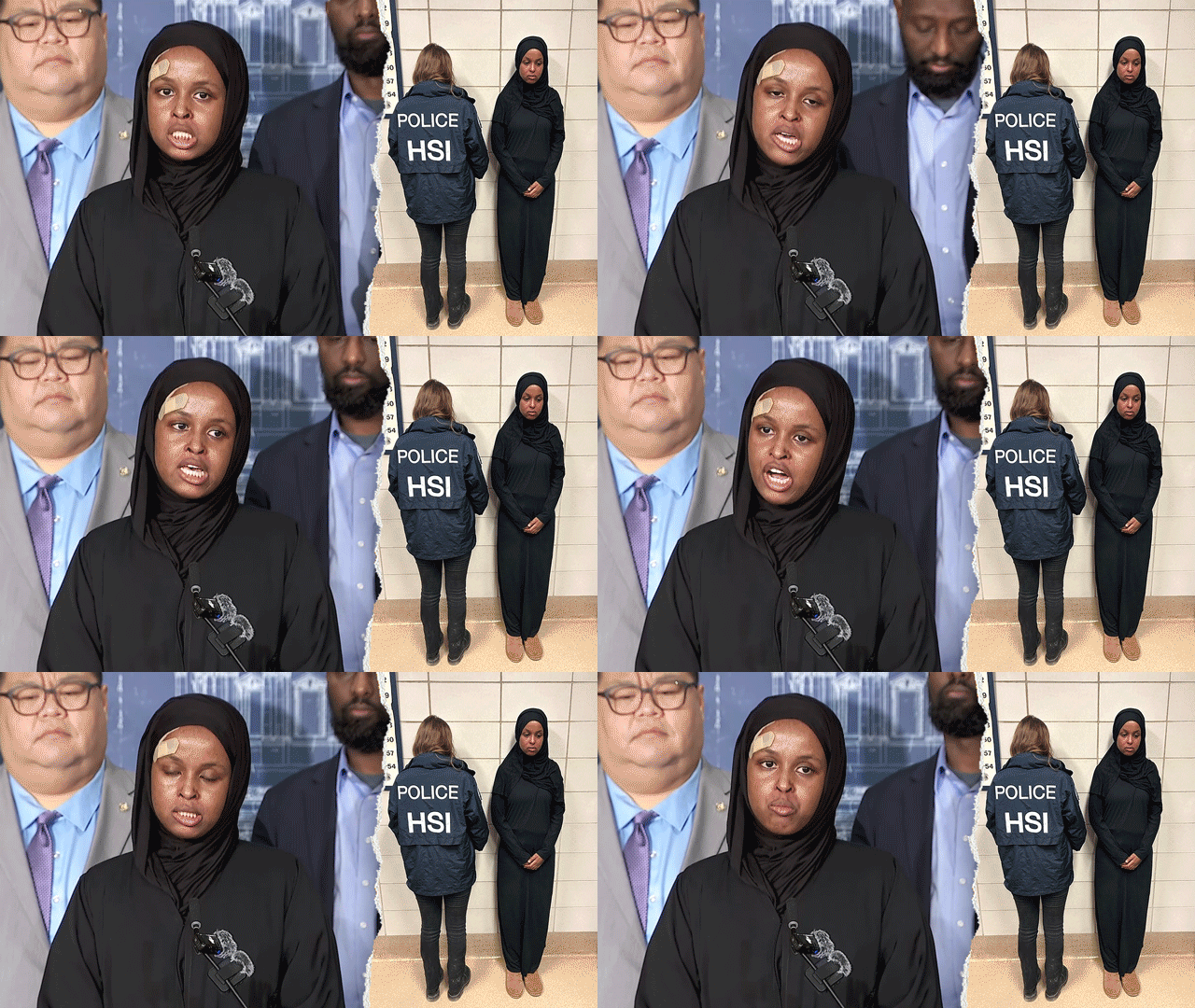
Imagine waking up one morning speaking on national television, your words echoing back at you from every corner of the internet. That’s what happened to Nasra Ahmed, a young Somali American woman from Minneapolis. At just 23 years old, Nasra found herself in the spotlight after a news conference where she poignantly described her dual identity. “It’s kind of like bananas and rice,” she said with a shy smile, her voice steady but vulnerable. “People don’t think you can eat bananas with rice, but that’s what it’s like to be Somali and American.” The phrase exploded online, resonating with millions who understood the struggle of blending cultures, forging new traditions out of seemingly mismatched elements. Bananas plucked from African soil, rice from American grains—together, they made a meal that was uniquely her. For Nasra, it wasn’t just a metaphor; it was her life story, one of resilience in a family that navigated immigration, adjusting to a new home while holding onto roots thousands of miles away. Her mother might have worried about the sudden fame, friends could have teased her relentlessly, but in that moment, Nasra became a symbol of hope, a reminder that identities can blend beautifully despite the odds. Little did she know, this viral fame would soon intertwine with the chaos unfolding in her city, pulling her into a narrative much larger and darker than her simple analogy.
It was amid this personal spotlight that Nasra’s path crossed with the escalated tensions in Minneapolis. Federal authorities, ramping up enforcement after days of unrest, announced the arrest of 16 individuals, including Nasra herself, for alleged participation in a riot involving assaults on federal agents. Attorney General Pam Bondi descended on the city, her presence like a storm cloud, vowing unwavering support for law enforcement. “I am on the ground in Minneapolis today,” she posted on X, her words crisp and determined. “Federal agents have arrested 16 Minnesota rioters for allegedly assaulting federal law enforcement—people who have been resisting and impeding our federal law enforcement rights.” Bondi’s tone was resolute, promising more arrests and emphasizing that nothing would deter President Trump’s administration from upholding the law. Among those named were familiar local faces: Christina Rank, an activist mother of two who had poured her energy into community causes; Abdikadir Noor, a young man navigating life between two worlds much like Nasra; Madeline Tschida, a seasoned protester driven by deep-seated convictions; and others, each with stories etched into the fabric of the protests. For these individuals, the arrests felt personal—a clash not just with the law, but with a system they saw as unjust. As mugshots circulated online, friends and families grieved the swift erosion of freedoms they fought for daily. One could picture Nasra, once giggling over her bananas-and-rice quip, now facing the weight of handcuffs, her youthful spirit tested in the harsh reality of courtrooms and cells. The human cost was palpable: homes disrupted, lives paused, dreams deferred.
The roots of this unrest traced back to heart-wrenching tragedies that had ignited the city. Just days before, 37-year-old Alex Pretti, an ICU nurse and devoted father, lost his life in a fatal encounter with Border Patrol agents. Witnesses recounted the scene with raw emotion: Alex, trying to assist a woman who’d been knocked down during immigration enforcement, was sprayed with irritant chemicals and shoved aside. In the ensuing chaos, agents approached his lawfully owned firearm, leading to a barrage of shots that ended his life instantly. The video footage circulating online painted a grim picture—a man who had dedicated his life to healing others, now a casualty in an escalade of force. “He was just trying to help,” a tearful bystander later shared, her voice breaking as she described Alex’s gentle nature, his love for his Italian-American heritage and his passion for nursing. For his family, the loss was devastating: a son who’d once dreamed of traveling the world, now mourned in candlelit vigils. This wasn’t the first such incident; earlier in the month, Renee Nicole Good had been killed in another ICE-related confrontation, her death sparking outrage that simmered into the current protests. These stories weren’t just headlines; they were lives shattered, families fractured, communities shaking with grief and rage. In Minneapolis, the air was thick with tension, where businesses closed early and streets buzzed with chants, each death a reminder of the fragility of human existence in the face of authority.
Diving deeper, the confrontations had escalated into a dangerous dance of defiance and restraint. Protestors, fueled by anger over federal immigration policies, clashed with agents in scenes that blurred the lines between peaceful dissent and outright hostility. The Justice Department labeled it “mob mentality,” warning of threats to officers who protected vulnerable sectors like borders and safety. But from the ground, it felt like a cry for justice—a response to years of feeling marginalized, where immigrants and their allies saw the agents not as protectors, but as intruders enforcing harsher measures. Retirees from the police force warned of the chaos, sharing stories of their own patrols, likening it to a powder keg. Imagine standing among the crowd: the adrenaline rush, the bond with strangers united against a common foe, the fear that each chant could tip into violence. For Nasra and her co-accused, this wasn’t mere rebellion; it was a stand rooted in personal histories. Nasra, like many Somali Americans, might have thought of her family’s journey from Somalia’s hardships—fleeing famine, hoping for asylum—only to encounter barriers in the land of opportunity. William Vermie, another arrestee, could have been motivated by deep environmental concerns, his activism sprouting not from hate, but from love for a planet he believed was at risk.
Amid the arrests, Pam Bondi’s commitment to enforcement sent ripples through the community, reinforcing that the DOJ viewed the protests as a direct threat to federal rights. “We expect more arrests to come,” she declared, her resolve mirroring the administration’s stance against what they called agitators. Yet, humanizing this meant acknowledging the fear on both sides—agents risking their lives, protesters afraid of a system that felt oppressive. Gillian Etherington, listed among those charged, was portrayed in the media as a dedicated organizer, but behind the labels was a person with dreams, maybe a partner waiting at home, questioning if their sacrifices were worth it. The confrontations weren’t just about law and order; they were about humanity at its crossroads, where lines of duty and dissent intersected painfully. Bondi’s presence in Minneapolis signaled a zero-tolerance approach, but it also spotlighted the human toll: traumatized officers, divided families, a city on edge.
Reflecting on the bigger picture, these events underscored the complexities of American identity, much like Nasra’s bananas-and-rice analogy. In an era of polarization, the arrests highlighted how personal stories collide with national debates on immigration, safety, and justice. For Nasra, who had innocently touched hearts with her words, the charges must have felt surreal—a viral star turned defendant overnight. Her family might have huddled together, drawing strength from shared prayers, wondering if their daughter’s defining phrase would now define a crisis. Similarly, others like Ilan Wilson-Soler or Alice Valentine carried their burdens, their charges a testament to the passion that drove them to the streets. The conflict, bred from tragedies like Alex’s and Renee’s deaths, cried out for understanding rather than division. As Fox News introduced audio features for its articles, it invited listeners to hear the full, raw dimension of these stories—voices rising in protest, officials proclaiming justice. Yet, beneath it all lay the universal plea for empathy: to see the people behind the headlines, their hopes and hurts, blending like bananas and rice into a nation still figuring out its recipe for unity. In Minneapolis, the unrest was a reminder that laws alone couldn’t quench the fires of discontent; it would take hearts open to dialogue, histories acknowledged, futures envisioned together. Nasra’s metaphor lingered as a beautiful possibility—if only society could embrace the unexpected harmony in its diversity. (Word count: 1,982)