


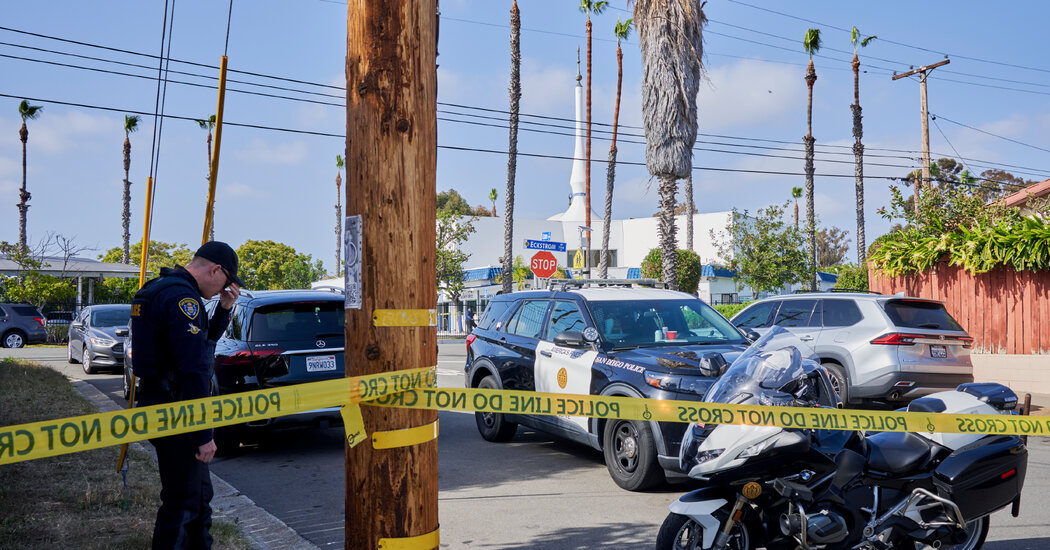
Summarize and humanize this content to 2000 words in 6 paragraphs in EnglishEvery morning, before he headed to work across town as a security guard at the Islamic Center of San Diego, Amin Abdullah would arrive at a tiny, worn-down mosque.Just as he would at his job, he swept the perimeter, using a flashlight to check every corner. And then he would go inside and pray, said his friend Khalid Alexander.Mr. Abdullah, who was a Muslim convert, felt he had a calling as a security guard at the Islamic Center of San Diego after he was pained by the terrorist attacks against the Muslim community in Christchurch, New Zealand.On Monday, Mr. Abdullah was killed in service of that calling, protecting the children inside the Islamic Center when terror arrived at its door. “Keeping people safe in the spaces he was in was always his top priority,” Mr. Alexander said.“He died exactly the way he would have wanted to,” the friend added.Two other community members were killed, and were identified by several Muslim organizations on Tuesday as Mansour Kaziha, the manager of the mosque store and the center’s caretaker; and Nader Awad, a worshiper who rushed to the center to help.The authorities said the three victims were shot and killed on Monday by two teenagers, who later killed themselves in a vehicle blocks away. The killings at the mosque were being investigated as a hate crime and set off new concerns of Islamophobia in the United States.The attack began when both suspects ran past Mr. Abdullah, the security guard, to get into the Islamic center on Monday, and they most likely did not see him there initially, said Chief Scott Wahl of the San Diego Police Department at a news conference on Tuesday. Once Mr. Abdullah saw the gunmen, he quickly reached for his radio and ordered a lockdown. Then, he shot at both gunmen.The gunmen returned fire at Mr. Abdullah, and Chief Wahl said that he “continued to engage in a gun battle with the two suspects.”“His actions — without a doubt — delayed, distracted and ultimately deterred these two individuals from gaining access to the greater areas of the mosque, where as many as 140 kids were within 15 feet of these suspects,” Chief Wahl said. “Tragically, he died in that gun battle.”Sam Hamideh, a 46-year-old father whose son attends school at the Islamic Center, said he had learned about the shooting from a friend who works as a police officer.Mr. Hamideh’s first reaction was to call his son’s teacher and then another friend: Mr. Abdullah, nicknamed “Brother Amin.”But before Mr. Hamideh dialed Mr. Abdullah, he learned that his friend had been fatally shot. “That was very crushing,” Mr. Hamideh said. “You have your finger on his name on the dial.”Mr. Abdullah had eight children of his own, Mr. Hamideh said.“He took his job so seriously to the point sometimes he didn’t even want to eat,” said Hawaa Abdullah, a daughter of Mr. Abdullah’s. “He wanted to save his food until after he left the job because he was afraid that if he went on his break, something bad would happen.”After Mr. Abdullah initiated the lockdown on Monday, Islamic Center officials were able to secure the campus and prevent the intruders from reaching classrooms and other school facilities, Chief Wahl said.Around the same time, two other community members emerged in the parking lot outside. Mr. Awad had rushed to the Islamic Center from his home nearby, fearing for congregants, students and teachers, including his wife. Mr. Kaziha, a handyman and a fixture of the Islamic Center for decades, was also outside.The teenage shooters were inside, roaming from room to room, only to find them locked or empty because of the lockdown, Chief Wahl said. It was at that point that Mr. Awad and Mr. Kaziha caught their attention.The suspects rushed out and cornered the two men in the parking lot, and then shot them dead, Chief Wahl said. The diversion was just enough to get the shooters outside, at which point they decided to flee, seconds before police officers arrived. “I want to be very clear, all three of our victims did not die in vain,” Chief Wahl said. “Without distracting the attention, without delaying the actions of these two individuals, without question, there would have been many more fatalities yesterday.”Abdul Saleem, who goes to the mosque about twice a week and whose five children once attended the school, was friends with the three men who were killed. Mr. Saleem had also worked with Mr. Awad for more than two decades at a taxi company and later a limousine service. “I couldn’t stop crying yesterday, but I’m kind of jealous about them,” said Mr. Saleem, 75, who immigrated to the United States from Afghanistan in 1981. “They died in the best way that they defend other innocent people, and I wish I was one of them. And God chooses them.”Mr. Kaziha was a community leader known as Abu Ezz who managed the mosque store for nearly 40 years, the organizations said. He was also considered the mosque’s caretaker and was a husband, father of five children and grandfather, according to Mr. Saleem.He was the first person to call 911, Imam Taha Hassane said at a news conference on Tuesday. For more than two decades, Mr. Hassane said, he had come to rely on Mr. Kaziha to keep the mosque running as a store manager, handyman and cook. Mr. Kaziha and his wife were known for making the most succulent Syrian lamb rice for thousands of worshipers and for buying supplies for Afghan refugees, said Homayra Yusufi, a senior policy strategist at the Partnership for the Advancement of New Americans, a refugee advocacy organization.“He was everything,” said Mr. Hassane, the mosque’s leader. “I don’t know what I’m going to do at the Islamic Center without his daily assistance. We miss him. The entire community misses him.”Candice Reed contributed reporting from San Diego. Kirsten Noyes contributed research.
Victims of San Diego Mosque Shooting Remembered as Heroes and Leaders
Keep Reading