



In the soft, humid dusk of an Austin evening, a routine traffic stop dissolved into chaos, leaving a 28-year-old Venezuelan national with a bullet lodged in his back and a federal criminal charge that could send him to prison for two decades. Wilber Rafael Garces-Perez, a man whose name most Texans had never heard before, now finds himself at the center of a stormy intersection where immigration enforcement, police violence, and human fragility collide. Federal prosecutors announced Tuesday that Garces-Perez has been formally charged with assaulting, resisting, interfering with, and impeding a federal officer, a charge that carries a maximum sentence of twenty years. The charge stems from an encounter on a September evening when ICE officers attempted to arrest him, a moment that began calmly with him handing over his driver’s license and ended with gunfire, sirens, and a wrecked body lying in the street. For all the legal language and political posturing swirling around his case, the heart of the matter is a simple, devastating truth: a man fled in fear, another officer fired his weapon, and now a fellow human being is lying in an ICE detention facility, sick, wounded, and waiting to learn what tomorrow will bring.
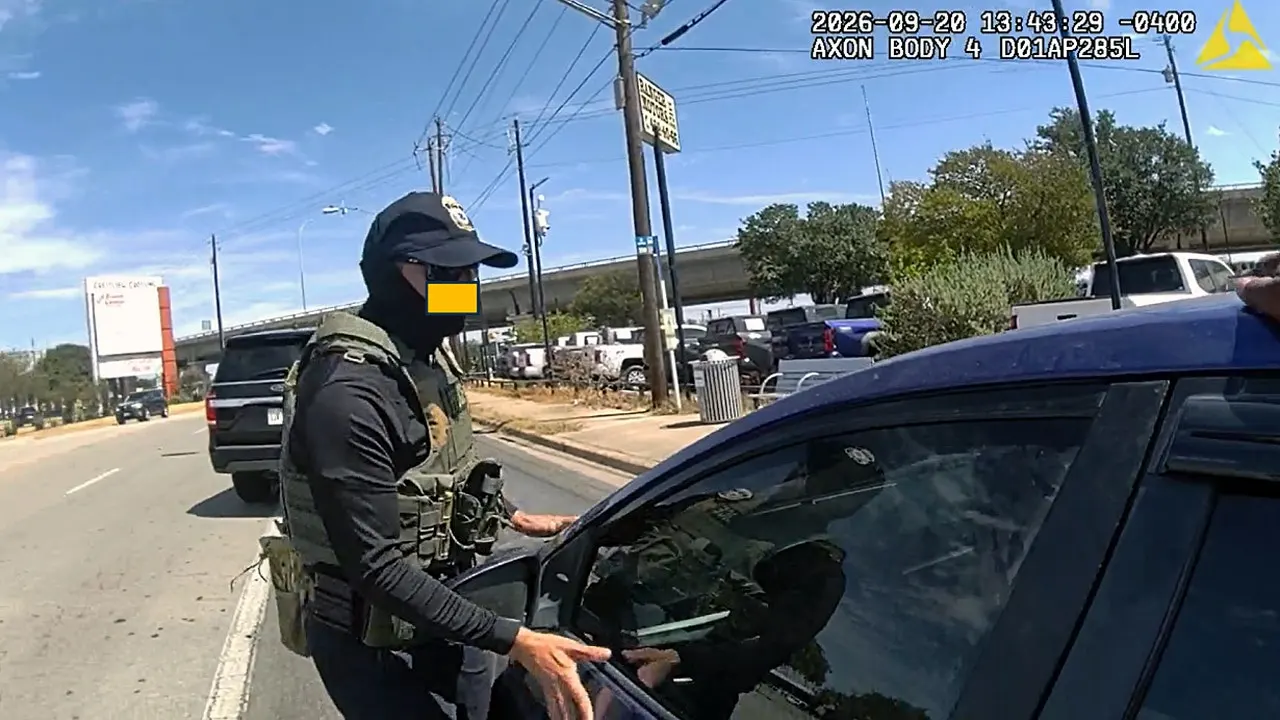
The story begins, according to the criminal complaint, in an almost mundane manner. ICE officers spotted Garces-Perez’s vehicle parked outside a restaurant, ran his license plate, and discovered that an immigration judge had issued a final order of removal against him. That discovery set in motion a targeted traffic stop that would forever change the lives of everyone involved. As the officers approached his vehicle, they described the initial encounter as “pleasant and not aggressive.” Garces-Perez handed over his driver’s license, and for a brief moment, there was no hint of violence. But then the officers instructed him to put the car in park and step out. Body camera footage allegedly shows Garces-Perez abruptly rolling up his window and driving away. In that split second, with his window closed and his engine roaring, the pleasant encounter became a desperate flight. Prosecutors allege that as Garces-Perez sped away, his driver’s side-view mirror struck one officer in the torso, turning what might have been a mere escape attempt into a violent assault on a federal officer. Garces-Perez later admitted to investigators that he disregarded the officers’ command and drove off, though the details of exactly how the vehicles interacted remain disputed. The officer who was allegedly struck told investigators there was no contact between the vehicles, while Garces-Perez claimed the ICE SUV itself had caused a collision before the officers even approached him.
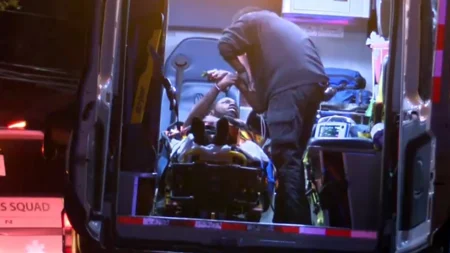
What followed was a high-speed pursuit through the streets of Austin, a chase that cut through commercial districts and residential neighborhoods alike, with emergency lights strobing and sirens screaming into the night. According to the complaint, one of the ICE officers, wearing a body camera, lost sight of both Garces-Perez and his colleague while requesting assistance from a Texas DPS dispatcher. In that moment of confusion, the officer switched off his camera. The second officer, the one who would eventually fire his weapon, was not equipped with a body camera at all. This absence of visual evidence has become a critical point of contention. The second officer later called his partner and reported that Garces-Perez had attempted to strike him with his vehicle, forcing him to draw his service weapon and fire. Garces-Perez was struck in the upper back. His own account, given later from a hospital bed or interrogation room after being read his Miranda rights in Spanish, tells a different version: that the officer’s SUV deliberately rammed his vehicle to force a spinout, and that after the bullet tore into his body, the officer opened his driver’s door, pulled the keys from the ignition, and instructed him to stay inside until an ambulance arrived. Two men, two perspectives, one terrifying reality—and no camera to untangle the truth.
Beyond the shooting itself lies a tangled immigration case that has become a flashpoint for broader national debates. Fox News previously reported that Garces-Perez’s attorney, Kate Lincoln-Goldfinch, has argued that the removal order against him was issued after a hearing notice was sent to an old address, despite her client having updated his contact information with the court. If true, that would mean he never received a fair chance to present his case, that the machinery of immigration enforcement crushed him while he was looking elsewhere. ICE, for its part, has disputed the claims surrounding his immigration status, noting that his work authorization expired in 2025 and emphasizing that holding a work permit does not confer lawful status. The legal chaos is compounded by his physical condition. His attorney says Garces-Perez remains seriously ill, with a bullet still lodged in his body, all while being held at an ICE detention facility. The image is haunting: a man with a piece of metal inside him, lying in a cell, his body in pain and his future hanging by a thread. He is not a statistic or a political symbol; he is a person whose life was reduced to a set of legal arguments, his voice swallowed by the roar of a policy debate that rages far above his head.
Attorney Kate Lincoln-Goldfinch responded to the criminal complaint with a demand for transparency, writing on social media that the complaint itself revealed a crucial piece of information: one of the officers involved had a body camera that was, at some point during the pursuit, turned off. That footage, she argued, has never been seen by the public, and the Department of Homeland Security must release it immediately to provide full transparency. Her words carried a note of anguish and urgency, referencing both the criminal case and the separate federal immigration habeas case she is fighting. “We are working through what these developments mean,” she wrote, “and we will share additional information as we are able.” The demand for body camera footage is not just a legal maneuver; it is a plea for accountability in a situation where the most critical moments remain shrouded in darkness. If the officer turned off his camera deliberately, the reasoning is unclear. If the equipment failed, that too must be examined. But for Garces-Perez, the absence of footage means his word stands against that of law enforcement, and history has shown that such disputes rarely favor the man who fled.
Now, Garces-Perez faces two parallel legal battles. In the federal criminal case, he made his initial appearance in court on Tuesday, with a detention hearing scheduled for October 2. The charge of assaulting, resisting, interfering with, and impeding a federal officer is a serious offense, carrying up to twenty years in prison. Meanwhile, his immigration habeas case continues in a separate forum, potentially deciding whether he will be deported to Venezuela, a country in the midst of deep political and economic turmoil. The convergence of these proceedings means that even if he is acquitted of the criminal charge, he may still be removed from the only life he has built in the United States. The uncertainty is crushing. His attorney has painted a picture of a man who is not just a defendant but a patient, a person gripped by illness and trauma, uncertain whether he will ever walk free again. There is no triumphant ending here, no clear-cut villain or hero—only a chain of choices made in seconds, a bullet, and a man whose life is now written in legal dockets and detention logs. The broader American public, polarized by immigration politics, views him either as a dangerous lawbreaker or a victim of an unforgiving system. But in the quiet moments, when the cameras are gone and the rhetoric fades, the question that remains is not about policy. It is about a 28-year-old man, a shattered rearview mirror, a body camera rendered dark, and whether the justice system will see him as a whole human being, with fear and flaws and a story worth understanding, rather than just a case number.