



Paragraph 1: The Fall from Grace
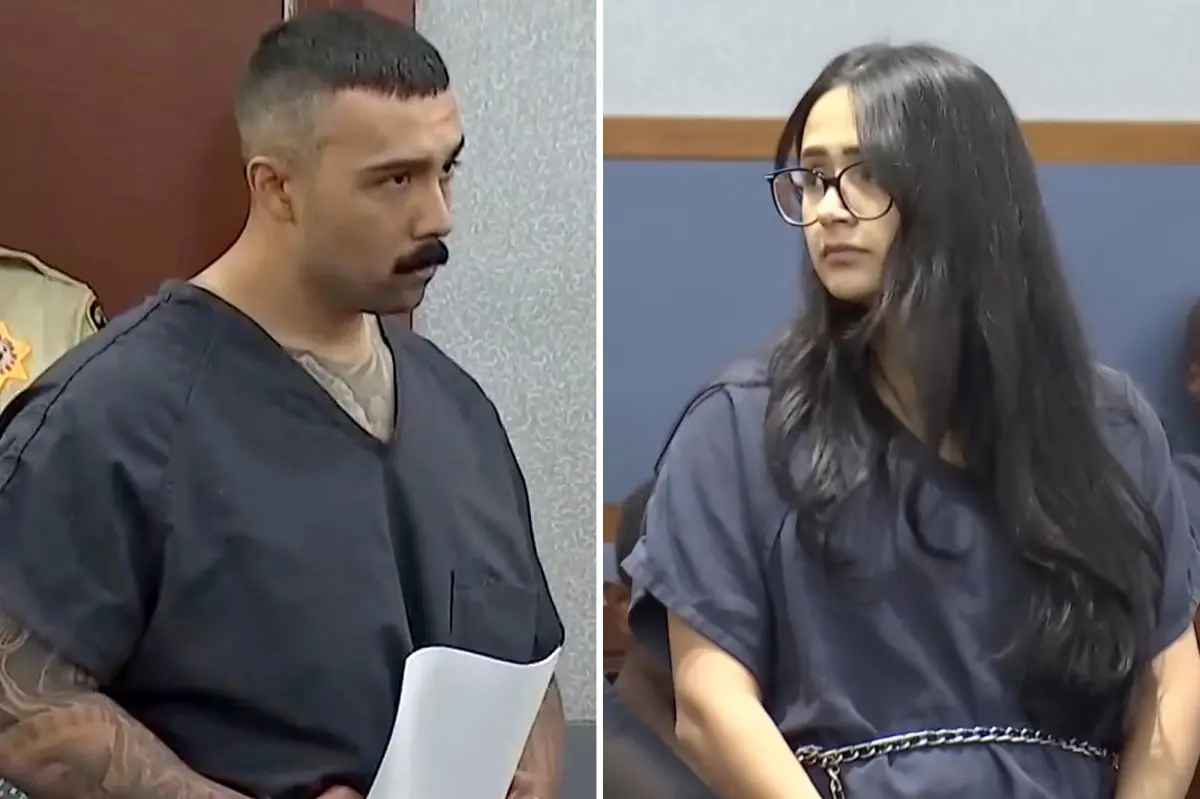
In the glittering, often deceptive landscape of Las Vegas, where fortunes are made and lost on the turn of a card, the line between law and its violation is usually starkly drawn. Yet for Antonio Chavez, a 28-year-old officer with the Las Vegas Metropolitan Police Department, that line appears to have blurred beyond recognition. Alongside his wife, 30-year-old Claudia Guzman-Marquez, Chavez now stands accused of orchestrating a sophisticated credit-card fraud spree that spanned two states, bilking financial institutions and retailers out of tens of thousands of dollars. The very badge that symbolizes protection and integrity has become the backdrop for a tale of alleged greed, deceit, and a grotesque betrayal of the public trust. The indictment reads like a sordid crime thriller: a police officer conspiring with his pregnant wife to stage thefts of their own wallets, filing false reports, and then leveraging those fictitious claims to erase six-figure liabilities. It is a story that speaks to a profound moral disconnect—a man sworn to uphold the law, allegedly weaponizing his knowledge of police procedures to perpetrate the very crimes he was paid to prevent. The couple moved with apparent impunity for months, confident in their scheme, until the quiet, methodical work of detectives peeled back the layers of their duplicity, exposing a lifestyle predicated on fraud.
Paragraph 2: The Architecture of Deceit
The alleged scheme was not born of spontaneity but was a carefully constructed effort, executed over a period stretching from May 25 to August 3. According to the arrest report and the warrant application authored by Detective Theodore Snodgrass, the fraudulent activity began boldly. On that late May day, Chavez and Guzman-Marquez allegedly purchased more than $13,000 worth of gift cards from the Town Square Concierge on South Las Vegas Boulevard. The purchases were made with credit cards, but the couple never intended to absorb the cost. Within days, they contacted Capital One and American Express, claiming their wallets and purses had been stolen—a convenient fiction devised to void the transactions. To add a layer of legitimacy to their lies, Chavez reportedly filed a false police report with the Henderson Police Department, a charge that carries immense weight, as filing a false official document is a felony. This was not a petty crime; it was a brazen abuse of the systems designed to protect consumers and victims of actual theft. The spending spree continued with an almost manic energy. Chavez allegedly disputed a $1,200 transaction at an Apple Store, again citing the phantom stolen wallet. Meanwhile, Guzman-Marquez was reportedly busy on the same dates using Citibank and JPMorgan Chase cards, racking up over $11,000 in charges at two separate Louis Vuitton locations—luxury goods that would quickly become trophies of their alleged fraud. The couple’s appetite for high-end consumerism seemingly knew no bounds, but their foresight was severely lacking.
Paragraph 3: The California Connection and the Web of Evidence
The alleged criminal enterprise did not remain confined to Nevada’s borders; it stretched into the sunny retail districts of Southern California. Guzman-Marquez allegedly disputed charges made in California in June, including a staggering $5,000 gift card purchase at the upscale Fashion Island mall in Newport Beach. These weren’t small-time con artists skimming pennies; they were systematically dismantling financial safeguards brick by brick. The investigation revealed a disturbing level of organization, which included not just the couple but the alleged involvement of a third party based in California. Chief Deputy District Attorney Eckley Keach outlined this network during court proceedings, noting that the scheme was a “commercial fraud” targeting stores and credit card companies. The investigators tracked the gift cards as they were laundered into tangible assets, used at an automotive shop and an Aritzia clothing store at the Las Vegas North Premium Outlets Mall. The meticulous paper trail eventually became impossible to ignore. Detectives noted a telling behavioral pattern: Chavez did not dispute charges made in the days immediately preceding his claims of theft, and he inexplicably delayed reporting his American Express card as stolen—both to the company and to law enforcement. These minor inconsistencies, overlooked by a typical criminal, became the threads that unraveled their carefully woven tapestry of lies, leading detectives to seek interviews with the couple, which eventually turned into full admissions of guilt.
Paragraph 4: The Courtroom Reckoning
The consequences of their actions came to a head in a Las Vegas courtroom, where the couple appeared before Justice of the Peace Rebecca Saxe. Prosecutors, led by the stern and uncompromising Keach, argued for strict bail conditions, seeking $100,000 cash bail and house arrest for Chavez, along with a hearing to scrutinize the source of any posted money. Keach highlighted Chavez’s profession, emphasizing the gravity of his betrayal. “He knew better,” Keach stated, his voice carrying the weight of a department’s shame. “He knows what the law is and he knows that he violated the law willfully because he wanted to enrich himself and his family.” Keach painted a portrait of a police officer who had cynically manipulated the legal system he was meant to serve. Yet, the defense, led by attorney Robert Draskovich, presented a counter-narrative focused on the couple’s humanity amidst the wreckage. Draskovich pointed to Chavez’s lack of criminal history, his full cooperation with investigators, and his deep ties to the local community. He reminded the court of the couple’s current predicament, particularly highlighting that Guzman-Marquez is pregnant, adding a layer of tragic complexity to their situation. In a surprising legal victory for the defense, Judge Saxe rejected the prosecution’s request for cash bail. Citing the non-violent nature of the charges and the absence of a criminal history, she ordered Chavez released without bail, though he was placed under strict electronic monitoring. Guzman-Marquez received the same conditional release, leaving the courtroom as a free woman under surveillance, her future—and that of her unborn child—hanging precariously in the balance.
Paragraph 5: The Human Cost and the Shattered Trust
Beyond the cold legal jargon and the procedural maneuvers lies the deeply human tragedy of this case. For the credit card companies—Capital One, American Express, Citibank, and JPMorgan Chase—these are financial losses quantifiable in spreadsheets and insurance claims. For retailers like Louis Vuitton and Apple, it is a frustrating loss of inventory and margin. But the true casualty here is the profound erosion of public trust. When a police officer engages in criminality, the delicate social contract between the community and those who protect it is fractured. Every citizen who relies on the legitimacy of a police report now wonders if the system can be trusted. The victims include the other employees of the Metropolitan Police Department, who must now answer for the actions of one of their own, and every officer who wears the uniform with honor and integrity. The scheme also victimized the couple themselves, trapping them in a cycle of greed that has likely destroyed their futures. Chavez, hired in 2020, is now suspended without pay, his career in law enforcement effectively over. Guzman-Marquez faces the daunting prospect of raising a child while fighting felony charges of theft exceeding $25,000, burglary, conspiracy, and perjury. The initial thrill of that Louis Vuitton bag or that $5,000 gift card has certainly dulled into the stark, unforgiving reality of potential prison time and a permanently tarnished name.
Paragraph 6: The Unfolding Aftermath
As the couple left the courthouse under the quiet gaze of electronic monitoring, their immediate future is a purgatory of uncertainty. Draskovich indicated that both parties are working toward an “equitable resolution,” a legal euphemism suggesting plea negotiations are likely underway, hoping to spare the pregnant wife a lengthy sentence and the disgraced officer a harsher verdict. Yet, the shadow of their actions looms large. For Chavez, the man who once swore an oath to protect and serve, the path forward is now paved with the accusation of perjury and a fundamental violation of his oath. The case serves as a stark cautionary tale, a sobering reminder that the veneer of respectability can often be the thinnest of masks. In a city built on the gamble, Antonio Chavez and Claudia Guzman-Marquez took the ultimate risk—not on the roulette wheel, but on the false promise of untraceable deceit. They bet their careers, their liberty, and their family’s stability on the notion that the badge would protect them, only to discover that the law, which they so brazenly manipulated, has an unyielding memory. As they await their next court date, the neon lights of the Strip flicker on, indifferent to their plight, illuminating yet another tale of those who believed they could outrun the consequences of their own avarice. The true verdict, though, belongs to a jury of their peers, who will soon weigh the weight of a broken badge against the fragile plea of a family on the brink.