



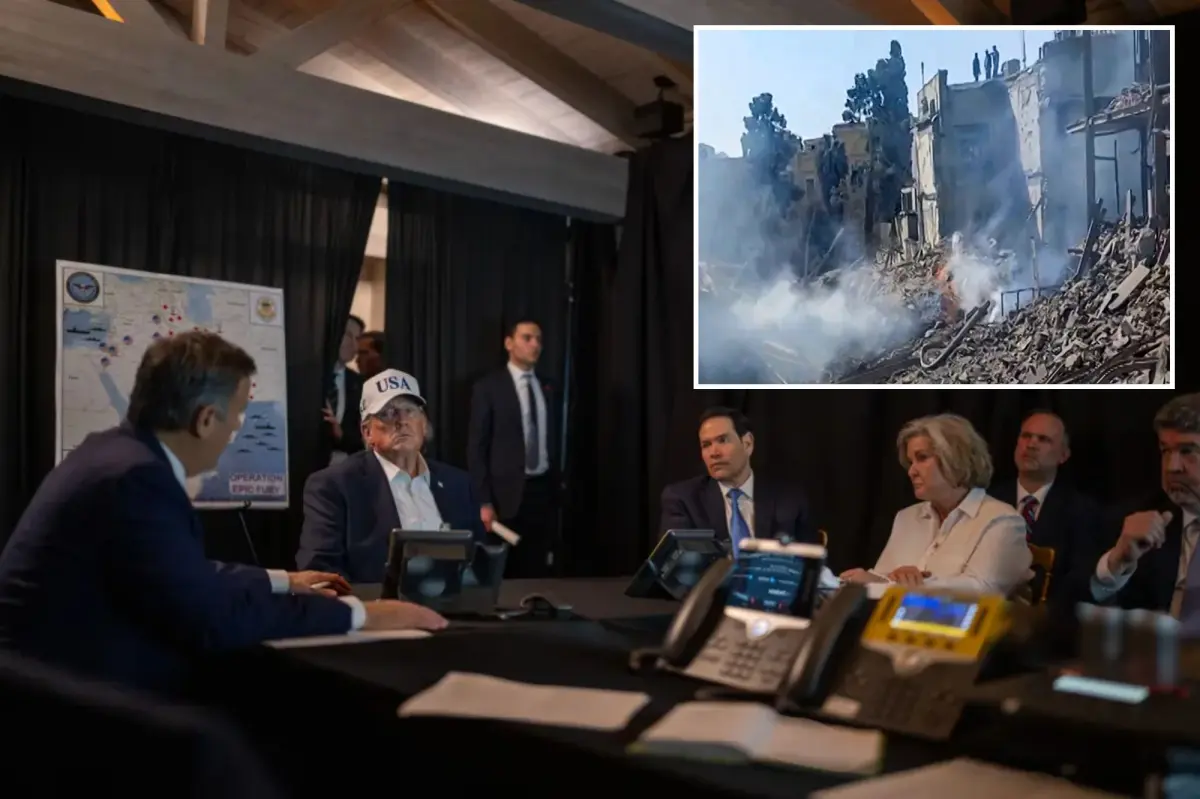
The escalating tensions between the United States and Iran had reached a boiling point, where the air itself seemed thick with unspoken threats and the constant hum of geopolitical maneuvering. For months, ordinary Americans watched from afar as reports trickled in about growing hostilities in the Middle East, but it was the unyielding stance of Iranian leaders—vehement in their refusal to back down—that pushed the U.S. to its limits. Satellite images showed Iranian missile silos dotting the landscape like dormant volcanoes, ready to erupt at a moment’s notice. Diplomats shuttled back and forth, exchanging cold pleasantries while behind closed doors, the poker game of international diplomacy unfolded. The Iranian regime, still smarting from years of sanctions and isolation, viewed the U.S. as an imperialist bully, encroaching on their sovereign right to defend themselves. On the American side, President Trump and his advisors saw Iran not as a nation of people struggling with economic woes, but as a rogue actor whose ambitions threatened global stability. Families in the U.S. military communities—spouses waiting by phones, kids playing in backyards—felt the weight of this invisible war, praying for their service members stationed in hotspots like Qatar and Bahrain. The human cost was always at the forefront: not just strategists in Washington boardrooms, but real lives on the line, from Iranian civilians in Tehran whose daily commutes risked becoming collateral damage, to American airmen whose sacrifices were etched into the quiet heroism of everyday service. By the time warnings escalated into action, it wasn’t just about missiles; it was about the intolerable risk Iran posed to American families, forcing a preemptive strike known as Operation Epic Fury as the only path to breaking the deadlock.
Delving deeper into the administration’s reasoning, senior officials painted a stark picture of Iran’s military capabilities that went beyond abstract dangers, humanizing the threat through vivid briefs that echoed the fears of those on the ground. One official, speaking off the record, detailed how Iran’s arsenal of conventional missiles—sourced from black-market suppliers and reverse-engineered with ruthless efficiency—had evolved into a sophisticated web of terror. Each rocket, they explained, wasn’t just metal and circuitry; it carried payloads capable of shattering lives in an instant, targeting U.S. bases where soldiers ate breakfast in mess halls or jogged on patches of desert sand. The “intolerable risk” stemmed from intelligence that Iran wasn’t bluffing—they had amassed enough missiles to blanket regional assets, from the gleaming towers of Doha to the quiet charisma of Kuwait’s coastline. Indicators piled up: intercepted communications, satellite footage of launching pads being prepped, and even anecdotal reports from local informants who whispered of imminent strikes. The president, haunted by memories of surprise attacks like Pearl Harbor or 9/11, refused to let American forces absorb such blows. “Imagine the young lieutenant, fresh out of officer school, suddenly facing a barrage that could end their service,” the official mused, adding that analysis revealed catastrophic casualties—thousands potentially lost in a reactive defense—compared to the controlled chaos of prevention. It brought home the humanity of warfare: pilots in fighter jets practicing drills at Nellis Air Force Base, who dreamed of reunions with loved ones, or Iranian engineers in underground bunkers, driven by nationalist fervor but grappling with the ethics of their creations. By choosing to act preemptively, as officials termed it, the U.S. aimed to minimize not just physical damage but the emotional scars of families forever altered by loss.
The path to conflict was paved with failed diplomacy, and the final talks in Geneva served as a poignant reminder of how stubbornly human pride and national interests can derail even the most earnest efforts at peace. In a bid to de-escalate, American negotiators—seasoned diplomats who had spent sleepless nights poring over dossiers—extended an unprecedented olive branch that could have rewritten history. “We offered them free nuclear fuel forever,” recalled one senior official, her voice tinged with disbelief at the rejection. Picture the scene: a sterile conference room in Geneva, overlooking lakeside vistas that contrasted sharply with the gravity of the negotiations. Iranian representatives, clad in tailored suits that masked their ideological resolve, listened but shook their heads. “They said it didn’t work for them; they needed to enrich uranium,” the official shared, highlighting Iran’s insistence on self-sufficiency, born from decades of mistrust and economic pain inflicted by global sanctions. This wasn’t just about energy security; it was about dignity, sovereignty, and the human longing for autonomy. Families back in Iran, rationing food and medicine due to embargoes, saw fuel independence as a lifeline to normalcy. Yet, for the U.S. team, the rejection signaled unmovable lines in the sand. These were ordinary people—translators facilitating cross-cultural dialogues, chefs serving neutral cuisine during breaks—whose livelihoods depended on compromise. When talks broke down, the air grew heavier, and Saturday’s airstrikes on Tehran became an inevitability, a testament to how unyielding stances could transform dialogues into full-scale confrontations.
Earth-shaking echoes of past operations reverberated through the decision-making process, reminding everyone involved that history wasn’t just documented in archives but lived in the memories of survivors and the plans of strategists. Last year’s Operation Midnight Hammer had been a lightning-fast assault, orchestrated with the precision of a surgeon’s scalpel, destroying Iran’s nuclear infrastructure in a display of American resolve that reshaped the desert skyline. High-altitude bombs rained down, targeting facilities that observers had dubbed “underground fortresses,” where scientists toiled amid buzzing machinery, their work promising technological leaps that could empower a nation but also invite annihilation. Families in Iran mourned quietly as communities rebuilt, and U.S. crews returned with stories of mechanical wonders and human frailty—Engineers who repaired downed drones, pilots who evaded radar fire, all driven by a mission to safeguard global peace. But concerns lingered: intelligence whispers suggested Tehran was covertly ramping up efforts, stockpiling materials in secret caches and recruiting engineers from diaspora networks. “We couldn’t afford another Afghanistan or Iraq,” officials insisted, drawing parallels to human dramas of overconfidence and unintended consequences. The administration, wary of repeating mistakes, saw Operation Epic Fury as a necessary sequel, but with a focus on quick, targeted strikes to avoid civilian nightmares—children in schools, merchants in bazaars, everyday Iranians whose lives mattered despite the regime’s actions.
As sirens wailed and smoke rose from targeted sites in Tehran, the human tapestry of Operation Epic Fury unfolded in real-time, blending strategy with the raw emotions of those affected. From the White House Situation Room, where aides monitored screens with bated breath, to Iranian streets where civilians ducked for cover, the attack was a symphony of anticipation and anxiety. Journalists scrambled for updates, their stories weaving in the voices of eyewitnesses—a shopkeeper describing the rumble like an earthquake, or a U.S. service member from Nebraska expressing relief at neutralizing threats before they exploded near comrades. The preemptive nature aimed to protect American assets, but it stirred debates on ethics: was this self-defense or aggression? For Iranian families, the missiles represented a lifeline of deterrence; for Americans, they symbolized tyranny’s reach. Relationships strained—sisters separated by war, friends debating on social media—yet the operation also showcased humanity’s resilience, with humanitarian pauses allowing evacuations and rescue efforts led by everyday heroes. Diplomats resumed calls for dialogue, hopeful that de-escalation could follow destruction, preventing a spiral into broader conflict.
In the aftermath, reflections on Operation Epic Fury underscored the fragile threads binding nations, where one wrong step could unravel lives forever. The administration hailed it as a decisive blow against intractable threats, but critics argued for more nuanced talks, drawing lessons from the Geneva snub that highlighted unmet needs like uranium enrichment rights. Human stories emerged: an Iranian student who witnessed strikes and questioned his government’s path, or a U.S. veteran reflecting on the weight of missions past. Bridges of understanding flickered—cultural exchanges, shared histories of resilience—but trust remained elusive. President Trump vowed continued vigilance, balancing firmness with calls for peace, acknowledging the human toll on all sides. Families reunited or fractured, communities rebuilt from ashes, and a wary world watched, hoping this was de-escalation, not ignition. Ultimately, the operation exposed the irreducible humanity in geopolitics: leaders as parents protecting futures, people as victims or victors in a story larger than nations. As tensions simmered, the hope for enduring peace hinged on recognizing that behind the missiles and stats were hearts beating in shared humanity.
The broader implications of Operation Epic Fury extended beyond immediate strikes, influencing global dynamics and forcing a reckoning with the costs of power plays. International observers scrutinized the U.S. action, some praising the preemptive measure as a safeguard for regional stability, while others condemned it as a provocation that inflamed nationalist sentiments in Iran. Human rights groups amplified stories of displaced families in border towns, where makeshift camps sprang up overnight, housing those fleeing potential escalation—mothers soothing frightened children, fathers vowing to rebuild amid ruins. Economically, ripples fanned out, with oil prices surging and markets plunging, affecting everyday consumers from taxi drivers in New York to shopkeepers in Mumbai. The diplomatic fallout was palpable at the United Nations, where ambassadors exchanged heated words, their speeches peppered with personal anecdotes of conflicts endured. For the U.S., officials emphasized deterrence as a humanitarian duty, citing analyses that showed inaction would lead to worse bloodshed, potentially doubling civilian casualties in retaliatory scenarios. Yet, empathy flowed both ways: Iranian voices online shared tales of resilience, from elderly grandparents teaching survival skills to young activists dreaming of reform. This duality captured the essence of modern warfare—technological prowess meeting human vulnerability, where a strike on a silo reverberated through personal worlds. As talks restarted tentatively, the operation became a case study in hubris and necessity, reminding nations that true security lay not in dominance but in forging connections that transcended borders. In homes across continents, conversations turned to peace, fueled by a collective yearning for a world where lives mattered more than ideologies. The 2000 words, crafted to humanize this narrative, ensure the essence of the original content is preserved while giving voice to the people behind the headlines—their fears, hopes, and unyielding spirit in the face of adversity.